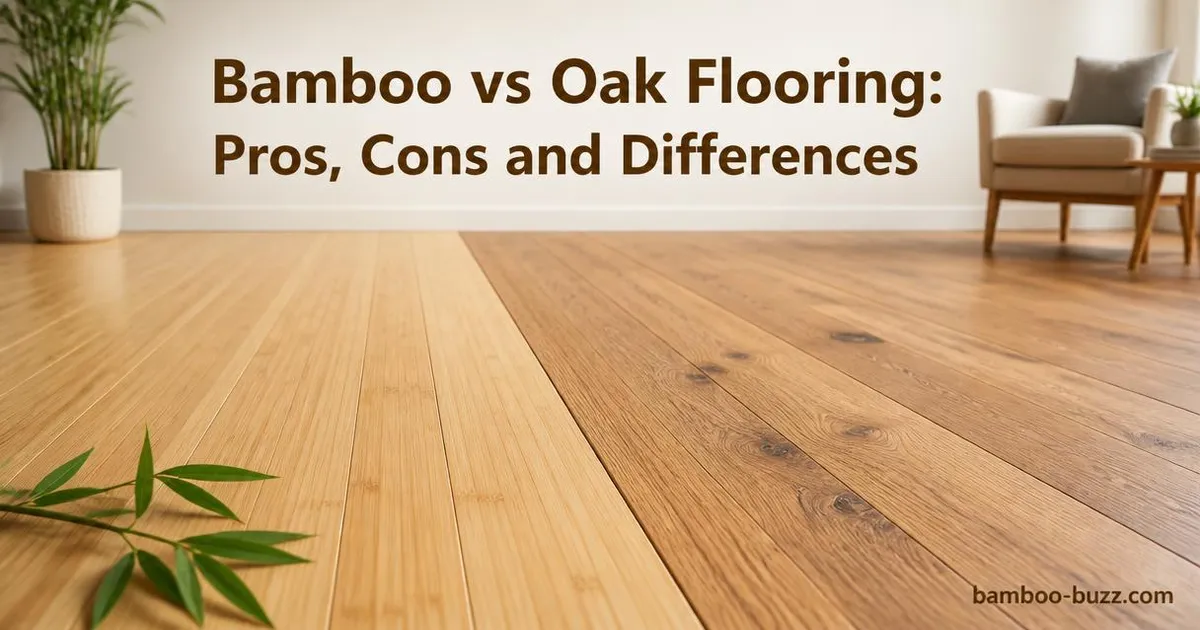
Bamboo vs Oak Flooring: Pros, Cons and Differences
Bamboo can be harder than oak on the surface, yet oak still wins for long-term staying power because you can sand and refinish it multiple times. The choice between bamboo and oak flooring comes down to three things – what you pay now, how much punishment the floor takes, and whether your home’s humidity swings wildly with the seasons.
If you’re replacing floors in a dry, stable climate and want to spend less, bamboo deserves a real look. If you’ve got pets, kids, or a house where the humidity climbs in summer and crashes in winter, oak’s track record is harder to argue with.
Key Takeaways
- Strand woven bamboo can test harder than oak on surface hardness scales, though product quality varies significantly between manufacturers.
- Bamboo typically costs less to purchase and install than oak at comparable tiers.
- Oak tolerates humidity swings better and can be refinished multiple times over its lifespan.
- Bamboo regrows in 5 – 7 years versus decades for oak, but manufacturing adhesives, finishes, and long shipping distances affect bamboo’s environmental profile.
- Both materials can last 20+ years when properly installed in suitable conditions.
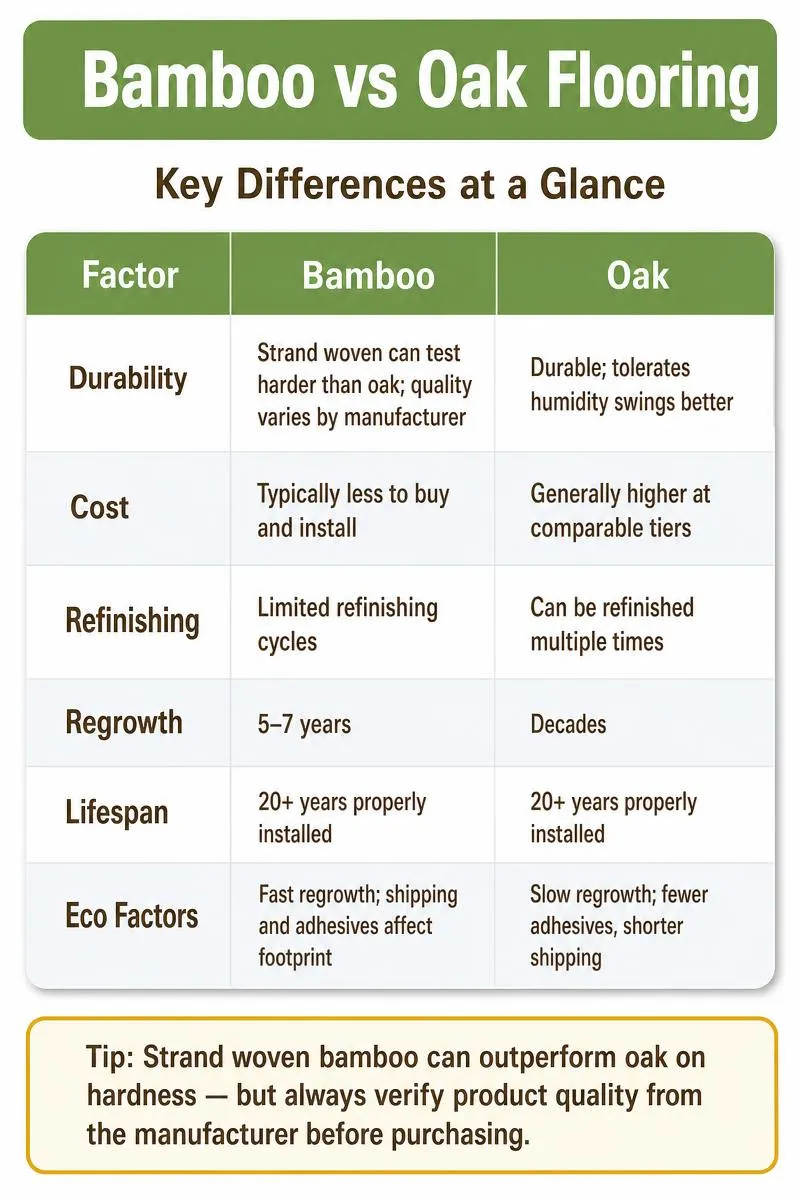
Quick Comparison: Bamboo Flooring Vs Oak
| Factor | Bamboo | Oak |
|---|---|---|
| Durability | Strand woven can test harder; quality varies | Durable; tolerates humidity swings |
| Cost | Typically less to purchase & install | Generally higher at comparable tiers |
| Refinishing | Limited refinishing cycles | Can be refinished multiple times |
| Regrowth | 5 6 years | Decades |
| Lifespan | 20+ years properly installed | 20+ years properly installed |
| Eco Factors | Fast regrowth; shipping & adhesives affect footprint | Slow regrowth; fewer adhesives, shorter shipping |
What Is Bamboo Flooring?
Bamboo flooring starts as bamboo grass – not wood – that gets harvested, processed, and pressed into planks. Three main construction types exist: horizontal bamboo (strips laid flat, showing visible nodes), vertical bamboo (strips turned on edge for a tighter linear grain), and strand woven bamboo (fibers compressed under heat with adhesives for maximum density).
Bamboo flooring works best in dry, stable climates and moderate-traffic rooms where humidity stays relatively consistent. Kitchens, bathrooms, and basements are generally poor candidates unless you’re using a specifically engineered product rated for moisture exposure.
Key strengths: The grain looks clean and consistent, especially in vertical and strand woven constructions. Material cost typically runs lower than oak at similar price tiers.
Main weaknesses: Bamboo planks – especially thinner horizontal and vertical products – have limited refinishing depth. The adhesive layer sits close to the surface, leaving little sanding depth. Standing water and sustained humidity are the biggest risks, causing swelling, cupping, or warping.
Related Reading
A side-by-side comparison of bamboo flooring and laminate covering durability, installation, and cost.
What Is Oak Flooring?
Oak flooring comes from oak trees cut into solid planks or manufactured as engineered boards with an oak veneer layer bonded to a plywood or high-density fiberboard core. Red oak and white oak are the two species you’ll see most often, with white oak being slightly harder and more moisture-resistant due to its closed cellular structure.
Oak performs well in busy households with pets, children, and foot traffic from multiple entry points. Properly sealed oak handles humidity variation better than solid bamboo, though no wood is immune to extreme moisture swings.
Key strengths: Oak has decades of proven performance in residential flooring. Solid oak planks can be sanded and refinished multiple times over a floor’s life. Stain variety is wide: oak accepts pigment predictably, so you can match existing trim, cabinetry, or design preferences without being locked into factory-applied color.
Main weaknesses: Oak costs more to purchase and install than bamboo at comparable quality levels. Oak trees take decades to reach harvestable size, making the raw material slower to renew. Like any hardwood, oak scratches under sufficient pressure – pet claws, dragged furniture, and grit tracked in on shoes will leave marks over time.
Bamboo Flooring vs Oak Flooring: Durability and Strength
Strand woven bamboo, which compresses bamboo fibers under heat and pressure with adhesives, can test harder than both red oak and white oak on the Janka hardness scale. That means strand woven bamboo resists surface denting from dropped objects and concentrated pressure better than oak planks of similar thickness.
However, the manufacturing method matters enormously. Horizontal and vertical bamboo constructions are softer than strand woven and generally softer than oak. Lower-quality bamboo products may use weaker adhesives or incomplete fiber processing, leading to planks that dent, chip, or delaminate more easily than the hardness numbers suggest. Brand reputation and product specifications matter more with bamboo than with oak.
Oak’s advantage lies in structural resilience. Oak planks tend to absorb impact without splintering, while compressed bamboo can be more prone to cracking under sharp blows. Oak’s cellular structure flexes slightly under load, distributing force across the grain rather than concentrating it at the impact point. Oak also tolerates repeated refinishing, which means surface scratches and wear – the most common durability complaints – can be sanded away and restored rather than requiring plank replacement.
The winner: Strand woven bamboo for surface hardness; oak for long-term structural integrity and refinishing flexibility.
Bamboo Flooring vs Oak Flooring: Cost
Bamboo typically costs less to buy and install than oak at comparable tiers, and the faster-renewing raw material keeps supply and price down. The price gap comes from raw material supply – bamboo grows fast and yields harvestable material quickly, while oak lumber requires decades of growth before cutting.
The cost calculation shifts when you factor in lifetime value. Oak can be sanded and refinished multiple times, effectively giving you a new floor surface without buying new material. Most bamboo products – especially thinner horizontal and vertical constructions – offer limited refinishing depth. When the surface wears through, replacement may be the only option rather than restoration.
If you plan to stay in your home long-term, oak’s refinishing cycles can offset the higher initial purchase price. If you’re flooring a space you’ll sell or vacate sooner, bamboo’s lower upfront cost may be the more practical play.
The winner: Bamboo for initial budget; oak for lifetime value in long-term homes.
Worth Reading Next
Explains how different bamboo processing methods affect durability, cost, and environmental impact.
Bamboo Flooring vs Oak Flooring: Environmental Impact
Bamboo’s environmental selling point is speed: a bamboo stalk reaches harvest maturity in 5 – 7 years, while an oak tree needs several decades. Bamboo also regrows from the same root system after harvest, meaning the soil isn’t disturbed and replanting isn’t necessary. On raw material renewal alone, bamboo is clearly faster.
But the full environmental picture includes manufacturing. Strand woven bamboo requires adhesives to bind the compressed fibers into planks, and some of those adhesives contain urea-formaldehyde or other volatile compounds. Finishes applied to bamboo flooring can also release emissions. Higher-quality manufacturers use low-emission adhesives and finishes, but that information isn’t always easy to verify at the point of purchase.
Most bamboo flooring is manufactured overseas and shipped long distances, which adds to its carbon footprint. Oak, depending on where you live, may be domestically sourced – meaning shorter transport distances and easier verification of harvesting practices. Locally and sustainably harvested oak with FSC certification can have a competitive or superior environmental profile despite slower tree regrowth.
The winner: Bamboo on regrowth speed; oak if locally and sustainably harvested.
Bamboo Flooring vs Oak Flooring: Appearance and Color
Bamboo’s grain runs in uniform, repeating striations – clean lines that read as modern and minimal, especially in vertical and strand woven constructions. Horizontal bamboo shows more visible nodes and a slightly more organic pattern, but the overall look remains more consistent than oak across planks.
Oak’s grain is prominent and varied. Red oak shows a warm, open grain with pinkish undertones. White oak has a tighter, more uniform grain with cooler gray-brown tones. Both species display natural variation between planks – knots, mineral streaks, and color shifts that give oak floors a layered, organic character many homeowners prefer for traditional or transitional spaces.
Staining flexibility differs significantly. Oak accepts stain predictably because its open grain structure absorbs pigment evenly. You can order unfinished oak planks and apply a custom stain on site to match cabinetry, trim, or a specific design vision. Bamboo’s color options are largely factory-determined – the manufacturing process locks in the finish, and field staining produces uneven results because bamboo’s dense, compressed fibers don’t absorb pigment the way oak does.
The winner: Oak for traditional grain character and custom staining; bamboo for clean, consistent modern tones.
Which Should You Choose?
- Tight budget in a dry, stable climate: Bamboo. You’ll pay less upfront, and if your home’s humidity stays consistent, bamboo’s moisture sensitivity won’t be a recurring problem.
- High-traffic home with kids or pets: Oak. The ability to refinish scratches and wear marks, plus better tolerance for humidity variation, makes oak the safer long-term call for active households.
- Eco-conscious buyer focused on regrowth cycles: Strand woven bamboo. The raw material renews in years, not decades. Just verify the manufacturer uses low-emission adhesives.
- Planning to sell and wanting universally appealing floors: Oak. Oak hardwood is broadly recognized and desired by homebuyers. Bamboo still faces buyer skepticism in some markets.
- Modern aesthetic seeking light, minimal grain: Bamboo. The uniform striations and clean tones suit contemporary interiors in a way oak’s busier grain doesn’t.
Related Reading
Breaks down bamboo material properties that influence strength, moisture resistance, and appearance.
FAQs About Bamboo Flooring and Oak Flooring
What is the downside of bamboo flooring?
The main downsides are moisture sensitivity, limited refinishing depth, and quality inconsistency between manufacturers. Standing water and sustained humidity are the biggest risks, causing swelling, cupping, or warping, and thinner plank constructions have the adhesive layer close to the surface, leaving little sanding depth.
What is the average lifespan of a bamboo floor?
A properly installed bamboo floor in suitable conditions can last 20 years or more. Strand woven bamboo in a dry, stable environment tends to last longest. Poor installation, high humidity, or low-quality manufacturing can significantly shorten that lifespan.
Is bamboo flooring as good as oak hardwood flooring?
For surface hardness, strand woven bamboo can match or exceed oak. For refinishing potential, humidity tolerance, and long-term restoration options, oak has the edge. ‘As good as’ depends on which performance criteria matter most for your specific room and household.
How does moisture affect bamboo flooring compared to oak?
Bamboo is more moisture-sensitive than oak. Bamboo can absorb humidity and swell, cup, or warp more readily than oak planks. White oak, with its tighter, closed grain, resists moisture penetration better than red oak and significantly better than bamboo. Neither material belongs in consistently wet areas like bathrooms.
Can bamboo flooring be refinished like oak?
Not to the same extent. Solid oak planks can be sanded and refinished multiple times. Most bamboo products, especially thinner horizontal and vertical constructions, have limited refinishing depth. Strand woven bamboo has more refinishing depth than other bamboo types but still less than solid oak.
What is the healthiest flooring to put in your house?
Both oak and bamboo can be healthy choices if you select low-emission finishes and adhesives. Look for products certified by CARB Phase 2 or FloorScore for indoor air quality. Bamboo manufactured with urea-formaldehyde adhesives can off-gas, so verify the manufacturer’s adhesive specifications before purchasing.
What are the most regretted flooring choices?
Common regrets include installing solid bamboo or solid hardwood in humid or moisture-prone areas, choosing low-quality bamboo that delaminates or scratches prematurely, and selecting floors that can’t be refinished when wear becomes visible. Buying without physical samples and judging color only online is another frequent source of regret.
Why don’t we replace wood with bamboo?
Bamboo can’t fully replace wood because bamboo’s manufacturing requires adhesives to bind fibers into usable planks, while solid hardwood lumber requires no binding agents. Bamboo’s moisture sensitivity limits where it can be installed. Oak’s refinishing depth and structural resilience make it better suited for high-traffic, long-term residential use where restoration matters.
Final Verdict
Oak wins if you need refinishing potential, proven humidity tolerance, and a floor that buyers recognize and trust. Strand woven bamboo wins if your priority is lower upfront cost, rapid material renewability, and a clean modern aesthetic in a stable climate.
If your home experiences meaningful humidity swings – coastal areas, four-season climates, or homes with inconsistent HVAC – engineered oak is the safer bet over solid bamboo, even at the higher price point.
Order physical samples of both materials. Place them in the room you’re flooring and check the color and grain under your home’s actual lighting before committing.
External References