Bamboo vs Teak Cutting Board: Which Is Better?
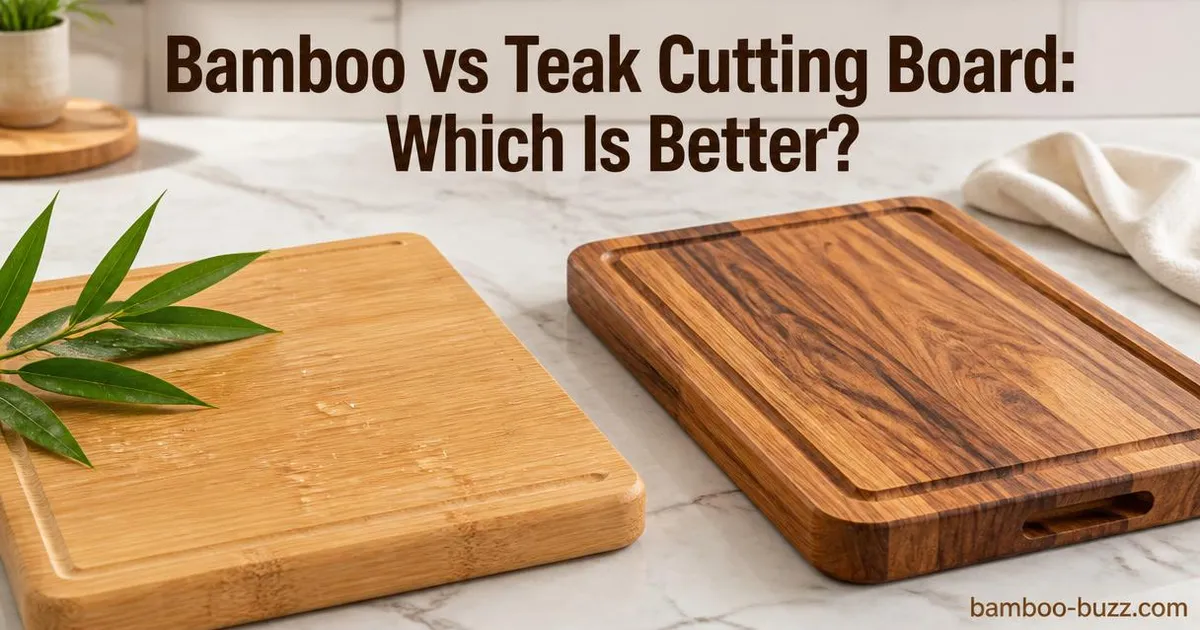
Teak costs more and lasts longer. Bamboo costs less and grows faster. That’s the core of the bamboo vs teak cutting board debate, but the details around water resistance, knife wear, and food safety are where the real decision lives.
Most people pick a cutting board based on price or looks, then wonder why it warps, dulls their knives, or holds odors after a few months. The material you choose determines how often you oil it, how it handles raw meat, and whether your knife edges stay sharp.
Key Takeaways
- Teak and bamboo differ most in water resistance and maintenance needs.
- Hardness and density affect durability and knife wear differently for each material.
- Teak is generally the better option for frequent raw meat preparation.
- Price and environmental sourcing are major deciding factors for many buyers.
- Both materials require hand washing and periodic oiling to last.
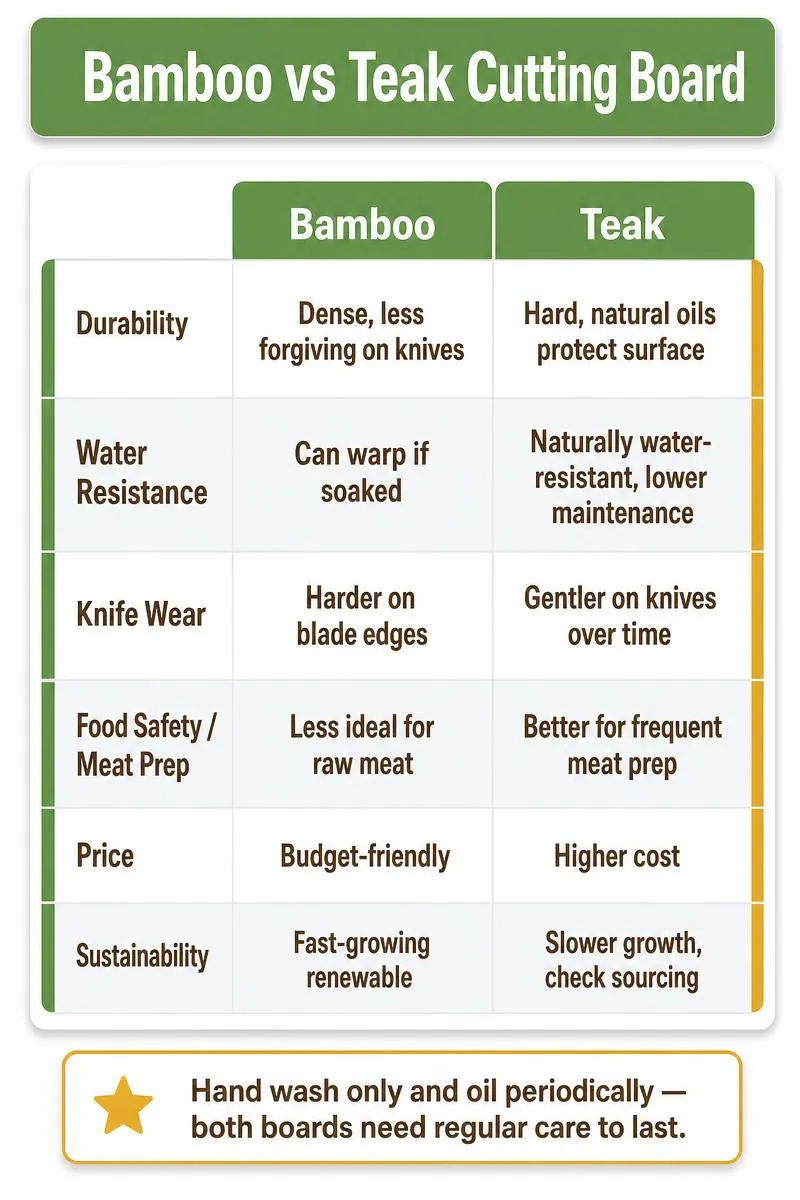
Bamboo Vs Teak Cutting Board at a Glance
| Factor | Bamboo | Teak |
|---|---|---|
| Durability | Dense; less forgiving on knives | Hard; natural oils protect surface |
| Water resistance | Can warp if soaked | Naturally water-resistant |
| Knife wear | Harder on blade edges | Gentler on knives over time |
| Food safety / Meat prep | Less ideal for frequent raw meat | Better for frequent meat preparation |
| Price | Budget-friendly | Higher cost |
| Sustainability | Fast-growing; renewable | Slower growth; check sourcing |
| Care | Hand wash; oil periodically | Hand wash; oil periodically |
What Is a Bamboo Cutting Board?
Bamboo cutting boards are made from compressed bamboo grass fibers laminated into board form. The grass is harvested, split into strips, and bonded under pressure with adhesive. That process creates a dense, lightweight surface that works well for vegetable prep, bread slicing, and light daily kitchen tasks.
Bamboo boards are affordable, lightweight, and sourced from a fast-growing grass that regenerates quickly. Moso bamboo, the species most commonly used, can reach harvest maturity in a few years.
The weaknesses matter if you cook a lot. Bamboo is harder than most hardwoods, which means it can dull knife edges faster than teak. Some sources also suggest it can show wear under heavy chopping, with fibers fraying or splitting along the grain over time.
Keep Reading
A focused comparison of bamboo and maple cutting boards-covers hardness, knife wear, and care to help choose between…
What Is a Teak Cutting Board?
Teak cutting boards come from tropical hardwood known for dense grain and rich natural oils. The oil content is what sets teak apart from most other wood cutting boards, because the oils help repel moisture and reduce the need for frequent conditioning.
Teak boards are best for heavy chopping, frequent meat prep, and daily hard use. The dense grain resists scarring, and the natural oil content helps the surface resist water absorption.
The strengths include self-healing properties, meaning the wood fibers can close up minor cuts rather than leaving permanent grooves. Teak’s density and natural oil content also tend to give it a longer functional lifespan than bamboo or plastic boards.
The weaknesses come down to cost and sourcing. Teak carries a higher price point than bamboo, and teak trees grow slowly compared to bamboo grass. That slower growth is why teak buyers should look for boards from managed plantations.
Bamboo vs Teak: Durability and Knife Wear
Teak wins for long-term resilience and gentler impact on knife edges. The difference comes down to hardness and density working in opposite directions for each material.
Bamboo’s compressed fiber structure is harder than teak. A harder surface means your knife blade takes more impact on each cut, which can dull edges faster over time. The trade-off is that a harder board resists surface scratching, but that same hardness works against your knives.
Teak has a lower hardness rating than bamboo but higher density in the grain structure. That combination lets the wood absorb some of the impact from your blade, which is gentler on knife edges. Teak’s self-healing properties also mean minor cuts close up rather than becoming permanent scars that collect food particles. Teak boards hold up better under repeated heavy use because the dense grain and oil content keep the surface from breaking down as quickly.
Bamboo vs Teak: Water Resistance and Maintenance
Teak wins for moisture resistance and lower warping risk. The natural oil content in teak is the primary reason.
Teak’s natural oils act as a built-in moisture barrier. Water beads on the surface rather than soaking in, which reduces the risk of warping, cracking, and splitting. You still need to hand wash teak boards, but the oil content buys you more forgiveness if the board sits wet for a short time.
Bamboo absorbs water more readily than teak because the compressed fiber structure lacks the same oil content. The adhesive used in lamination can also degrade if exposed to moisture repeatedly. Warping and splitting are more common with bamboo boards that aren’t dried promptly after washing.
Both materials need hand washing. Neither belongs in a dishwasher, where heat and water pressure will damage the surface and break down the structure.
Oiling frequency differs. Teak needs less frequent oiling because the natural oils already do some of the work. Bamboo needs more regular applications of food-grade mineral oil to prevent drying and cracking, especially along the edges where the compressed fibers are most exposed.
Also Worth Checking Out
Bamboo cutting board vs plastic
Explains water resistance, sanitation, and maintenance differences between bamboo boards and plastic…
Bamboo vs Teak: Food Safety and Meat Prep
Teak wins for raw meat handling and odor control.
Teak contains natural oils that have mild antimicrobial properties. The dense grain also leaves fewer gaps where bacteria can settle, which matters when you’re cutting raw meat. Fewer grooves means fewer places for juices to collect and fewer opportunities for cross-contamination.
Bamboo boards have a harder, more rigid surface that doesn’t self-heal the way teak does. Cuts in bamboo can become permanent grooves that trap food particles and bacteria. For vegetable prep, that’s less of a concern. For raw chicken or fish, those grooves become a food safety issue.
Odor retention is another factor. Teak’s natural oils help resist absorbing smells from strong foods like garlic, onions, and raw meat. Bamboo can hold odors more readily, especially as the surface develops cut marks that trap food residue.
Bamboo works fine for vegetables and cooked foods where bacterial contamination is less of a concern.
Bamboo vs Teak: Price and Sustainability
Bamboo wins on upfront price and renewability. Teak wins on lifespan. The environmental trade-offs depend on what you prioritize.
Bamboo boards cost less to produce because bamboo grass grows fast and harvests quickly. Moso bamboo regenerates from the root system after cutting, so the same plant can produce multiple harvests. That fast growth cycle makes bamboo one of the most renewable materials used for kitchen products.
Teak costs more because the trees grow slowly and the wood is denser. A longer growing cycle means more time and land investment before harvest. Some teak is sourced from sustainable plantations, but teak buyers who care about deforestation should check that boards come from managed plantations.
The lifespan trade-off matters too. One teak board can outlast several bamboo boards bought over the same period. If you factor in replacement frequency, the cost gap narrows. But if your budget only allows for one purchase right now, bamboo gets you a functional board at a fraction of the price.
Which Should You Choose?
The right choice depends on how you cook and what you prioritize.
- Budget-conscious buyers who mostly cut vegetables and bread should go with bamboo. The lower price and lighter weight make it practical for everyday prep that doesn’t involve heavy chopping or raw meat.
- Frequent meat preparers who want minimal warping and odor retention should choose teak. The natural oils and dense grain handle raw protein better and resist the smells that linger on harder surfaces.
- Eco-focused shoppers prioritizing fast-regrowth material should pick bamboo. The renewable harvest cycle and root regeneration after cutting make it the lower-impact choice in terms of raw material sourcing.
- Cooks wanting one board that lasts through years of heavy use should invest in teak. The self-healing grain and oil content give it a longer functional life than bamboo under hard daily use.
- Beginner cooks needing an affordable entry point should start with bamboo. It gets the job done for basic kitchen tasks without a big upfront cost, and you can always upgrade later.
Acacia vs bamboo cutting board
Compares bamboo with another popular hardwood option (acacia) on durability, aesthetics, and long-term care for cutting…
FAQs About Bamboo and Teak Cutting Boards
What are the downsides of bamboo cutting boards?
Bamboo boards are harder than most wood cutting boards, which can dull knife edges faster. The compressed fiber structure can fray under heavy chopping, and the adhesive used in lamination may degrade with repeated moisture exposure. Bamboo also needs more frequent oiling than teak and can absorb odors as cut marks develop.
Is it safe to put raw meat on a bamboo cutting board?
It works, but teak is a better choice for raw meat. Bamboo’s surface can develop permanent cut grooves that trap bacteria and food particles. If you use bamboo for meat, wash the board immediately with hot soapy water and consider keeping a separate board for raw protein to avoid cross-contamination.
What is the healthiest and most hygienic cutting board material, and which will not dull knives?
No single material wins on both hygiene and knife preservation. Teak offers natural antimicrobial oils and a dense grain that resists bacterial buildup. For knife edges, teak’s slightly softer surface is gentler than bamboo’s harder compressed fibers. Wood boards generally outperform plastic on hygiene because plastic develops deep knife grooves that are difficult to clean.
What is the most hygienic chopping board for meat?
Teak ranks well for meat prep because the natural oils have mild antimicrobial properties and the dense grain resists deep scoring. A well-maintained teak board with regular oiling keeps the surface sealed and reduces the gaps where bacteria settle.
What do Japanese use for cutting boards?
Japanese kitchens commonly use hinoki wood cutting boards, particularly for sushi and sashimi preparation. Hinoki is a softwood that’s exceptionally gentle on knife edges, which matters for the thin, precision blades used in Japanese cooking. Some Japanese cooks also use plastic boards for raw meat to simplify sanitation.
What does Gordon Ramsay use for cutting boards?
Gordon Ramsay has been shown using heavy wooden cutting boards in his kitchens and television appearances. The specific wood type varies, but he favors substantial boards that can handle heavy chopping without sliding. A thick teak board fits that profile well.
What is the best cutting board in the world?
There’s no single answer. The best board depends on what you cook and how you maintain it. Teak is a strong all-around choice for durability, knife preservation, and food safety. End-grain hardwood boards from maple or walnut also perform well. Bamboo is the best value option for lighter use.
Final Verdict
Teak is the better choice for heavy use and meat prep. Bamboo works well for light use and tight budgets. If you only cook occasionally, either material will serve you fine as long as you maintain it properly.
Before you use your chosen board for the first time, hand wash it and apply a thin coat of food-grade mineral oil. That single step gives you a head start on keeping the surface sealed and protected.
External References
- Janka Comparison Chart – Teragren
- Rapid growth of Moso bamboo (Phyllostachys edulis) – PMC – NIH (NCBI)
- Antibacterial Effects of Wood Structural Components and … – NCSU (.edu)
- Cutting Boards | Food Safety and Inspection Service – USDA FSIS
- Comparative Study of Antibacterial Activity between … – Microbiologyjournal
- What is the Healthiest Cutting Board Material? Our Top 3 List – Healthierhomes