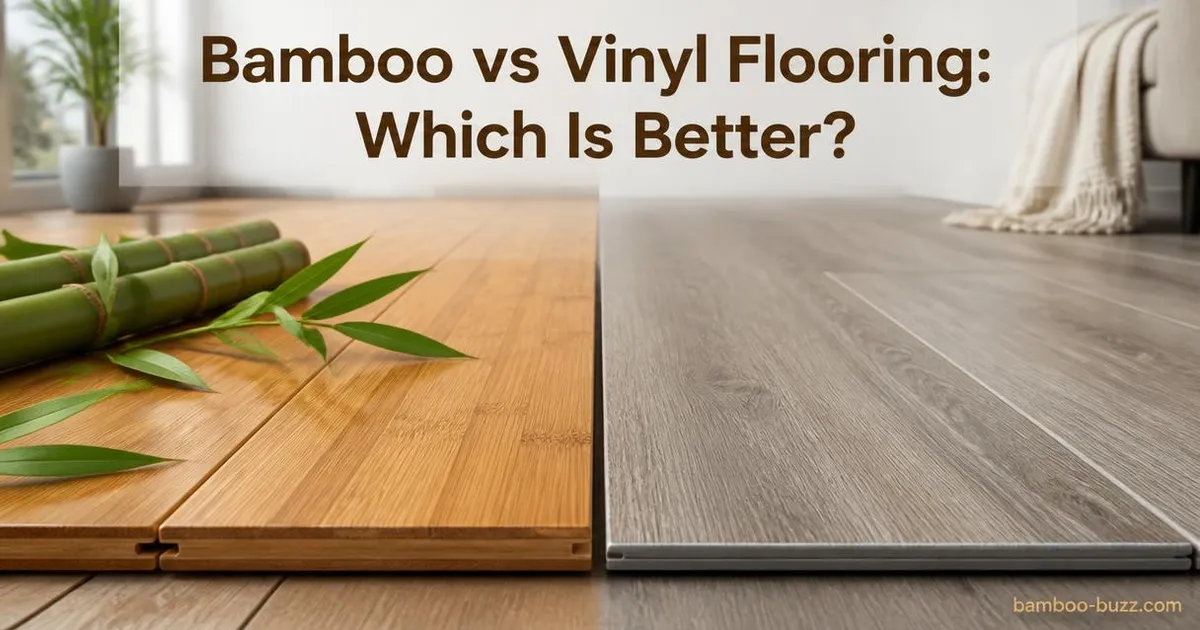
Bamboo vs Vinyl Flooring: Which Is Better?
# Bamboo vs Vinyl Flooring: Which Belongs in Your Home?
Bamboo and vinyl flooring both mimic the look of wood, but underneath the surface they are completely different materials. One is a fast-growing grass pressed into planks. The other is PVC shaped and printed to resemble timber.
The choice between them usually comes down to moisture exposure, budget, and whether you want a natural surface you can refinish or a synthetic one you can ignore. Both options can work in a home that wants a hardwood aesthetic without the hardwood price tag. But they behave differently underfoot, react differently to humidity, and age in completely different ways.
Knowing where each one excels saves you from installing the wrong material in the wrong room.
Key Takeaways
- Bamboo is a natural, refinishable material, but it absorbs moisture and expands and contracts with humidity.
- Vinyl is synthetic, fully waterproof, and usually cheaper upfront than bamboo.
- Some sources suggest strand-woven bamboo is harder than many traditional hardwoods, yet it can still dent under heavy impact.
- Vinyl handles bathrooms, basements, and humid climates better than bamboo.
- Bamboo offers renewable sourcing from moso grass; vinyl offers chemical stability and minimal upkeep.
- The right pick depends on the room and climate, not on one being objectively better.
Worth Reading Next
A detailed comparison of bamboo and engineered hardwood covering durability, cost, and installation.
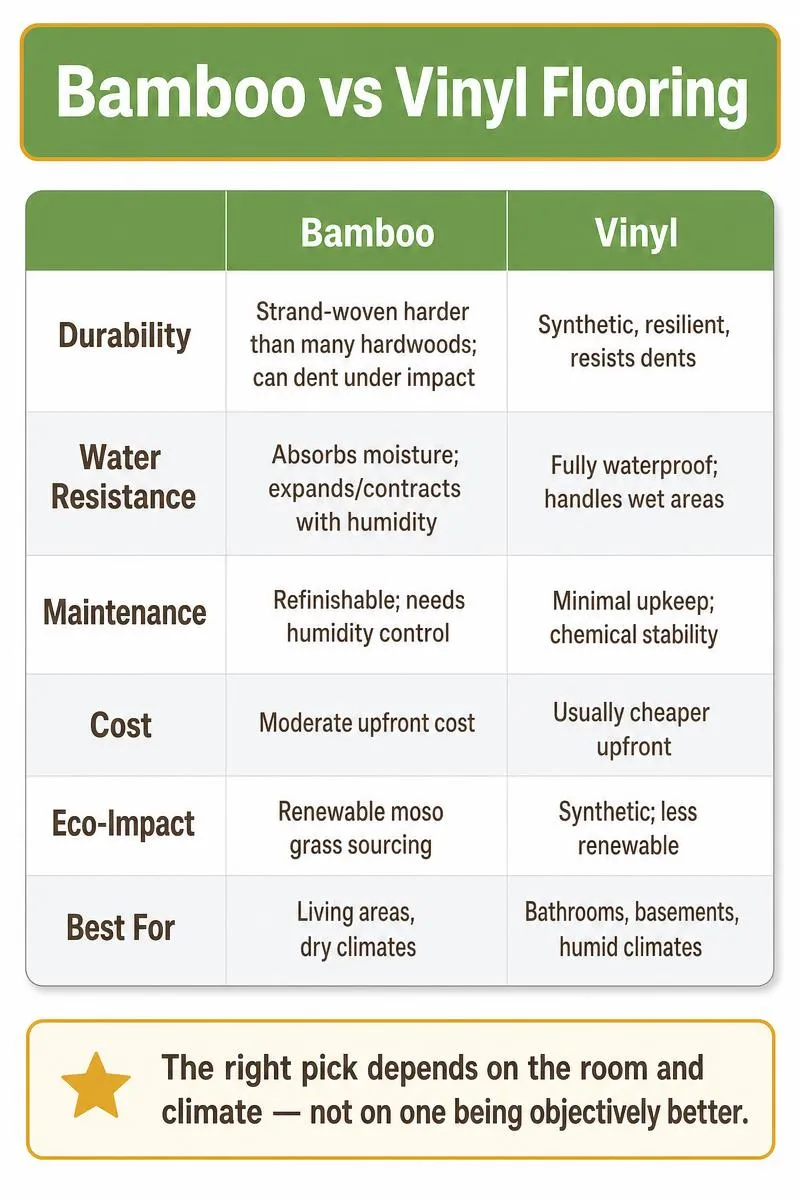
Comparing the Top Bamboo Vs Vinyl Flooring
| Factor | Bamboo | Vinyl |
|---|---|---|
| Durability | Strand-woven very hard; can dent under heavy impact | Synthetic, resilient; resists dents |
| Water Resistance | Absorbs moisture; expands/contracts with humidity | Fully waterproof; suitable for wet areas |
| Maintenance | Refinishable; needs humidity control | Minimal upkeep; chemically stable |
| Cost | Moderate upfront cost | Usually cheaper upfront |
| Eco-Impact | Renewable moso grass sourcing | Synthetic; less renewable |
| Best For | Living areas, dry climates | Bathrooms, basements, humid climates |
What Is Bamboo Flooring?
Bamboo flooring is made from processed bamboo grass, most commonly pressed into planks that look like hardwood. Three main types exist, and each behaves a little differently:
- Solid bamboo: Milled from strips of bamboo laminated together
- Engineered bamboo: A bamboo wear layer bonded to a plywood or fiberboard core for dimensional stability
- Strand-woven bamboo: Shredded fibers compressed under heat and pressure with adhesive for a denser, harder plank
Bamboo flooring works best in dry living areas, bedrooms, and spaces where you want a genuine natural grain. The surface can be sanded and refinished, which extends its usable life. Strand-woven bamboo in particular is reported by some sources to be harder than many traditional hardwoods.
The tradeoff is moisture. Bamboo absorbs water, which causes the planks to expand and contract as indoor humidity shifts. Carbonized bamboo, which is steamed to achieve a darker color, is softer than natural bamboo and more vulnerable to dents and scratches.
What Is Vinyl Flooring?
Vinyl flooring is a synthetic product made from PVC, typically sold as luxury vinyl planks (LVP) or luxury vinyl tiles (LVT). The planks are printed with a wood or stone visual layer and topped with a clear wear layer that protects the image underneath.
Vinyl flooring works best in kitchens, bathrooms, basements, laundry rooms, and any area where spills and humidity are likely. The entire plank is waterproof, not just the surface, which means standing water does not warp or swell the material.
The advantages are practical: vinyl costs less upfront than most bamboo, resists water completely, and is relatively easy to install as a floating floor.
Vinyl cannot be sanded or refinished. Once the wear layer shows scratches or wear, the plank needs replacing. Vinyl is also less renewable than bamboo, since PVC production and disposal involve chemical processes that do not break down naturally.
Bamboo Flooring vs Vinyl Flooring: Durability
Bamboo can dent but can be repaired. Vinyl resists dents but is harder to fix when damaged.
Strand-woven bamboo is the hardest bamboo option, and some sources rate it above many traditional hardwoods on the Janka scale. That hardness helps with scratch resistance, but bamboo is still a natural fiber product. Drop something heavy on it and the surface can dent.
The advantage is that a dented or scratched bamboo floor can be sanded down and refinished, restoring the surface without replacing planks.
Vinyl takes a different approach to durability. The clear wear layer on top of the printed design resists scratches and scuffs, and the resilient PVC core absorbs impact without denting in the way rigid materials do. However, once that wear layer wears through or a deep gouge cuts the printed layer, there is no refinishing option. You replace the plank or you live with the damage.
Comparison of scratch resistance, wear layers, and longevity between bamboo and laminate flooring.
Bamboo Flooring vs Vinyl Flooring: Water Resistance and Climate
Bamboo absorbs water. Vinyl does not.
Bamboo is a porous natural material. Bamboo planks absorb moisture from the air and expand in high humidity, then release it and contract in dry conditions. This movement can cause gaps between planks, cupping at the edges, or buckling if the expansion has nowhere to go. Bamboo flooring needs a stable indoor humidity range to perform well.
Vinyl is PVC through and through. Water sits on the surface, wipes off, and never penetrates the plank. Spills, mop water, and even minor flooding will not cause vinyl to swell, warp, or grow mold. In humid climates, coastal areas, or rooms below grade like basements, vinyl has a clear advantage.
Bamboo Flooring vs Vinyl Flooring: Maintenance
Vinyl is the lower-maintenance option on a daily basis. Sweep or vacuum loose dirt, mop with a damp mop, and you are done. No special products are needed beyond what the manufacturer recommends.
Bamboo needs a bit more attention to moisture. Wet mopping is not recommended because standing water can seep between planks and cause swelling. Use a barely damp mop and avoid excess water. The payoff: when the surface gets dull, scratched, or worn, sanding and resealing brings it back to a near-original state.
Bamboo Flooring vs Vinyl Flooring: Cost
Vinyl almost always costs less upfront. Material prices for LVP and LVT are generally lower than bamboo plank prices, and installation tends to be simpler, especially for click-lock floating floors that a confident DIYer can handle.
Bamboo costs more to buy and install. Professional installation is more common with bamboo, particularly for glue-down or nail-down formats. The long-term value calculation shifts if you plan to stay in the home for many years. A bamboo floor that gets refinished once or twice may outlast a vinyl floor that needs full replacement after the wear layer degrades.
Bamboo Flooring vs Vinyl Flooring: Eco-Impact
Bamboo wins on renewability. Moso bamboo reaches harvest size far faster than hardwood trees, which take decades to mature. The plant regrows from the same root system after harvest. These factors make bamboo a more renewable raw material than PVC.
Vinyl offers chemical stability and a long service life, which reduces replacement frequency and waste. But PVC production involves petrochemicals, and vinyl disposal is problematic because the material does not biodegrade. If your priority is a renewable, plant-based material, bamboo is the closer fit. If your priority is a floor that needs no refinishing and resists water for its entire life, vinyl has its own argument.
You Might Also Like
Examines environmental impact and sustainability differences between bamboo and teak.
Which Should You Choose?
Bathrooms, laundry rooms, or basements: Choose vinyl. These rooms have moisture, and bamboo’s tendency to absorb water makes it a poor fit for spaces where spills and humidity are constant.
Refinishable natural surface: Choose bamboo. If you want a floor that can be restored rather than replaced, bamboo is the only option of the two that allows refinishing.
Humid or variable climates: Vinyl handles moisture swings better. If your home experiences wide humidity changes across seasons, bamboo may expand and contract enough to cause gaps or cupping.
Renewable materials matter most: Bamboo is the closer fit. Moso bamboo grows fast and regrows after harvest, while PVC is a petroleum-based synthetic.
Lowest cost, easiest DIY: Vinyl is typically the better bet. Click-lock LVP is straightforward to install as a floating floor, and the material costs less per square foot than bamboo.
FAQs About Bamboo Flooring and Vinyl Flooring
What are the downsides of bamboo flooring?
Bamboo absorbs moisture, which causes expansion and contraction. Carbonized bamboo is softer than natural bamboo and more prone to denting. Strand-woven bamboo is harder but still vulnerable to heavy impact.
Can bamboo flooring go in bathrooms?
Not recommended. Bathrooms have consistent humidity and frequent water exposure, both of which cause bamboo planks to swell and potentially buckle. Vinyl is the better choice for bathrooms.
How does bamboo handle humidity and expansion?
Bamboo planks expand in high humidity and contract in dry conditions. Gaps between planks, cupping, and buckling can result if the indoor humidity swings too widely or the floor lacks proper expansion gaps.
What is the healthiest flooring for a home?
Both bamboo and vinyl have considerations. Bamboo is a natural material, but some bamboo flooring uses adhesives that can off-gas. Vinyl is PVC, which has raised indoor air quality concerns related to phthalates and other additives. Look for products with low-VOC certifications from independent testing programs.
Do high end homes use vinyl plank?
Yes. Higher-quality LVP with thick wear layers and realistic printed designs appears in higher-end homes, particularly in kitchens, bathrooms, and mudrooms where waterproofing matters more than natural material.
Does bamboo scratch or dent easily?
Natural bamboo resists scratches reasonably well. Strand-woven bamboo is harder and more scratch-resistant. Carbonized bamboo is softer and more vulnerable. All bamboo types can dent under heavy impact, but the surface can be sanded and refinished.
Is carbonized bamboo softer than natural?
Yes. Carbonized bamboo is steamed to darken the color, which softens the fibers and reduces hardness. If durability is a priority, natural or strand-woven bamboo is the harder choice.
How do I clean bamboo flooring?
Sweep or vacuum loose dirt regularly. Mop with a barely damp mop, avoiding excess water. Use cleaners recommended by the flooring manufacturer. Never wet-mop or steam-clean bamboo, as standing water can seep between planks and cause swelling.
Final Verdict
There is no single winner here. Bamboo belongs in dry, stable-climate rooms where the ability to refinish the surface matters. Vinyl belongs in moisture-prone spaces, humid climates, and budgets where upfront cost and easy installation are the priority.
Order samples of both, set them in the actual room, and see how they look and feel in your space before committing.
External References
- Non-Toxic Vinyl Flooring Brands: Top Choices for a … – Changlongflor
- Effects of carbonization conditions on properties of bamboo … – USDA
- ENVIRONMENTAL SPECIFICATION GUIDANCE FOR … – | doee – Dc
- Recent Developments in Eco-Friendly Wood-Based … – PMC – NIH (NCBI)
- Volatile Organic Compounds’ Impact on Indoor Air Quality – EPA