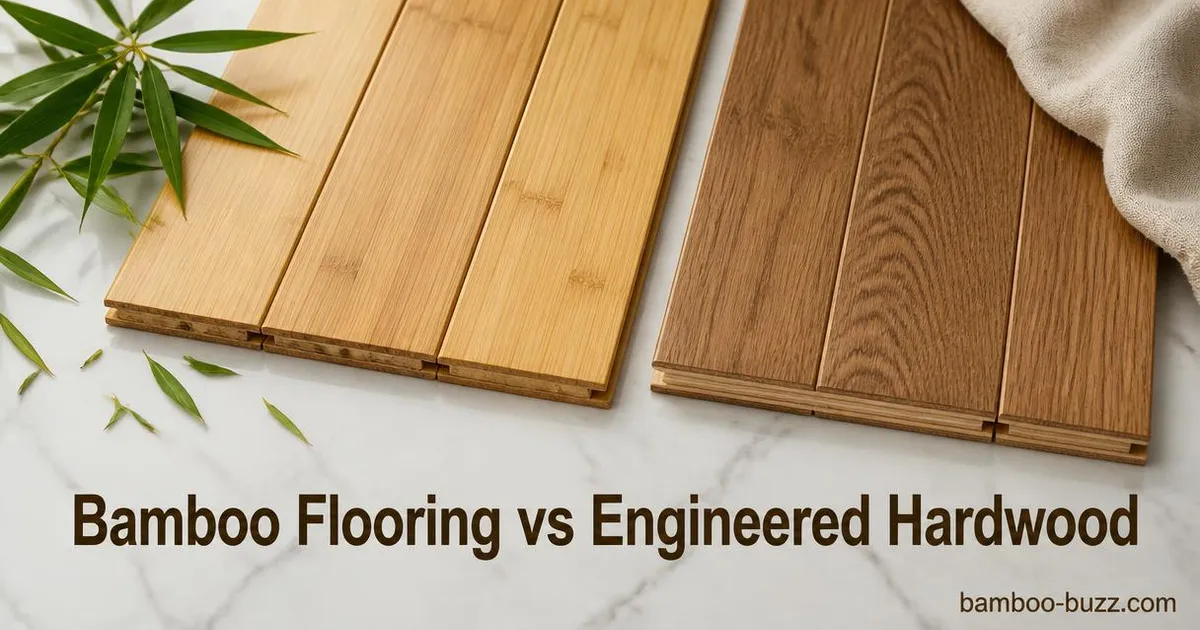
Bamboo Flooring vs Engineered Hardwood
Most people comparing bamboo flooring and engineered hardwood are trying to answer one question: which one actually holds up better in a real home? Engineered hardwood generally lasts longer because you can refinish it, while bamboo is harder underfoot but much harder to sand down and restore. Both are popular alternatives to solid hardwood, but they differ in construction, durability, cost, and moisture tolerance in ways that change which one makes sense for your situation.
The best choice depends on your budget, your climate, and how long you plan to stay in the home. If you’re renovating a starter house you’ll sell in five years, bamboo’s lower material cost and modern look might be all you need. If you’re settling into a home for a decade or more, engineered hardwood’s ability to be refinished could save you from a full replacement down the road.
Key Takeaways
- Engineered hardwood lasts longer and can be refinished; bamboo is hard but harder to refinish once the surface wears.
- Bamboo costs less upfront – material prices run lower, though installation labor is similar.
- Moisture is a wash – it depends more on construction quality than whether the surface is bamboo or wood.
- Both use adhesives that affect indoor air quality, so checking for FloorScore or CARB Phase 2 certification matters either way.
- More species variety and traditional grain patterns with engineered hardwood; bamboo gives a modern, uniform look.
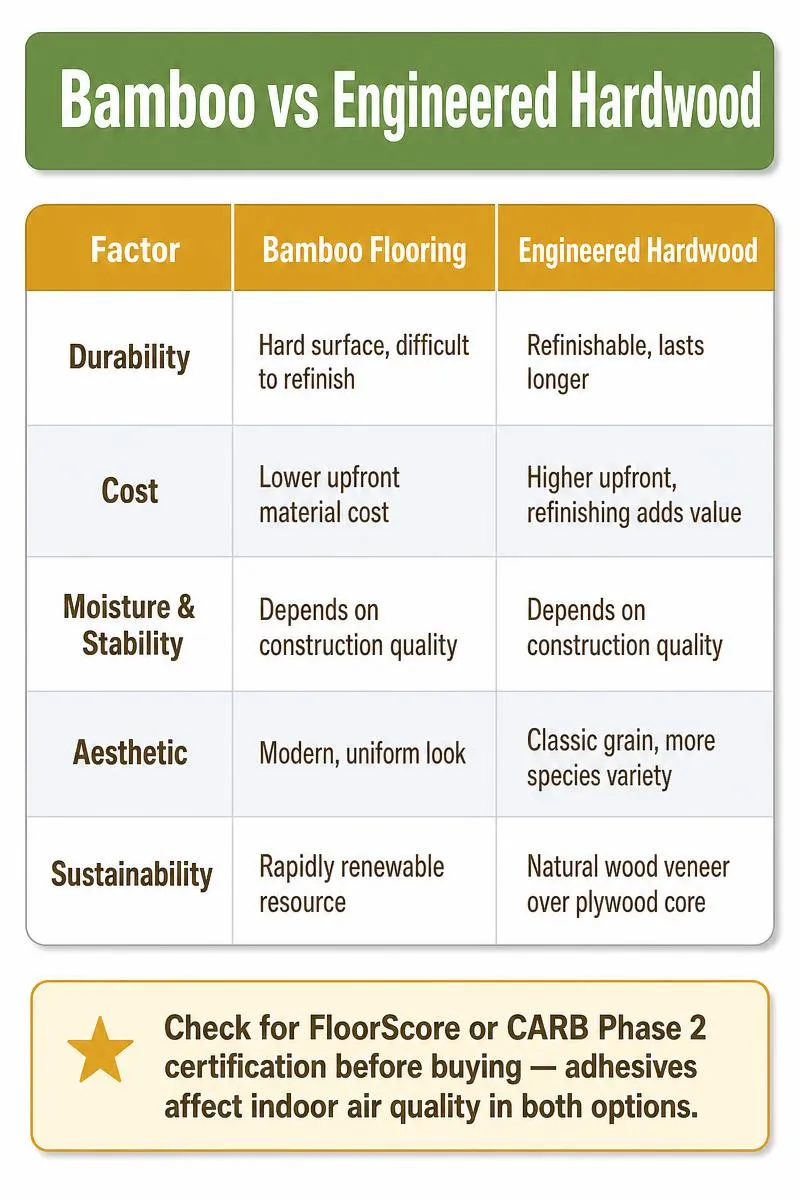
Comparing the Top Bamboo Flooring Vs Engineered Hardwood
| Factor | Bamboo Flooring | Engineered Hardwood |
|---|---|---|
| Durability | Hard surface, difficult to refinish | Refinishable, lasts longer |
| Cost | Lower upfront material cost | Higher upfront; refinishing adds value |
| Moisture & Stability | Depends on construction quality | Depends on construction quality |
| Aesthetic | Modern, uniform look | Classic grain; more species variety |
| Sustainability | Rapidly renewable resource | Wood veneer over plywood core |
What Is Bamboo Flooring?
Bamboo flooring is made from grass stalks that are sliced, flattened, or shredded and then compressed under heat with adhesives. Strand-woven bamboo – the densest type – shreds the fibers and presses them together with resin into solid planks. Other types slice the stalk into flat strips and laminate them into an engineered veneer over a core.
Bamboo flooring works best in residential interiors, modern spaces, and budget renovations where you want a clean, uniform look without paying for solid hardwood. The material renews fast – bamboo reaches harvest maturity in a few years compared to decades for most hardwood trees – and strand-woven bamboo achieves high density that resists scratching in daily use.
Bamboo flooring has limited refinishing because strand-woven planks have no separate wood veneer – sanding cuts into the compressed fiber core itself. Moisture resistance varies by manufacturer and construction quality rather than being a built-in trait of the material. The adhesives used to bind strand-woven bamboo can off-gas volatile organic compounds, so adhesive certification matters when you’re comparing brands.
Keep Reading
Pros and cons of bamboo decking
A thorough look at how bamboo performs as a flooring-like material outdoors, including durability and moisture…
What Is Engineered Hardwood?
Engineered hardwood is a real wood veneer – usually oak, maple, hickory, or walnut – glued over a plywood or high-density fiberboard core. The veneer is sliced or rotary-peeled from a log, and the core is built from stacked layers of wood or fiberboard with grains running in alternating directions for dimensional stability.
Engineered hardwood suits traditional interiors, homeowners who want refinishing flexibility, and spaces where solid hardwood would be too prone to expansion and contraction. The cross-grain core keeps planks more stable than solid wood through humidity swings, and the real wood veneer can be sanded and refinished if the wear layer is thick enough.
The downsides: material cost runs higher than bamboo, and the plywood or fiberboard core is vulnerable to moisture if water penetrates the edges. Sustainability is also variable – some engineered hardwood uses fast-growth cores and responsibly sourced veneers, but others don’t, and you’re still cutting slow-growth trees for the visible surface.
Bamboo Flooring vs Engineered Hardwood: Durability and Refinishing
Winner: Engineered Hardwood. Engineered hardwood’s refinishing potential gives it a longer practical lifespan, though strand-woven bamboo wins on surface hardness.
1. Hardness and Dent Resistance
Strand-woven bamboo registers high on the Janka hardness scale – often higher than many common hardwood species. But density does not always translate to real-world dent resistance. Bamboo’s hardness comes from compressed fibers and resin, and a dropped can or heavy furniture leg can still leave a mark because the material doesn’t flex the way solid wood does.
Engineered hardwood’s dent resistance depends on the species used for the veneer. Hickory and maple resist dents well; walnut and cherry are softer. The core underneath doesn’t contribute much to surface durability, so the veneer species is what matters for day-to-day wear.
2. Wear Layer Thickness and Refinishing
The wear layer on engineered hardwood is actual wood that can be sanded down and refinished. Thicker wear layers – usually found on mid-range and premium products – allow repeated refinishes over the floor’s lifespan.
Bamboo flooring, especially strand-woven, has a surface that’s structurally integrated with the compressed core. Sanding it removes the factory finish and starts cutting into the fiber-and-resin composite, which doesn’t look the same as the original surface. Some bamboo products labeled as engineered have a veneer that can be lightly refinished, but most bamboo floors are effectively one-and-done on refinishing.
Bamboo Flooring vs Engineered Hardwood: Cost
Winner: Bamboo Flooring (upfront), condition-dependent long-term.
Bamboo flooring typically costs less per square foot for material than engineered hardwood, especially when comparing mid-range bamboo to mid-range engineered oak. The gap narrows at the budget end, where low-cost engineered hardwood competes with mid-tier bamboo.
Installation labor runs similar for both – both use click-lock or tongue-and-groove systems, and both go over the same types of subfloor. The cost difference is almost entirely in the material.
Long-term value shifts the math. If engineered hardwood gets refinished once or twice instead of replaced, the higher upfront cost spreads over a longer service life. If bamboo flooring needs full replacement after the surface wears, the lower initial price may not hold up as a better deal over the full time you own the floor.
Related Reading
Bamboo cutting board vs plastic
A focused material comparison that highlights how bamboo stacks up against other materials for durability and…
Related Reading
Pros and cons of bamboo fabric
A general pros-and-cons rundown that helps readers understand broader sustainability and material trade-offs that also…
Bamboo Flooring vs Engineered Hardwood: Moisture and Stability
Winner: Tie – depends on construction quality.
Both bamboo and engineered hardwood are dimensionally more stable than solid hardwood, but neither is waterproof. Both expand and contract with humidity changes, and both require proper acclimation before installation.
Engineered hardwood’s cross-grain core resists warping better than solid wood, but the plywood or fiberboard core can swell permanently if water reaches it through edge gaps or scratches. Bamboo’s behavior depends on the construction – strand-woven bamboo is dense and resists surface moisture well, but cheaper bamboo planks can absorb water through the joints and cup or buckle.
In both cases, subfloor preparation matters as much as the flooring material. A vapor barrier, a flat subfloor, and proper expansion gaps do more for moisture performance than choosing bamboo over engineered hardwood or vice versa.
Bamboo Flooring vs Engineered Hardwood: Sustainability and Indoor Air Quality
Winner: Condition-dependent.
Bamboo’s renewability advantage is real – the stalks regrow from the same root system and reach harvest size within a few years. Hardwood trees used for engineered veneers take decades to mature. If your priority is rapidly renewable raw material, bamboo has a clear edge at the crop level.
That said, some sources suggest that the full lifecycle comparison is more complicated. Processing bamboo into flooring involves adhesives, heat pressing, and shipping – often from overseas – and the energy and chemical inputs may narrow the gap with domestically sourced engineered hardwood.
Both materials use adhesives that can release VOCs into your home. Strand-woven bamboo uses more adhesive by volume because the entire plank is bound resin and fiber. Engineered hardwood uses adhesive mainly between the core layers and to attach the veneer. In both cases, look for certifications like FloorScore, CARB Phase 2, or equivalent standards that verify low emission levels.
Which Should You Choose?
Most buyers fall into one of the five situations below.
1. Lowest Upfront Cost: Bamboo Flooring
If your budget is tight and you want a clean, modern floor installed without paying for hardwood species pricing, bamboo flooring is the lower-cost route. Just plan for the likelihood that you won’t refinish it – you’ll replace it instead.
2. Long-Term Stay With Planned Refinishing: Engineered Hardwood
If you’re in a home for the long haul and want a floor you can sand and restain, engineered hardwood with a thick wear layer gives you that option. Check the wear layer spec before buying – thinner veneers limit or eliminate refinishing.
3. Modern, Uniform Aesthetic: Bamboo Flooring
Bamboo gives a consistent, contemporary look with minimal grain variation. If you want a floor that doesn’t fight with modern furniture and clean-line design, bamboo’s uniform appearance fits without effort.
4. Classic Species Variety and Grain: Engineered Hardwood
Oak, hickory, maple, walnut – engineered hardwood lets you pick a species with the grain pattern, color, and character you want. If traditional wood grain is the look you’re after, bamboo won’t substitute for it.
5. Rapidly Renewable Material Priority: Bamboo (With Certifications Checked)
If the fast-growth raw material matters to you, bamboo regenerates in years rather than decades. Pair that preference with an adhesive certification check so the indoor air quality side of the equation doesn’t get lost.
Acacia wood vs bamboo utensils
Another direct comparison of bamboo versus a hardwood that discusses performance and maintenance trade-offs useful for…
FAQs About Bamboo Flooring and Engineered Hardwood
What is the downside of bamboo flooring?
Limited refinishing once the factory finish wears is the main drawback. Moisture resistance also varies by manufacturer, so cheaper bamboo can cup or buckle if water gets through the joints.
Is bamboo as hard as hardwood?
Strand-woven bamboo is often harder on the Janka hardness scale than common hardwoods like oak. But hardness ratings measure resistance to a specific type of indentation, and dropped objects and furniture legs can still dent it in daily use.
What is the lifespan of bamboo flooring?
Bamboo flooring can last decades if the finish holds up and the floor stays dry. The catch is that once the finish wears through, your options are limited to screening and recoating rather than full refinishing, which shortens the practical service life compared to engineered hardwood that can be sanded and restained.
Why do experts warn against bamboo?
The warnings usually focus on three things: variable quality across manufacturers, adhesives that can off-gas VOCs, and limited refinishing options. Cheap bamboo flooring from uncertified sources can have inconsistent moisture resistance and higher emissions. Buying from a manufacturer with FloorScore or CARB Phase 2 certification addresses the first two; the refinishing limitation is inherent to the material.
What is the healthiest flooring to put in your house?
There’s no single healthiest option – it depends on what you’re trying to avoid. For low VOC emissions, look for FloorScore or CARB Phase 2 certification on either bamboo or engineered hardwood. For minimal chemical processing, solid hardwood with a natural oil finish avoids the adhesives used in both engineered and bamboo products, though you give up dimensional stability and pay more.
Why don’t we replace wood with bamboo?
Bamboo works well for flooring and some structural uses, but it doesn’t replace hardwood in applications that require solid dimensional lumber – framing, stair treads, furniture joinery. The compressed plank format that makes bamboo flooring dense also makes it unsuitable for load-bearing construction in most building codes. The two materials serve overlapping but different purposes.
Final Verdict
Engineered hardwood suits most homeowners who value refinishing flexibility, species variety, and proven long-term performance. Bamboo flooring works if you’re budget-conscious, want a modern uniform look, and accept that refinishing options are limited.
Order samples of both, bring them home, and see how they look in your actual lighting and humidity before you commit.
External References