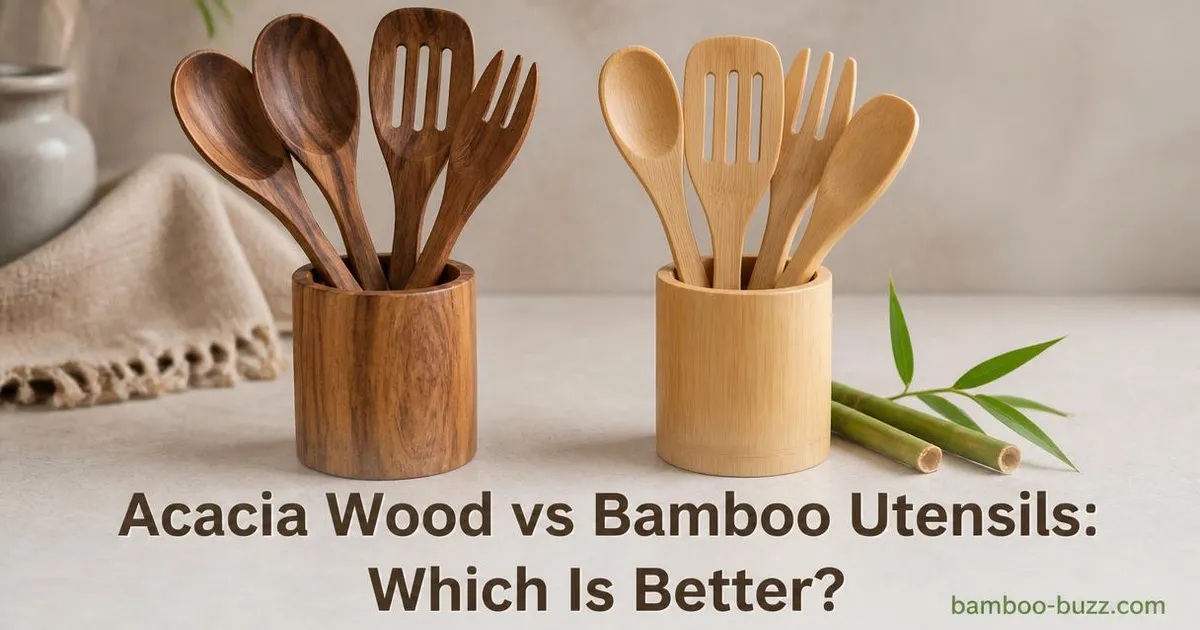
Acacia Wood vs Bamboo Utensils: Which Is Better?
Most kitchen guides position acacia as the premium choice and bamboo as the budget alternative. That framing skips the part where bamboo beats acacia for nonstick cookware and long stirring sessions, and where acacia’s durability advantage only matters if you’re using your utensils in ways that stress the wood grain.
The real decision isn’t about quality tiers. It’s about matching the material to how often you cook, what you’re willing to maintain, what you want to spend, and how carefully you’ll dry and store your tools.
Key Takeaways
- Acacia utensils are typically described as durable and luxurious, while bamboo utensils are lightweight, sustainable, and budget-friendly
- Both materials are considered safe for cooking, though proper drying and replacing worn utensils matter more than the material itself
- Maintenance routines differ slightly – both need hand washing and thorough drying, but acacia requires more attention to preserve its finish
- Acacia holds up better under heavy daily use according to some sources, while bamboo remains the practical budget pick for lighter cooking
- Bamboo is explicitly labeled as sustainable in most coverage, while acacia is positioned as a premium option for frequent use
Comparing the Top Acacia Wood Vs Bamboo Utensils
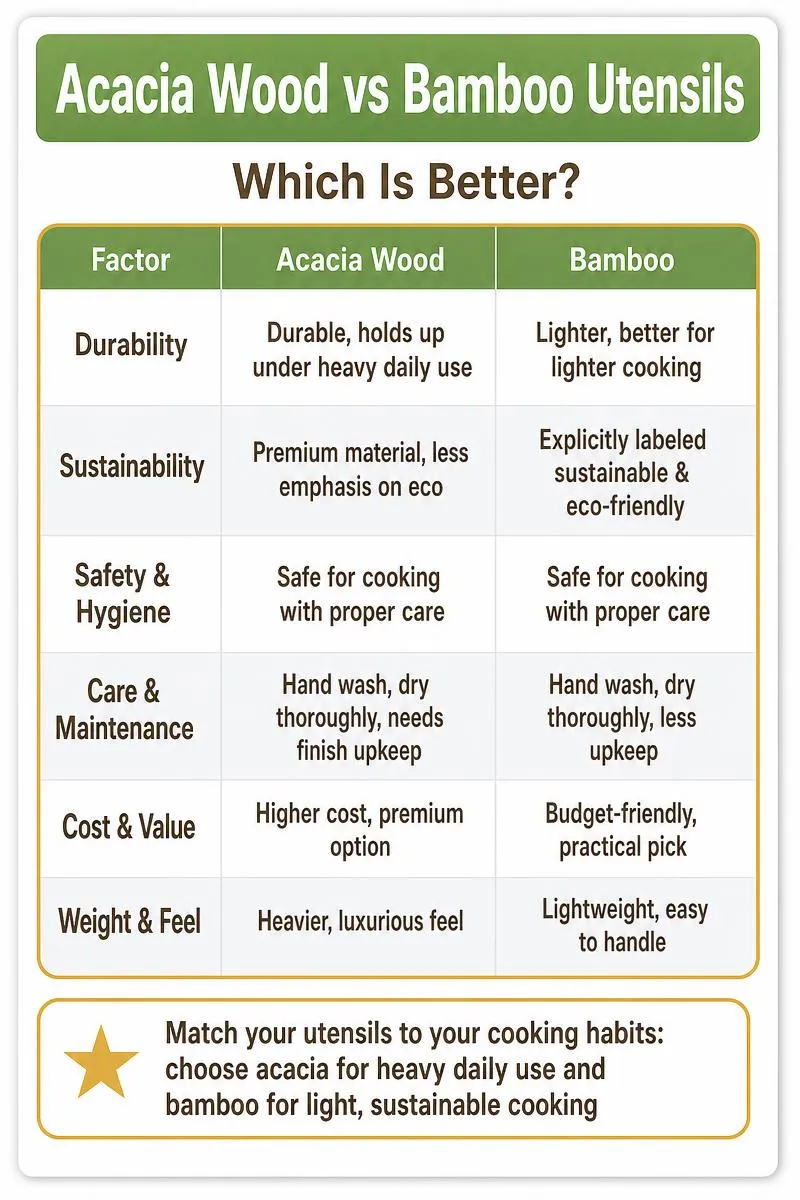
| Factor | Acacia Wood | Bamboo |
|---|---|---|
| Durability | Durable; holds up under heavy daily use | Lighter; better for lighter cooking |
| Sustainability | Premium material; less emphasis on eco | Explicitly labeled sustainable & eco-friendly |
| Safety & Hygiene | Safe for cooking with proper care | Safe for cooking with proper care |
| Care & Maintenance | Hand wash, dry thoroughly; needs finish upkeep | Hand wash, dry thoroughly; less upkeep |
| Cost & Value | Higher cost; premium option | Budget-friendly; practical pick |
| Weight & Feel | Heavier; luxurious feel | Lightweight; easy to handle |
What Is Acacia Wood Utensils?
Acacia utensils are hardwood cooking and serving tools made from acacia trees, described in most kitchen guides as warm-toned and durable. The wood’s density gives it a heft bamboo doesn’t match, which translates to a more solid feel during stirring or scraping.
Most people use acacia utensils for daily cooking, serving pieces, and cutting boards. The material works for high-heat tasks like sautéing.
Acacia’s main strength is durability – it holds up under heavy daily use better than softer woods. The tradeoffs center on cost and maintenance. Acacia utensils carry a higher price than bamboo, and reader questions about moisture sensitivity suggest the wood needs consistent care to avoid warping or cracking over time.
Also Worth Checking Out
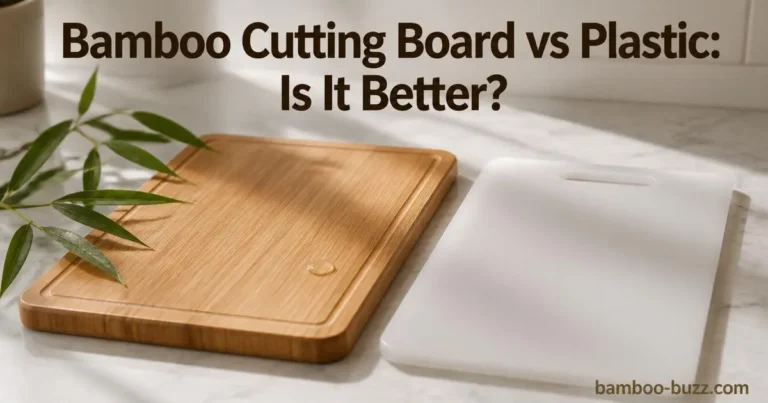
Acacia vs bamboo cutting board
A focused comparison of acacia and bamboo for cutting boards, showing how hardness, grain, and finish affect kitchen…
What Is Bamboo Utensils?
Bamboo utensils are cooking tools made from bamboo stalks, positioned in most guides as a lightweight alternative to hardwood. The material is technically a grass, not a wood, which gives it a different grain structure and density.
These utensils work best for everyday cooking, first kitchens, and budget-conscious households. The light weight makes them easy to maneuver during long cooking sessions, and they’re gentle on nonstick surfaces.
Bamboo’s core strengths are sustainability, low cost, and versatility across cooking tasks. The material grows quickly, and utensils made from it remain affordable enough to replace regularly. The care and maintenance requirements are straightforward, though the material doesn’t always hold up as long under heavy daily use compared to denser hardwoods like acacia.
Acacia Wood Utensils vs Bamboo Utensils: Durability & Longevity
Both work for a variety of cooking tasks, but the density difference between hardwood and grass translates to different wear patterns over time.
Acacia’s hardwood structure tends to resist dents and scratches better than bamboo when you’re stirring thick sauces or scraping fond from a pan. The material maintains its shape and surface smoothness longer under daily stress, which matters if you’re cooking multiple meals a day with the same utensil.
Bamboo holds up well for light to moderate home cooking but shows wear faster when used heavily. The grain can splinter or fray at edges under heavy high-heat use, especially if the utensil stays wet between uses.
Winner by condition: Acacia for heavy daily use where durability matters most. Bamboo for light to moderate home cooking where you’ll replace utensils as they wear out anyway.
You Might Also Like
Bamboo countertops pros and cons
An in-depth look at bamboo’s durability and wear in kitchen surfaces, useful for readers evaluating longevity and…
Acacia Wood Utensils vs Bamboo Utensils: Safety & Hygiene
Reader questions cluster around bacteria retention, toxicity, and whether one material is inherently safer than the other. Care habits and surface condition are the real variables.
Both acacia and bamboo are considered safe for cooking when the utensils are intact and properly dried after washing. Wood and bamboo surfaces can harbor bacteria in cracks or deep scratches, but the same risk applies to any porous material left damp or damaged.
Neither material introduces toxins during normal cooking use. The safety concern shifts to how well you maintain the surface – a worn bamboo utensil with visible splinters poses the same risk as a cracked acacia spoon.
Winner by condition: Neither material is clearly safer. Proper drying and replacing worn utensils matter more than the material alone.
Acacia Wood Utensils vs Bamboo Utensils: Care & Maintenance
Both materials need hand washing and thorough drying to prevent warping, cracking, or bacterial growth. Surface preservation is the key maintenance goal, which means avoiding dishwashers and extended soaking for both acacia and bamboo.
Acacia utensils require more attention to maintain their premium finish. The wood benefits from occasional oiling with food-safe mineral oil to prevent drying and cracking, especially in low-humidity environments. Skipping this step doesn’t ruin the utensil immediately, but it shortens the lifespan and dulls the appearance.
Bamboo utensils follow a simpler routine. Wash, dry thoroughly, and store in a dry spot. The material doesn’t need regular oiling to stay functional, though it can help extend the life of heavily used pieces.
Winner by condition: Bamboo for users wanting simpler care. Acacia for those willing to maintain a premium finish with occasional oiling.
Acacia Wood Utensils vs Bamboo Utensils: Cost & Value
Acacia carries a luxurious positioning, while bamboo is explicitly labeled as budget-friendly. You pay more for the denser wood and the longer service life it’s sold on.
Bamboo utensils cost less upfront, often priced low enough that replacing a full set when it wears out doesn’t strain a kitchen budget. The lower price makes them accessible for first apartments, gift sets, or households that prefer rotating utensils regularly rather than maintaining them long-term.
Acacia utensils cost more initially but are positioned as long-term kitchen investments. If the durability claims hold and you maintain the wood properly, the higher upfront cost spreads over more years of use.
Winner by condition: Bamboo for upfront savings. Acacia for buyers treating utensils as long-term kitchen investments.
You Might Also Like
A practical pros-and-cons guide for a common bamboo kitchen item that highlights hygiene, care, and cost trade-offs…
Which Should You Choose?
You cook daily and want utensils that last years: Acacia. The hardwood density handles repeated high-heat use without wearing down as quickly as bamboo.
You need affordable, functional tools for occasional cooking: Bamboo. The low cost and straightforward care make it practical for kitchens where utensils see lighter use.
Sustainability is your top priority: Bamboo. The material grows quickly, making it the clearer choice for minimizing environmental impact.
You want serving pieces that double as kitchen decor: Acacia. The warm grain and premium finish make these utensils appealing enough to leave on the table after cooking.
You are equipping a first apartment or gift set on a tight budget: Bamboo. The upfront savings let you stock a full kitchen.
FAQs About Acacia Wood Utensils and Bamboo Utensils
Is acacia or bamboo better for kitchen utensils?
Acacia is better for heavy daily use and serving pieces, while bamboo is better for budget-conscious households and light to moderate cooking. The choice depends on how often you cook and whether you prioritize durability or upfront cost.
Is acacia wood good for kitchen utensils?
Yes, acacia works well for cooking and serving. The hardwood density resists scratches and dents better than softer materials, and the warm grain makes it appealing as a serving piece. The main tradeoff is cost and the need for occasional oiling to maintain the finish.
What is the downside of acacia wood?
Acacia costs more than bamboo and requires more consistent maintenance to prevent warping or cracking. The wood is sensitive to moisture, so it needs thorough drying after washing and occasional oiling to stay in good condition.
Are bamboo or acacia utensils safer, and do they hold bacteria or toxins?
Neither material is inherently safer. Both can harbor bacteria in cracks or deep scratches if left damp or damaged, but neither introduces toxins during normal cooking use. Dry both fully after washing and replace anything cracked or splintered.
What is the healthiest material for kitchen utensils?
Healthiest depends on surface condition and care habits, not material alone. Acacia, bamboo, stainless steel, and silicone are all safe when intact and properly cleaned. Replace any utensil with visible cracks, splinters, or deep scratches regardless of material.
Is acacia or bamboo better for cutting boards?
Acacia is better for cutting boards used daily or for tasks that require a harder surface. Bamboo works for lighter prep and smaller boards where cost and weight matter more than maximum durability.
Final Thoughts
No universal winner exists between acacia and bamboo utensils. Acacia suits heavy daily use and serving, while bamboo suits budget and sustainability priorities. If you need utensils that double as serving decor, acacia’s warm appearance is the better fit according to most competing coverage.
Start with one acacia utensil for daily use and a bamboo backup set to test which feel you prefer before fully committing.
External References
- Chemical, Physical, and Mechanical Properties of Belangke … – NIH (NCBI)
- Understanding Wood Anatomy & Enhancing Design with … – GRADUATESCHOOL (.edu)
- Bulletin #3108, Safe Cutting Boards: Materials, Usage, and … – UMAINE (.edu)
- Improving properties of particleboards with reduced density – NCSU (.edu)
- Community Request – Mineral Oil – CRIS@msu.edu – MSU (.edu)
- Cutting Boards of Plastic and Wood Contaminated … – NIH (NCBI)