Bamboo vs Organic Cotton: Which Is Better?
Most bamboo fabric starts as a hard woody grass and ends up as silky soft sheets through a chemical process that strips away nearly everything that made the raw plant appealing in the first place. Organic cotton takes the opposite route – it grows as a fiber-ready crop, gets harvested, spun, and woven with relatively familiar methods. So the choice between bamboo vs organic cotton isn’t just about which plant sounds greener.
It’s about how each one becomes fabric, how that fabric performs, and what tradeoffs you accept when you pick one over the other. Both materials show up in bedding, baby clothes, and everyday apparel marketed as better alternatives to conventional textiles. They differ in how they are made, how they feel, and what they cost.
Key Takeaways
- Most bamboo fabric is produced through chemical viscose processing, which complicates its eco-friendly reputation.
- Organic cotton is grown without synthetic pesticides and follows established certification standards like GOTS (Global Organic Textile Standard).
- Some sources suggest bamboo fabric sleeps cooler than organic cotton in humid conditions due to better moisture absorption.
- Organic cotton generally lasts longer with standard washing, while bamboo often requires gentler care to avoid damage.
- Organic cotton usually costs more at retail; bamboo viscose is often priced lower.
Bamboo Vs Organic Cotton Compared
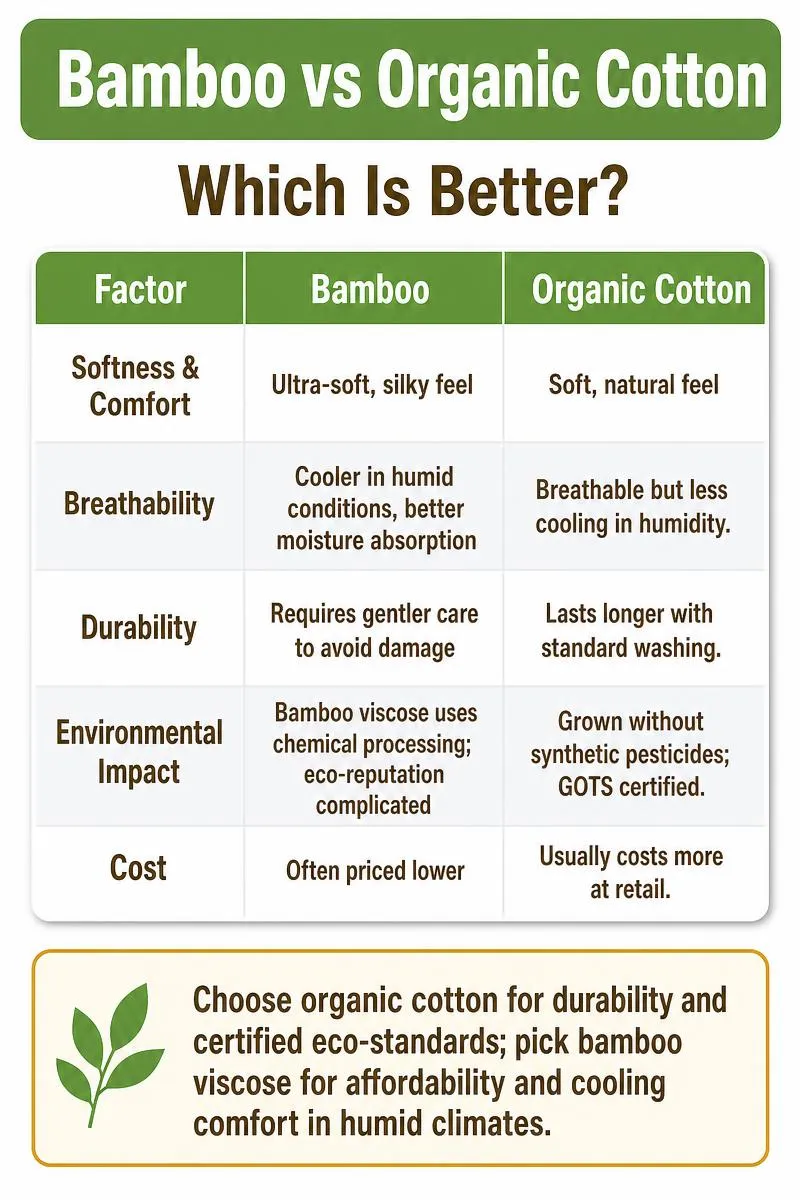
| Factor | Bamboo | Organic Cotton |
|---|---|---|
| Softness & Comfort | Ultra-soft, silky feel | Soft, natural feel |
| Breathability | Cooler in humid conditions | Breathable; less cooling in humidity |
| Durability | Requires gentler care | Lasts longer with standard washing |
| Environmental Impact | Viscose uses chemical processing | Grown without synthetic pesticides; GOTS certified |
| Cost | Often priced lower | Usually costs more at retail |
What Is Bamboo?
Bamboo is a fast-growing woody grass that requires no pesticides and minimal irrigation to cultivate. Raw bamboo stalks can’t be spun into yarn directly – the plant is too stiff and woody for that. Instead, the cellulose inside the stalk gets extracted and turned into fiber through one of two methods.
Mechanical processing crushes the bamboo and uses natural enzymes to break down the stalk into a workable fiber. This method preserves more of the plant’s original characteristics, including bamboo kun, a compound bamboo produces that has mild antibacterial properties. Mechanical bamboo fabric is rare and expensive because the process is labor-intensive and produces a coarser textile.
Chemical viscose processing is what nearly all bamboo fabric on the market actually goes through. The bamboo cellulose gets dissolved in chemical solvents – typically carbon disulfide and sodium hydroxide – then extruded through spinnerets to form regenerated cellulose fibers. This is essentially the same process used to make rayon from wood pulp.
The result is bamboo viscose: a soft, silky fabric with excellent drape and moisture absorption. Bamboo viscose appears in sheets, clothing, towels, and baby items. The fabric feels notably smooth against skin and absorbs moisture efficiently.
Downsides include the chemical intensity of viscose processing and the fact that bamboo viscose requires gentler laundering than cotton to maintain its texture and structure.
You Might Also Like
Best bamboo crib sheets on amazon
A buyer’s guide to top bamboo crib sheets that shows fabric performance and options when choosing between bamboo and…
What Is Organic Cotton?
Organic cotton is cotton grown without synthetic pesticides, synthetic fertilizers, or genetically modified seeds. Instead, organic cotton farming relies on crop rotation, compost, and biological pest control to maintain soil health and manage insects. The cotton fiber itself is harvested, ginned, spun, and woven using methods that closely parallel conventional cotton textile production.
Certification matters here. The Global Organic Textile Standard (GOTS) is the most widely recognized certification for organic cotton textiles. GOTS covers not just the farming practices but also the processing – restricting chemicals used in dyeing, finishing, and washing.
OEKO-TEX certification is another standard that tests finished textiles for harmful substance residues. Organic cotton shows up in sheets, towels, clothing, and baby products. The fabric has a familiar matte texture that most people recognize immediately.
Organic cotton handles standard machine washing and drying well, holds up over repeated laundering, and has an established track record for sensitive skin. The weaknesses of organic cotton are real, though. Cotton farming – even organic – uses significantly more water than bamboo cultivation.
Organic cotton is also less effective at wicking moisture away from the body compared to bamboo viscose. And organic cotton products typically cost more at retail than their bamboo counterparts.
Bamboo vs Organic Cotton: Softness and Comfort
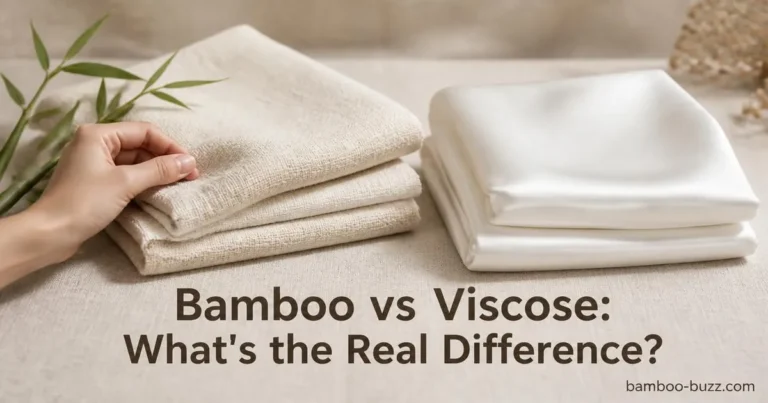
The gap is noticeable the first time you handle both fabrics side by side. Bamboo viscose has a silky, almost slick hand-feel that some people compare to a very high-thread-count sateen. The fibers are smooth and round in cross-section, which is what gives bamboo fabric its characteristic drape and fluid movement.
Fresh out of the package, bamboo sheets and clothing feel smooth and cool against skin. Organic cotton offers a softer version of what most people already expect from cotton. The texture is matte, slightly brushed, and familiar.
Organic cotton sheets feel substantial rather than slick – you get the sense of a fabric with body and structure rather than fluidity. After repeated washing, the texture of each material shifts in different directions. Bamboo viscose can lose some of its initial silkiness if washed in hot water or dried on high heat, developing a slightly rougher surface over time.
Organic cotton softens gradually with washing but maintains its fundamental character. The matte texture becomes gentler without changing dramatically. For sheets and everyday clothing, the comfort difference comes down to preference.
Bamboo feels silkier and cooler to the touch. Organic cotton feels familiar and substantial.
Bamboo vs Organic Cotton: Breathability and Temperature
Bamboo viscose absorbs moisture more efficiently than organic cotton. The fibers wick sweat away from the body and allow it to evaporate quickly, which helps the fabric feel cooler against skin. Some sources suggest bamboo fabric sleeps cooler than organic cotton, particularly in humid conditions where moisture management matters most.
Hot sleepers often notice the difference – bamboo sheets don’t trap heat the way heavier cotton can. Organic cotton breathes well on its own. The fiber structure allows air circulation, and cotton sheets don’t retain heat as much as synthetic materials.
But organic cotton holds less moisture than bamboo viscose, meaning it doesn’t wick sweat away as effectively.
In dry climates or moderate temperatures, organic cotton performs well. In humid conditions, cotton can feel damp against skin because it absorbs moisture without dispersing it as quickly as bamboo. For hot sleepers and people in humid climates, bamboo viscose generally offers better temperature regulation.
For cooler climates or sleepers who don’t overheat, organic cotton provides comfortable, reliable breathability without the slick texture of bamboo.
Also Worth Checking Out
A focused comparison of bamboo and cotton for baby products covering softness, breathability, and safety that…
Bamboo vs Organic Cotton: Durability and Care
Durability and care requirements differ significantly between bamboo and organic cotton. Organic cotton typically withstands standard laundering longer than bamboo viscose. You can machine wash organic cotton in warm water and tumble dry on medium heat without significant degradation.
Cotton fibers are structurally robust – they handle repeated washing, friction, and heat without losing much integrity. Organic cotton may shrink slightly on the first wash, but pre-shrinking is common in commercially produced textiles. Bamboo viscose requires cooler washes and gentler handling.
Hot water and high heat drying can weaken the regenerated cellulose fibers. Bamboo fabric is more prone to pilling than organic cotton, especially in high-friction areas like fitted sheet corners or underarm regions in shirts. For best results, wash bamboo viscose in cool or warm water and air dry or use low heat.
The expected lifespan of organic cotton bedding and clothing is generally longer than bamboo equivalents when both are cared for according to manufacturer instructions. Organic cotton can take years of regular washing and still maintain its texture and structure. Bamboo viscose, even with careful care, tends to show wear earlier – the fibers are simply more delicate than cotton’s.
If low-maintenance laundering matters to you, organic cotton is the clear winner. If you don’t mind cooler washes and air drying, bamboo’s softness and temperature regulation may justify the extra care.
Bamboo vs Organic Cotton: Environmental Impact
Comparing the environmental impact of bamboo and organic cotton requires looking at two separate stages: how the raw crop grows and how the crop becomes fabric. At the crop level, bamboo has clear advantages. Some bamboo species reach harvestable height within a single growing season.
Bamboo roots remain in the ground after harvest, preventing soil erosion and allowing rapid regrowth without replanting. Bamboo is also often cited as absorbing more carbon dioxide per acre than cotton. Organic cotton farming eliminates synthetic pesticides and fertilizers, which is a meaningful improvement over conventional cotton.
But cotton still requires substantial water inputs compared to bamboo. Organic cotton farming relies on rainfall in many regions, but irrigation is still common. At the fabric processing stage, the comparison reverses.
Most bamboo fabric goes through chemical viscose processing, which uses carbon disulfide and sodium hydroxide to dissolve bamboo cellulose. These chemicals can be recovered and reused in closed-loop systems, but not all manufacturers use closed-loop processing. The viscose process has been associated with worker health concerns and environmental pollution in regions where chemical recovery is poor.
Organic cotton processing, while still using water and energy, follows more transparent and regulated pathways. GOTS certification restricts chemicals used in processing, dyeing, and finishing. The supply chain for organic cotton is more traceable – certifications like GOTS and OEKO-TEX provide verifiable standards that bamboo viscose often lacks.
Organic cotton wins on supply chain transparency. Bamboo wins on raw crop sustainability. The environmental question depends on which stage of the lifecycle you weigh more heavily.
Bamboo vs Organic Cotton: Cost
Organic cotton usually costs more at retail – a set of organic cotton sheets typically carries a higher price tag than comparable bamboo viscose sheets. Several factors drive organic cotton’s higher price. Organic farming yields are generally lower than conventional cotton yields, meaning more land and labor produce less fiber per acre.
Certification costs add to the price at every stage of the supply chain. And organic cotton processing, with its restricted chemical list and monitoring requirements, costs more than standard textile manufacturing. Bamboo viscose is often the budget-friendlier option.
The viscose process is well-established and efficient at scale, which keeps production costs lower. Raw bamboo is abundant and fast-growing, so the input material is inexpensive. If budget is a primary concern and you want softness without paying the organic cotton premium, bamboo viscose offers good value.
If you’re willing to pay more for certification transparency and longer-lasting fabric, organic cotton justifies its higher price for many buyers.
Also Worth Checking Out
Bamboo vs cotton mattress protector
A direct comparison of bamboo and cotton mattress protectors addressing durability, care, and cost aspects useful for…
Which Should You Choose?
For hot sleepers and humid climates: Bamboo viscose is the better pick. The moisture-wicking properties and cooler hand-feel make a noticeable difference when temperature regulation is the priority. Just plan for gentler washing.
For babies and very sensitive skin: Certified organic cotton is the safer starting point. GOTS certification restricts chemical residues in finished fabric, and cotton’s long track record with sensitive skin gives you more certainty. Mechanical bamboo fabric would also work, but it’s hard to find and expensive.
For buyers prioritizing eco-certifications: Organic cotton wins. The GOTS and OEKO-TEX certifications provide verifiable supply chain standards. Bamboo viscose rarely carries comparable certifications, and the chemical processing stage is difficult to verify from the retail level.
For budget-conscious shoppers wanting softness: Bamboo viscose delivers silky texture at a lower price point than organic cotton. You trade some durability and certification transparency for the price savings.
For low-maintenance bedding that lasts: Organic cotton. Standard washing, standard drying, and a longer expected lifespan make organic cotton the practical choice when convenience and longevity matter.
FAQs About Bamboo and Organic Cotton
Is bamboo fabric really just rayon?
Mostly, yes. The vast majority of bamboo fabric on the market is bamboo viscose, which is a type of rayon made from bamboo cellulose rather than wood pulp. The Federal Trade Commission requires bamboo viscose to be labeled as ‘rayon made from bamboo’ rather than simply ‘bamboo fabric.’
Is bamboo clothing actually non-toxic?
It depends on the manufacturer. Bamboo viscose goes through chemical processing with solvents like carbon disulfide, but residues in the finished fabric are typically minimal. Look for OEKO-TEX certification if you’re concerned about chemical residues in the final product.
Which is healthier, cotton or bamboo?
Both are generally safe for skin contact. Organic cotton with GOTS certification has stricter controls on chemical residues. Bamboo viscose is smooth and less likely to irritate skin through friction, but the chemical processing makes some people cautious. For very sensitive skin or babies, certified organic cotton is the more conservative choice.
What are the downsides of bamboo fabric?
Bamboo viscose requires gentler washing, is more prone to pilling, and has a shorter expected lifespan than cotton. The chemical processing used to make most bamboo fabric raises environmental and transparency concerns. Bamboo fabric can also lose its silkiness with improper care.
Does bamboo give off microplastics?
No. Bamboo viscose is a regenerated cellulose fiber, not a synthetic polymer. It sheds natural cellulose fibers rather than microplastics. Organic cotton also sheds natural fibers during washing. Neither material contributes to microplastic pollution.
What is the least toxic fabric to wear?
Certified organic cotton with GOTS or OEKO-TEX certification is one of the least toxic options available, because the certifications restrict harmful chemicals at every stage from farming to finishing. Mechanically processed bamboo (not viscose) would also qualify, but it’s rare in retail products.
Why isn’t bamboo used more in clothing?
Bamboo viscose is actually used fairly widely, but it has limitations. The fabric is less durable than cotton, requires gentler care, and the chemical processing complicates its environmental marketing. These factors have kept bamboo from dominating the apparel market despite its softness and moisture-wicking performance.
Which is more eco-friendly, cotton or bamboo?
It depends on which stage you evaluate. Bamboo grows faster, needs less water, and requires no pesticides at the crop level. Organic cotton has more transparent and certified supply chains, avoids synthetic chemicals in farming, and uses more straightforward processing. Neither is perfect – bamboo’s chemical processing and cotton’s water use are both real environmental costs.
Final Thoughts
Neither material is perfect. Pick bamboo if you want silky softness and temperature regulation, but accept that most bamboo textiles are chemically processed viscose with limited certification transparency. Pick organic cotton if you want verifiable certifications, easy care, and a proven record for sensitive skin.
If you’re shopping for babies, start with GOTS-certified organic cotton unless the bamboo product uses mechanical processing – and the label says so explicitly. For everything else, weigh whether cooler sleep and lower cost outweigh bamboo’s care requirements, or whether organic cotton’s durability and transparency justify its higher price.
External References
- The Ongoing History of Harm Caused and Hidden by … – PMC – NIH (NCBI)
- Carbon Disulfide Toxicity – StatPearls – NCBI Bookshelf – NIH (NCBI)
- Resistance of natural bamboo fiber to microorganisms and … – NCSU (.edu)
- OEKO-TEX® STANDARD 100 – OEKO-TEX
- Global Standards – Global Standards – Voluntary … – Global-standard
- Recycling of Post-Consumer Cotton Waste – Sciepublish