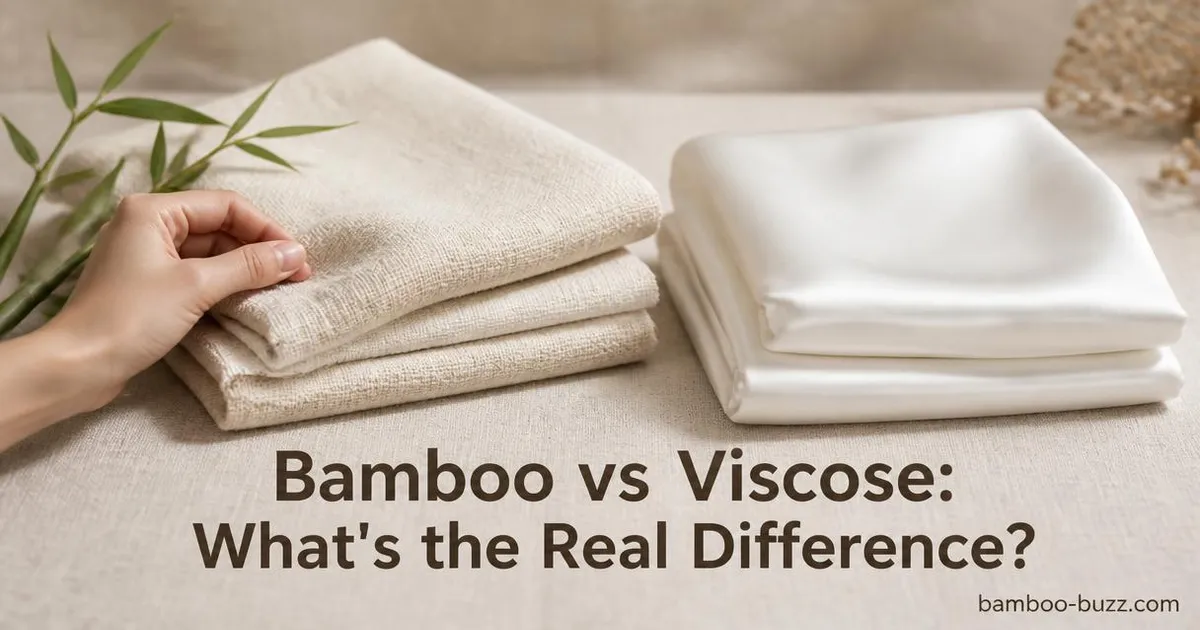
Bamboo vs Viscose: What’s the Real Difference?
Most products labeled ‘bamboo’ aren’t what you think they are. The soft sheets, the comfy shirts, the baby blankets – they’re almost all bamboo viscose, a semi-synthetic fiber made by dissolving bamboo pulp in chemical solvents. Natural bamboo fabric, the kind mechanically processed straight from bamboo stalks, makes up a tiny fraction of what’s on the market.
So when you’re comparing bamboo vs viscose, you’re really comparing two completely different manufacturing processes that happen to start from the same plant. The choice between them comes down to processing transparency, chemical exposure, environmental priorities, and budget.
Key Takeaways
- Most products labeled ‘bamboo’ are actually bamboo viscose – a semi-synthetic fiber made with chemical processing, not natural bamboo fabric.
- Natural bamboo fabric is mechanically processed, rarer, and typically more expensive than viscose.
- Conventional bamboo viscose production raises concerns about toxic chemical use and environmental waste.
- Checking fabric labels for ‘rayon’ or ‘viscose from bamboo’ is the only reliable way to know what material you’re actually buying.
- Your choice should depend on whether you prioritize chemical-free processing, softness, budget, or availability.
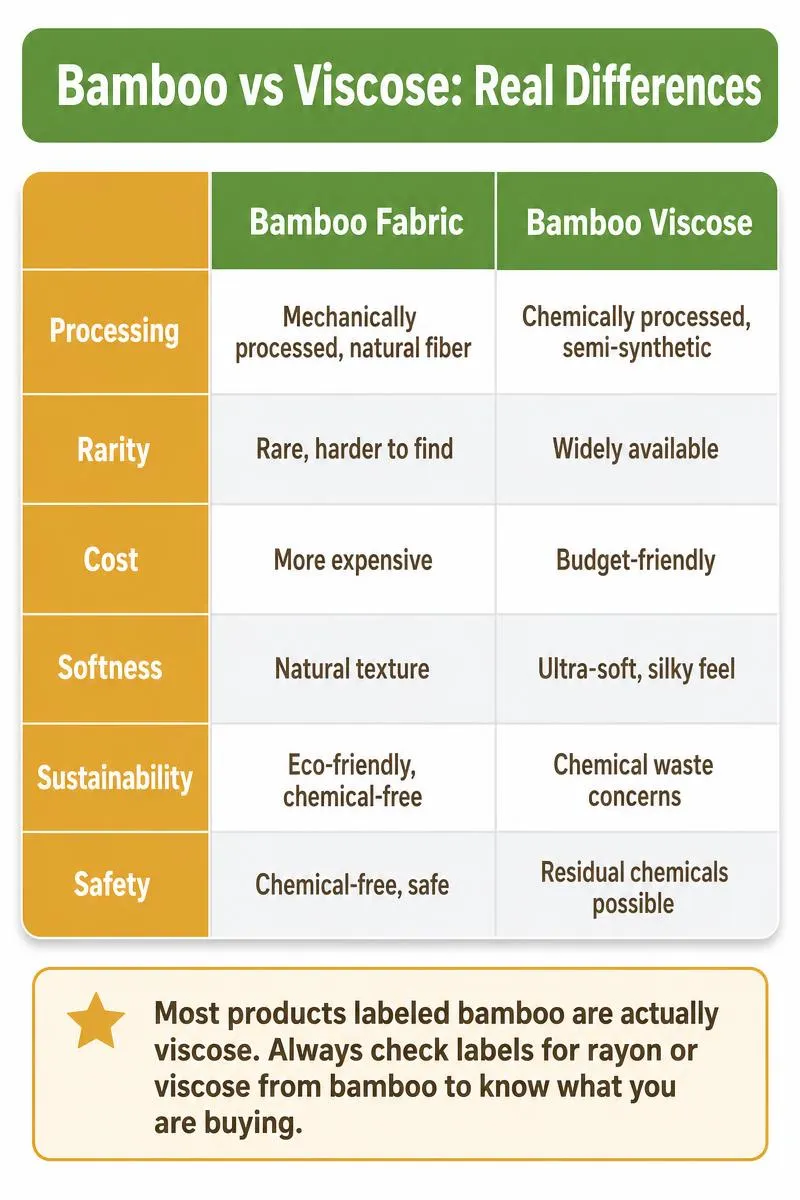
Bamboo Vs Viscose Quick Comparison
| Feature | Bamboo Fabric | Bamboo Viscose |
|---|---|---|
| Processing | Mechanically processed, natural | Chemically processed, semi-synthetic |
| Rarity | Rare, harder to find | Widely available |
| Cost | More expensive | Budget-friendly |
| Softness | Natural texture | Ultra-soft, silky feel |
| Sustainability | Eco-friendly, chemical-free | Chemical waste concerns |
| Safety | Chemical-free, safe | Residual chemicals possible |
What Is Bamboo Fabric?
Natural bamboo fabric is a textile made from bamboo bast fiber, the fibrous material inside bamboo stalks. The fiber is separated by mechanical crushing and combing, without dissolving the plant in chemical solvents. This process keeps the fiber close to its raw state.
For consumers seeking minimally processed textiles, natural bamboo fabric is the closest thing to wearing the plant itself. It avoids the harsh chemical solvents used in viscose production, and it biodegrades because the fiber hasn’t been chemically altered.
The tradeoff is availability and texture. Natural bamboo fabric is hard to find, commands a premium price, and tends to feel coarser than viscose alternatives. If you’ve felt something labeled ‘bamboo’ and it was silky-soft, that was almost certainly viscose, not bast fiber.
Explore More
A focused comparison of bamboo and satin sheets covering feel, breathability, and which sleepers each suits best.
What Is Bamboo Viscose?
Bamboo viscose is a semi-synthetic fabric created by dissolving bamboo pulp in chemical solvents and then extruding the resulting liquid into fibers. The process is the same one used to make rayon – the bamboo is simply the cellulose source instead of wood pulp.
This is what makes bamboo viscose so popular for soft bedding, clothing, and textiles where drape and a silk-like feel matter. It’s widely available, significantly less expensive than natural bamboo fabric, and breathable against the skin.
Conventional viscose production relies on carbon disulfide and sodium hydroxide, solvents that can harm workers and create toxic wastewater. On top of that, bamboo viscose is frequently mislabeled as ‘pure bamboo’ or ‘natural bamboo’, which obscures what you’re actually buying.
Bamboo Fabric vs Bamboo Viscose: How They’re Made
Natural bamboo fabric is made through bast fiber extraction. Workers crush bamboo stalks, scrape away the woody outer layer, and comb out the fibrous inner material. No solvents, no chemical baths. The result is a fiber that retains the structure of the original plant.
Bamboo viscose takes a different path entirely. The bamboo is broken down into pulp and dissolved in the same solvent bath to create a thick liquid. That liquid is forced through spinnerets to form fibers, which are then washed and spun into yarn. The bamboo’s original fiber structure is gone; what remains is regenerated cellulose.
Regulators have taken notice of the labeling gap. The U.S. Federal Trade Commission has warned brands against marketing viscose products as ‘bamboo’ without qualifying the term, requiring labels to say ‘rayon from bamboo’ or ‘viscose from bamboo’ instead. If a product just says ‘bamboo’ with no mention of rayon or viscose, that label may not be compliant.
Bamboo Fabric vs Bamboo Viscose: Sustainability
Natural bamboo fabric has the edge on chemical impact because it skips solvents entirely. No solvents, no toxic wastewater stream.
Bamboo viscose is more complicated. The chemical process generates waste, and conventional viscose production has been linked to water pollution near manufacturing sites. Viscose production also requires water for pulping and washing, while bast fiber separation is labor-driven rather than water-driven.
That said, some producers use closed-loop viscose processing, which recaptures and reuses solvents to reduce chemical discharge. Responsible viscose can narrow the sustainability gap, but only if the producer actually follows through.
Misleading eco-claims are common on bamboo bedding and clothing labels. A product labeled ‘green bamboo’ or ‘eco-bamboo’ tells you nothing about how the fiber was processed. To identify responsibly made viscose, look for certifications like OEKO-TEX or producer transparency about closed-loop manufacturing. Without that, the eco-claim is marketing, not information.
Related Reading
An in-depth look at weave, durability, and care differences between bamboo and sateen sheet options.
Bamboo Fabric vs Bamboo Viscose: Safety and Wearability
Natural bamboo fabric wins on chemical exposure: the mechanical process never uses carbon disulfide, so no solvent residue remains on the finished fabric.
Bamboo viscose raises concerns about residual solvent traces left in the finished fabric. Some sources suggest that responsible viscose brands reduce this risk through thorough washing and certification standards, but conventional viscose from unclear supply chains doesn’t offer that assurance. For people with sensitive skin or for baby products, the question of chemical residue becomes more pressing. When buying baby products, look for OEKO-TEX certification or documented closed-loop processing to reduce solvent exposure risk.
Bamboo viscose does not contain microplastics because it’s made from cellulose, not petroleum. But it is still a semi-synthetic fiber: the cellulose has been chemically dissolved and regenerated. That puts it somewhere between natural fibers like cotton and fully synthetic fibers like polyester, and the distinction matters if you’re trying to avoid processed materials.
Bamboo Fabric vs Bamboo Viscose: Cost and Availability
Bamboo viscose wins on both affordability and market presence. The chemical extrusion process scales well, which keeps costs down and makes viscose products easy to find in most bedding and clothing retailers.
Natural bamboo fabric is rare because the mechanical processing is labor-intensive and low-yield. Separating bast fiber from bamboo stalks produces less usable fiber per plant than dissolving the entire stalk into pulp. That scarcity drives the price up, and most consumers never encounter natural bamboo fabric unless they specifically seek it out.
Most budget-friendly products labeled ‘bamboo’ are viscose.
Which Should You Choose?
- If you want a textile with minimal processing and no chemical solvents, choose natural bamboo fabric. You’ll pay more and search harder.
- If you need soft, affordable bedding or clothing that’s easy to find, choose bamboo viscose.
- If you’re buying for a baby or have sensitive skin, prioritize natural bamboo fabric or verify that the viscose product comes from a producer with documented closed-loop processing and OEKO-TEX certification.
- If you want to avoid semi-synthetics and misleading green labels, look for transparently sourced bamboo bast fiber. The label should say ‘bamboo linen’ or describe mechanical processing – not just ‘bamboo.’
- If softness and drape are your priority and you accept that the product is semi-synthetic, bamboo viscose is the practical choice. Just know what you’re buying.
You Might Also Like
Best bamboo nightgowns on amazon
A curated list of top bamboo nightgowns (many made from viscose blends) for readers considering wearable bamboo fabrics.
FAQs About Bamboo Fabric and Bamboo Viscose
What exactly is bamboo viscose?
Bamboo viscose is a semi-synthetic fiber made by dissolving bamboo pulp in chemical solvents and extruding the liquid into threads. It’s essentially rayon made from bamboo instead of wood pulp.
Is bamboo viscose a natural or synthetic fabric?
Neither fully. Bamboo viscose is a semi-synthetic fiber – the cellulose comes from a natural source, but the chemical dissolution and regeneration process makes it processed rather than natural. It’s closer to rayon than to cotton or linen.
How are natural bamboo fabric and bamboo viscose made differently?
Natural bamboo fabric is made by mechanically crushing and combing bamboo stalks to extract bast fiber, with no solvents. Bamboo viscose is made by chemically dissolving bamboo pulp into a liquid and extruding it into fibers. One skips chemicals; the other depends on them.
Is bamboo viscose environmentally friendly?
Conventional bamboo viscose production generates chemical waste and has been linked to water pollution. Some producers use closed-loop processing to recapture solvents, which reduces environmental impact. Without transparency about the manufacturing method, the eco-claim doesn’t hold up.
Is bamboo viscose toxic or unsafe for babies?
Residual chemical solvents from conventional viscose production are the main concern. Some sources suggest that certified viscose products with thorough washing reduce this risk. For baby products, look for OEKO-TEX certification or choose natural bamboo fabric to avoid the question entirely.
Does bamboo viscose contain microplastics?
No. Bamboo viscose is made from plant cellulose, not petroleum, so it doesn’t shed microplastics. It is still a semi-synthetic fiber because the cellulose is chemically dissolved and regenerated during manufacturing.
What are the disadvantages of bamboo fabric and viscose?
Natural bamboo fabric is hard to find, expensive, and coarser than viscose. Bamboo viscose involves chemical processing that can harm workers and the environment, and it’s frequently mislabeled as pure bamboo.
Is viscose a bad fabric?
Not inherently. Viscose is a soft, breathable, affordable fiber that works well for bedding and clothing. The concerns are about how it’s made, not the finished fabric itself: chemical solvents, wastewater, and labeling transparency. Responsibly produced viscose with certification can reduce those concerns.
Final Verdict
Natural bamboo fabric is the pick if you prioritize chemical-free processing and have the budget for a rare textile. Bamboo viscose is the pick if you want soft, accessible bedding and you’re fine with a semi-synthetic product.
If you’re after responsibly made options, verify labels and avoid products marketed as pure bamboo when they’re actually viscose. Read the fabric tag and look for ‘rayon’ or ‘viscose from bamboo’ – that’s the only reliable way to know what you’re actually buying.
External References
- Bamboo Textiles | Federal Trade Commission – FTC
- Bamboo Viscose 101: Is it an Eco-Friendly & Sustainable … – Theecohub
- Antimicrobial Properties of Bamboo Fibres – Biomedres
- OEKO-TEX® STANDARD 100 – OEKO-TEX
- Viscose from organically grown bamboo | Oasis – Oasis – Oasishealth
- Replacing Plastic with Bamboo: A Review of the Properties … – NIH (NCBI)