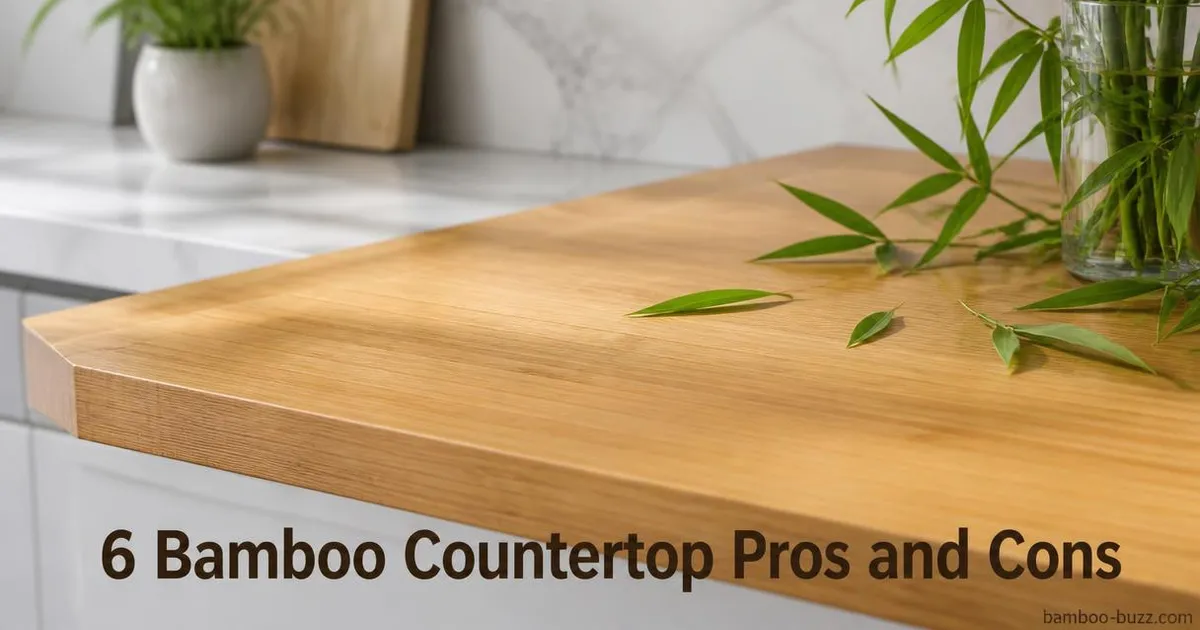
6 Bamboo Countertop Pros and Cons
Bamboo regrows from the same root system after harvest, making it one of the most renewable countertop materials you can put in a kitchen. But as a surface, bamboo scratches easier than granite, warps under prolonged moisture, and needs resealing far more often than granite or quartz.
So do bamboo countertops fit your kitchen? That depends on how much you cook, how often you’re willing to reseal, and whether the visible grain of bamboo suits your space. Six tradeoffs – sustainability, durability, appearance, maintenance, heat and scratch sensitivity, and cost – frame the decision.
Key Takeaways
- Bamboo countertops suit homeowners who prioritize sustainability and accept regular sealing and some durability compromises.
- Cost ranks among the top drawbacks – shoppers typically weigh bamboo prices against wood, quartz, and granite.
- Heat and moisture demand consistent trivet use and sealing; bamboo warps and scorches more readily than granite or quartz.
- Vertical, flat, end, and strand-woven grains each produce a different look and perform differently under daily use.
- Compared to wood, quartz, and granite, bamboo wins on renewability but loses on scratch resistance.
- Some sources suggest color and edge options remain narrower than what stone or engineered surfaces offer.
Related Reading
Pros and cons of bamboo decking
A practical look at pros and cons of bamboo decking that highlights durability and finishing issues readers can apply…
Comparing the Top Bamboo Countertops Pros And Cons
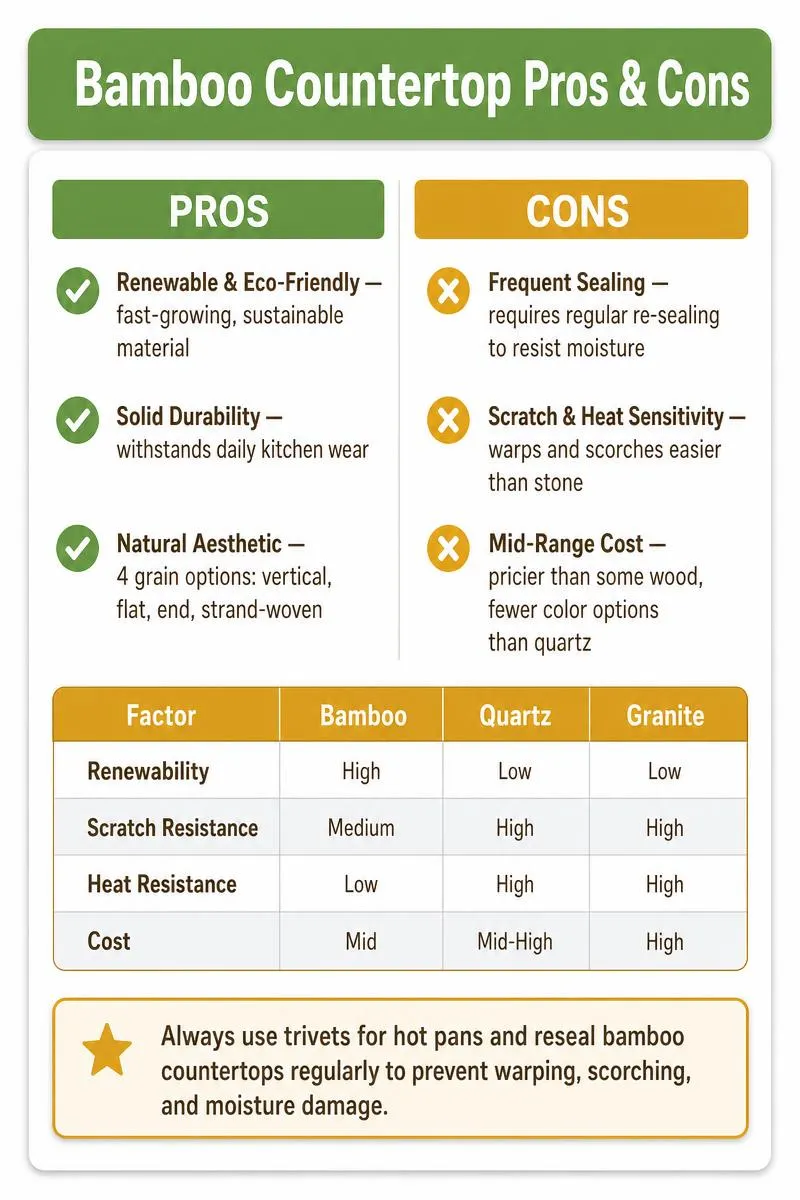
| Factor | Bamboo | Quartz | Granite |
|---|---|---|---|
| Renewability | High | Low | Low |
| Scratch Resistance | Medium | High | High |
| Heat Resistance | Low | High | High |
| Cost | Mid | Mid-High | High |
6 Pros and Cons of Bamboo Countertops
The sustainability case for bamboo is strong; the durability case is mixed – six tradeoffs decide whether it fits your kitchen.
1. Renewable and Eco-Friendly Material
Bamboo reaches harvest maturity in a fraction of the time that hardwoods need. After cutting, the same root system sends up new shoots, so the soil doesn’t need replanting. That regrowth cycle is the core sustainability argument for bamboo countertops.
Bamboo also grows without the pesticides and heavy irrigation that conventional timber plantations rely on. The plant sequesters carbon as it grows, and the root network holds soil in place against erosion.
The manufacturing side is less clean-cut. Converting bamboo stalks into countertop panels involves adhesives and resins that bind the fibers together.
Some manufacturers use formaldehyde-based glues; others have switched to low-emission or soy-based alternatives. If indoor air quality matters to you, ask the supplier what bonding agent their panels use.
2. Solid Durability for Daily Kitchen Use
Bamboo countertops hold up reasonably well under normal kitchen activity – setting down plates, wiping up spills, occasional chopping. Strand-woven bamboo, the densest grain option, resists denting better than flat or vertical cuts.
But bamboo is still a grass, not stone. Bamboo won’t match granite or quartz for sheer surface hardness. Dropping a heavy cast-iron pan can dent or crack a bamboo counter where granite would shrug off the impact.
Durability also depends heavily on how well the countertop is sealed. Unsealed or poorly sealed bamboo absorbs moisture at the joints and edges, which leads to swelling or splitting over time.
A properly sealed and maintained bamboo surface can serve a kitchen well for years. Skip the sealing and the same material degrades faster than you’d expect.
3. Natural Aesthetic and Grain Variety
Bamboo gives a kitchen an organic look that stone and engineered surfaces can’t replicate. The natural color lands in a honey or blonde tone, and a carbonized finish – heat-treated bamboo – deepens to a caramel or amber shade.
Flat grain shows wide growth rings, vertical grain narrow striping, end grain a butcher-block checkering, and strand-woven a tropical-hardwood look. But compared to stone or engineered quartz, some sources suggest bamboo’s color palette stays limited – you’re working within the range of honey and amber tones rather than cool grays, whites, or deep blacks.
4. Maintenance and Sealing Requirements
Bamboo countertops need sealing – not occasionally, but on a regular schedule. Food-grade mineral oil or a specialized bamboo sealer should be applied every few months, depending on how much use the surface gets. The sealant fills the pores and creates a barrier against moisture and stains.
Spills should be wiped promptly – letting water or acidic liquids sit gives them time to penetrate the finish and reach the bamboo fibers. Avoid abrasive cleaners, scouring pads, or anything that strips the sealant.
The edges and joints need particular attention during sealing. Water finds seams faster than the flat, sealed surface. If your bamboo countertop surrounds a sink, the area around the cutout is the most vulnerable spot for moisture damage.
5. Scratch and Heat Sensitivity
Bamboo scratches more easily than granite or quartz. Using the countertop as a cutting surface will leave marks – the knife blade cuts into the bamboo fibers rather than sliding off a hard stone surface. A cutting board isn’t optional with bamboo if you want to preserve the finish.
Heat is the other vulnerability. Setting a hot pan directly on bamboo can scorch the surface, discolor the finish, or cause the fibers to expand and split – even brief contact leaves a permanent mark. Trivets and hot pads need to be part of your kitchen routine.
Sunlight exposure can also fade bamboo over time, so a countertop near a south-facing window may gradually lighten unless you use window coverings or UV-filtering film.
6. Mid-Range Cost Compared to Alternatives
Bamboo countertops fall into a mid-range price bracket. Bamboo typically costs more than basic laminate but less than premium granite or quartz. Within the wood-countertop category, bamboo often prices comparably to or slightly below maple or oak butcher block, depending on the grain style.
Strand-woven bamboo tends to cost more than flat or vertical grain because its manufacturing adds steps beyond cutting and laying strips. The total price depends on grain orientation, finish, edge profiling, and installation complexity. Custom cuts for sinks, corners, or unusual layouts add to the total.
Bamboo Countertop Styles and Grain Options
Each grain orientation changes both how the countertop looks and how the surface holds up. Here’s how the four main options compare.
Flat Grain shows the broadest, most visible growth-ring pattern. The stalk is split lengthwise and laid flat, exposing the widest face of the fiber bundles.
Flat grain has a casual, layered look but tends to be the most susceptible to surface scratching and moisture penetration because the wider grain exposes more open fiber.
Vertical Grain orients the bamboo strips on edge, creating narrow, parallel lines that read as more uniform and contemporary. The tighter grain pattern hides minor scratches better than flat grain.
Vertical grain also resists moisture slightly better because the exposed surface has fewer open fibers.
End Grain cuts the bamboo into blocks and stands the blocks on end, exposing the cross-section of the fibers. This orientation creates a butcher-block appearance and is the traditional choice for cutting surfaces because the fibers self-heal around knife marks.
End grain absorbs more oil during sealing, which means more frequent maintenance but also a richer, deeper color over time.
Strand-Woven bamboo is made by shredding bamboo fibers, mixing the fibers with adhesive, and compressing the mixture under heat and pressure. The result is the hardest and densest bamboo countertop option available.
Strand-woven bamboo resists scratching, denting, and moisture better than the other three grain styles, and the pattern looks less like traditional bamboo and more like a variegated hardwood.
Bamboo Countertops vs. Other Materials
Bamboo trades the durability of stone for renewability and a more inviting look – here’s how it stacks up against wood, quartz, and granite.
Bamboo vs. Wood – wood shares the most similarities with bamboo among countertop options. Both are organic, both share similar tones, and both require sealing.
Bamboo grows far faster than the hardwoods used for countertops – maple, oak, and walnut – making bamboo the more renewable choice. Wood butcher block generally offers similar scratch resistance, though strand-woven bamboo can be harder than some hardwoods.
Both materials need oiling and both can scorch under hot cookware. Properly maintained, wood and bamboo hold up for comparable lengths of time.
Bamboo vs. Quartz – Quartz is an engineered surface made from crushed stone bound with resin. Quartz requires no sealing, resists scratches better than bamboo, and handles heat more reliably.
Bamboo beats quartz on renewability and visual character. Quartz beats bamboo on maintenance and longevity: wipe the surface down, done – no oiling, no resealing, no worrying about standing water.
Bamboo vs. Granite – Granite is a natural stone, harder and more heat-resistant than any bamboo option. You can set a hot pan on granite without damage, though fabricators often still recommend a trivet.
Granite needs sealing too, but less frequently than bamboo. Granite resists scratches from knives and daily wear far better than bamboo.
Where bamboo wins: renewability and weight. Granite mining is energy-intensive, and granite slabs are heavy – some installations need reinforced cabinetry to support them. Bamboo is lighter and easier to install.
You Might Also Like
A side-by-side comparison of bamboo and engineered hardwood covering strength, moisture resistance, and cost trade-offs…
Care and Maintenance for Bamboo Countertops
Keeping bamboo countertops in good shape comes down to three habits: wipe spills quickly, oil on schedule, and always use trivets.
Daily Cleaning starts with a damp cloth and mild dish soap. Don’t use abrasive powders, scouring pads, or vinegar-based cleaners – the acid and abrasiveness break down the sealant and expose the bamboo fibers. Dry the surface after wiping rather than letting water evaporate on its own.
Ongoing Sealing begins with watching the surface – whenever the countertop starts to look dry or faded, it’s time to reseal. Spread food-grade mineral oil or a bamboo-specific sealer evenly, let the oil absorb, then wipe off any excess.
The first few sealing cycles are the most important – a well-saturated surface from the start builds better long-term resistance to moisture. Pay extra attention to edges, seams, and the area around sink cutouts.
Water accumulates in these spots and penetrates faster than on flat surfaces. If the sealant around the sink begins wearing thin, reseal that area even if the rest of the counter still looks fine.
Heat and Scratch Protection keeps bamboo from scorching and marking. Keep trivets or hot pads within arm reach of the stove and oven – every hot pan goes on a trivet.
Use cutting boards for all food prep; a bamboo countertop is not a cutting surface, even though end-grain bamboo can handle some knife contact. Scratches add up over time, and repairing a scratched bamboo surface means sanding and refinishing the affected area.
FAQs About Bamboo Countertops
Is bamboo good for kitchen countertops?
Yes, with caveats. Bamboo works well in kitchens where the cook uses trivets, cutting boards, and keeps up with sealing.
If you routinely set hot pans on the counter or want a surface you can ignore for years, stone or quartz fits better.
What are the drawbacks of using bamboo countertops?
The main drawbacks are scratch and heat sensitivity, required sealing every few months, and a narrower range of colors compared to stone or quartz. Bamboo also warps or splits if moisture penetrates the seal – especially around sinks and edges.
Are bamboo countertops expensive?
Bamboo falls in a mid-range bracket – more than laminate, less than premium granite or quartz. Strand-woven bamboo costs more than flat or vertical grain due to the extra manufacturing steps involved in compressing the fibers.
What is the healthiest kitchen countertop material?
Non-porous materials like quartz and stainless steel are generally considered the healthiest because these surfaces don’t harbor bacteria and require no chemical sealants. Bamboo’s health profile depends on the adhesives used in manufacturing – low-emission or soy-based glues are preferable to formaldehyde-based binders.
What is the number one selling countertop?
Quartz has become the top-selling countertop material in recent years, overtaking granite. Quartz’s appeal is low maintenance – no sealing, strong scratch resistance, and wide color availability – which is exactly where bamboo falls short.
Explore More
A comparison of bamboo and laminate that explains scratch resistance, water resistance, and maintenance-useful when…
Final Thoughts
Bamboo countertops make sense if you want a renewable material with visible grain and natural character, and you’re willing to seal bamboo regularly and treat the surface with care. If you need a surface that shrugs off heat, scratches, and neglect, go with stone or quartz instead.
The next step: order samples of each grain style – flat, vertical, end, and strand-woven – or visit a showroom to see the grains in person. Photos don’t capture the difference in texture and pattern between grain orientations, and that difference determines whether bamboo looks right in your kitchen.
External References
- Industrial, Carbon Sequestration and Climate Change … – ACADEMIA (.edu)
- The Potential of Bamboo is Constrained by Outmoded Policy … – NIH (NCBI)
- FDA Food Code 2022: Full Document – FDA
- Improving properties of particleboards with reduced density – NCSU (.edu)
- What should I know about formaldehyde and indoor air … – EPA