12 Bamboo Fabric Pros and Cons
Bamboo fabric gets a lot of praise for feeling like silk and a lot of criticism for how it’s actually made. Both are partly right. Most bamboo fabric on the market is bamboo viscose – chemically processed cellulose that shares more with rayon than with the raw bamboo plant. A much smaller share is mechanically processed bamboo linen, which is pricier and harder to find.
The honest answer is that bamboo fabric is worth it for some uses and not others. If you want soft, breathable sleepwear or bedding and you’re willing to hand-wash or machine-wash on gentle, the comfort is real. If you need something that holds up to heavy wear or you want strict environmental transparency, you’ll need to look closely at the label.
Here are 12 specific pros and cons.
Key Takeaways
- Bamboo fabric is soft, breathable, and often recommended for sensitive skin, but it’s generally less durable than synthetics and requires careful washing.
- Most bamboo fabric sold today is chemically processed bamboo viscose; mechanically processed bamboo linen is much rarer and typically more expensive.
- Expect to pay more than standard cotton, with tradeoffs in longevity and ease of care.
- If environmental impact is your top priority, check the label for specific processing methods rather than assuming all bamboo fabric is equally sustainable.
Related Reading
A clear breakdown of rayon vs viscose terminology and processing so readers can better understand labels they see on…
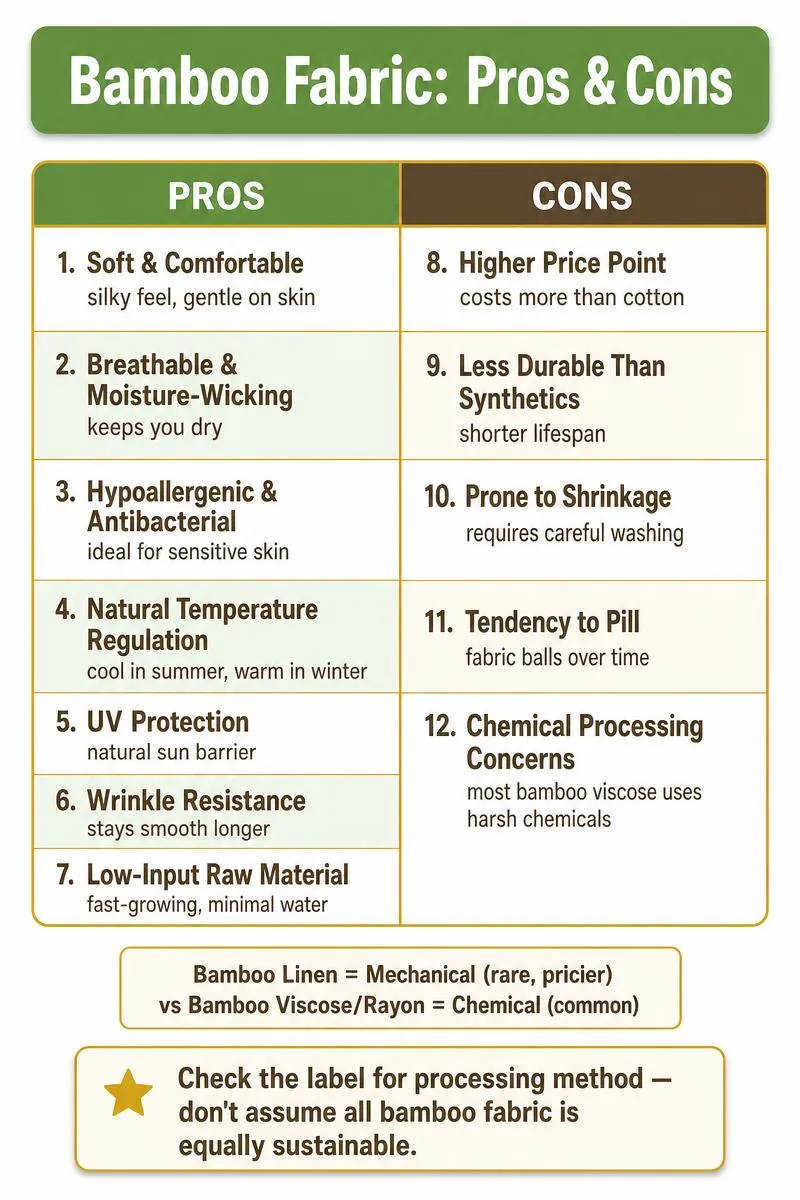
Bamboo Fabric Pros And Cons Side-by-Side
| Pros | Cons |
|---|---|
| Soft & comfortable (silky feel) | Higher price point |
| Breathable & moisture-wicking | Less durable than synthetics |
| Hypoallergenic & antibacterial | Prone to shrinkage |
| Natural temperature regulation | Tendency to pill |
| UV protection | Chemical processing concerns |
| Wrinkle resistance | |
| Low-input raw material |
12 Pros and Cons of Bamboo Fabric
The first seven cover what bamboo does well; the last five are the tradeoffs that come with it.
1. Soft and Comfortable
Bamboo viscose has a smooth, round cross-section at the fiber level, which gives the finished fabric a hand feel often compared to silk or cashmere. The fibers slide against skin rather than scratching, so the fabric drapes closely without clinging.
This matters most for sleepwear and base layers – anything worn directly against the body for hours. If you’ve tried bamboo sheets or a bamboo tee, the softness is usually the first thing you notice.
2. Breathable and Moisture-Wicking
Bamboo viscose fibers absorb moisture into their interior rather than letting it pool on the surface, which helps the fabric feel dry against skin even when you sweat. The fiber structure also allows air to pass through more freely than denser weaves.
Hot sleepers, activewear, and anyone in humid climates get the most benefit here.
3. Hypoallergenic and Antibacterial Properties
Bamboo produces a compound called bamboo kun that has mild antibacterial properties. Some sources suggest that bamboo fabric reduces bacterial growth and skin irritation, though much of the bamboo kun may not survive chemical processing.
This is most relevant for sensitive skin, allergies, and baby clothing. If antibacterial performance is your main reason for choosing bamboo, look for mechanically processed bamboo linen – it retains more of the plant’s original compounds.
4. Natural Temperature Regulation
Bamboo viscose breathes well in warm conditions and retains enough body heat in cool conditions to work across seasons. In practice, the fabric feels cooler when you’re warm and warm enough when the room drops.
Year-round bedding and temperature-sensitive sleepers benefit most. You won’t need separate summer and winter sheets if you choose bamboo bedding, though the effect is moderate, not dramatic.
5. UV Protection
Bamboo fabric is often claimed to block some UV light, meaning the fibers absorb a portion of ultraviolet light before it reaches skin. The level of protection depends on fabric weight and weave density, so a thin bamboo tee won’t perform like a tightly woven bamboo jacket.
Outdoor and summer apparel are where this counts. If UV protection is a priority, look for bamboo garments with a stated UPF rating rather than assuming the raw fiber provides enough on its own.
6. Wrinkle Resistance
Bamboo viscose drapes smoothly and resists creasing better than cotton, which tends to hold fold lines. The fiber’s flexibility lets the fabric fall back into shape after compression, so packed bamboo garments come out with fewer hard wrinkles.
Travel clothes and low-maintenance wardrobes benefit from this. You’ll still get some creasing if a garment sits folded for a long time, but the creases release more easily than cotton’s.
7. Low-Input Raw Material
Bamboo grows fast, regrows from the same root system after harvesting (no replanting), and needs minimal water and no pesticides. It needs far less water than conventional cotton farming.
Eco-conscious buyers get genuine benefits at the crop level. But the fabric processing – usually chemical solvents to make viscose – changes the final environmental footprint significantly. The raw material is low-input; the finished fabric may not be.
8. Higher Price Point
Bamboo fabric costs more to produce than standard cotton because the processing requires additional steps to break down the bamboo stalk into a spinnable fiber. Retail prices reflect that, so bamboo garments and bedding typically sit above comparable cotton products.
Budget-conscious shoppers should weigh this against the comfort and breathability gains. If you’re buying bamboo sheets, expect to pay a premium over basic cotton sets.
9. Less Durable Than Synthetic Fabrics
Bamboo viscose fibers are weaker than polyester and nylon, especially when wet. The chemical processing that turns bamboo pulp into fiber shortens the polymer chains, which reduces tensile strength compared to synthetic alternatives.
Heavy-use or high-abrasion applications – gym bags, workwear, anything that rubs against rough surfaces – will wear through bamboo fabric faster than synthetics. For light daily wear and bedding, the strength difference is less noticeable.
10. Prone to Shrinkage
Bamboo viscose shrinks when exposed to heat, particularly in hot wash cycles and dryer settings. The fibers contract under high temperatures, and the shrinkage can be permanent if the fabric goes through a hot dryer.
Buyers who want easy-care garments should know that bamboo requires cold washing and air drying or low-heat drying. If you’d rather throw everything in a hot wash and tumble dry on high, bamboo fabric will frustrate you.
11. Tendency to Pill
Bamboo viscose pills over time as short fibers work loose and tangle into small balls on the fabric surface. Friction accelerates pilling, so areas that rub against other fabric or skin – underarms, sheet edges, the inside of a jacket sleeve – show it first.
Daily-wear items and bedding are most affected. Pilling doesn’t affect performance, but it changes the texture and appearance over time.
12. Chemical Processing Concerns
Most bamboo fabric is bamboo viscose (also called bamboo rayon), made by dissolving bamboo pulp in chemical solvents like sodium hydroxide and carbon disulfide, then extruding the solution into fibers. The process is effective but raises concerns about chemical waste and worker exposure, depending on the factory’s practices.
Sustainability-focused buyers and anyone concerned about processing transparency should ask where the fabric came from. Closed-loop processing, which recovers and reuses solvents, reduces the environmental impact, but not all manufacturers use it.
How Bamboo Fabric Is Made and Why the Process Matters
Bamboo fabric comes from one of two processes, and the difference changes both the texture and the environmental profile.
Mechanical Processing: Bamboo Linen
Mechanical processing crushes bamboo stalks and uses natural enzymes to break down the fibers, which are then combed and spun into yarn. The result is bamboo linen – a coarser, stronger fabric that retains more of the plant’s original characteristics, including more of the bamboo kun compound.
Bamboo linen is rare because the process is labor-intensive and expensive. You’ll find it mostly from small producers and at higher prices.
Chemical Processing: Bamboo Viscose and Rayon
Chemical processing dissolves bamboo cellulose in solvents to create a spinnable fiber, which is the same method used to produce conventional rayon. The result is bamboo viscose – soft, draping, and affordable, but with fewer of the plant’s original compounds than bamboo linen keeps.
What to Look for on Labels
Check the label for specific terms: bamboo viscose, bamboo rayon, bamboo lyocell, or mechanically processed bamboo. Bamboo lyocell uses a closed-loop process that recovers and reuses its solvent, making it the most transparent of the chemical methods. Mechanically processed bamboo linen is the most natural but hardest to find.
If a label just says ‘bamboo’ without specifying the process, assume it’s viscose.
Related Reading
A focused comparison of viscose and modal from bamboo that highlights feel and durability details related to several…
Bamboo Fabric vs Cotton
Bamboo fabric and cotton overlap in softness and breathability but diverge in durability, cost, and care.
- Softness: Bamboo viscose is softer than standard cotton and comparable to high-end cotton sateen. Cotton gets softer with washing; bamboo viscose starts soft and stays soft but may pill over time.
- Breathability: Both fabrics breathe, but bamboo viscose absorbs moisture faster, which makes it feel drier in humid conditions. Cotton holds moisture longer, which can feel clammy in high humidity.
- Durability: Cotton fibers are stronger than bamboo viscose fibers, especially when wet. Cotton holds up better to repeated hot washing and drying, while bamboo fabric weakens with heat and abrasion.
- Cost: Bamboo fabric typically costs more than comparable cotton items. The processing adds expense that cotton doesn’t have.
- Care: Cotton tolerates hot water and machine drying. Bamboo viscose needs cold water and low-heat or air drying to avoid shrinkage and fiber damage.
- Where each wins: Cotton wins for heavy-use items, easy-care wardrobes, and budget. Bamboo wins for sleepwear, bedding, sensitive skin, and humid climates where moisture-wicking matters more than durability.
Keep Reading
A side-by-side comparison covering breathability, sustainability, and care to help readers weighing bamboo fabric…
FAQs About Bamboo Fabric
What is bamboo fabric made of, and is it really just rayon?
Most bamboo fabric is bamboo viscose, which is a type of rayon made from bamboo cellulose instead of wood pulp. The process is the same as conventional rayon – the difference is the source material. Mechanically processed bamboo linen is a separate product that doesn’t go through the chemical dissolving step.
Is bamboo viscose safe to wear?
Yes, for most people. The main exception is sensitive skin reacting to residual processing chemicals – look for OEKO-TEX certification if that’s a concern, since it tests for harmful substance residues in the finished fabric.
Does bamboo fabric release microplastics?
No. Bamboo viscose is a cellulosic fiber, not a synthetic polymer, so it doesn’t shed microplastics when washed. Synthetic fabrics like polyester and nylon are the primary microplastic shedders in laundry.
Is bamboo fabric better than cotton?
Depends on what you’re comparing. Bamboo is softer, more moisture-wicking, and better for sensitive skin. Cotton is more durable, easier to care for, and cheaper. For bedding and sleepwear, bamboo often wins; for everyday tees and heavy-use items, cotton usually makes more sense.
Is bamboo fabric good for sensitive skin?
Generally yes. The smooth fiber surface reduces friction against skin, and bamboo viscose doesn’t have the rough texture some cotton weaves do. If you react to residual chemicals from processing, look for certified options and wash new garments before wearing them.
Is bamboo fabric durable?
Not compared to synthetics. Bamboo viscose fibers are weaker than polyester and nylon, and they lose more strength when wet. For light wear and bedding, durability is adequate. For high-abrasion use, expect faster wear.
Does bamboo fabric shrink, and how should it be washed and cared for?
Yes, bamboo viscose shrinks under heat. Wash in cold water on a gentle cycle and air dry or use a low-heat dryer setting. Avoid hot water, high-heat drying, and ironing on high – all of which can shrink or weaken the fibers.
Is bamboo fabric actually eco-friendly if it is chemically processed?
The raw bamboo crop is low-input – fast-growing, no pesticides, minimal water. The chemical processing to make viscose adds a significant environmental cost, especially if the factory doesn’t use closed-loop solvent recovery. Bamboo lyocell and mechanically processed bamboo linen are the most transparent options if sustainability is your priority.
Is bamboo fabric expensive?
Yes, relative to standard cotton. The extra processing steps push production costs higher, and retail prices reflect that. Bamboo bedding and garments typically cost more than comparable cotton items but less than premium materials like silk or high-end linen.
Final Thoughts
Bamboo fabric makes sense if you value softness, breathability, and temperature regulation for sleep or loungewear. It falls short if you need heavy-duty durability or if you want strict sustainability guarantees without digging into the processing method.
Before you buy, check the label for whether it says viscose, rayon, lyocell, or mechanically processed bamboo – that one detail tells you more about what you’re getting than any marketing claim on the packaging.
External References