10 Bamboo Decking Pros and Cons
Bamboo decking gets promoted as the renewable alternative to tropical hardwoods – dense, natural-looking, and built to last. But bamboo decking also costs more than conventional lumber, weighs enough to make installation a two-person job, and still needs regular upkeep to stay looking good. So the real question isn’t whether bamboo decking is good in the abstract – it’s whether the tradeoffs work for your specific deck project.
This article covers 10 distinct points – five advantages and five drawbacks – plus how bamboo compares to composite and hardwood options, practical installation and maintenance guidance, and answers to the questions buyers ask most.
Key Takeaways
- Bamboo decking is promoted as an environmentally friendly, long-lasting option with a natural appearance, but bamboo decking costs more than conventional wood and requires ongoing care.
- Bamboo boards are denser and heavier than typical lumber, which affects shipping costs, handling, and how much of the project you can realistically DIY.
- Some sources suggest color choices are limited and that climate compatibility varies between standard and fused bamboo products.
- Buyers comparing bamboo to composite or hardwood should weigh natural aesthetics and renewability against maintenance demands and color flexibility.
- Performance depends heavily on correct installation and whether your local climate matches the product type.
Explore More
Pros and cons of bamboo batting
A concise pros-and-cons breakdown of bamboo batting that mirrors this article’s format and helps readers think through…
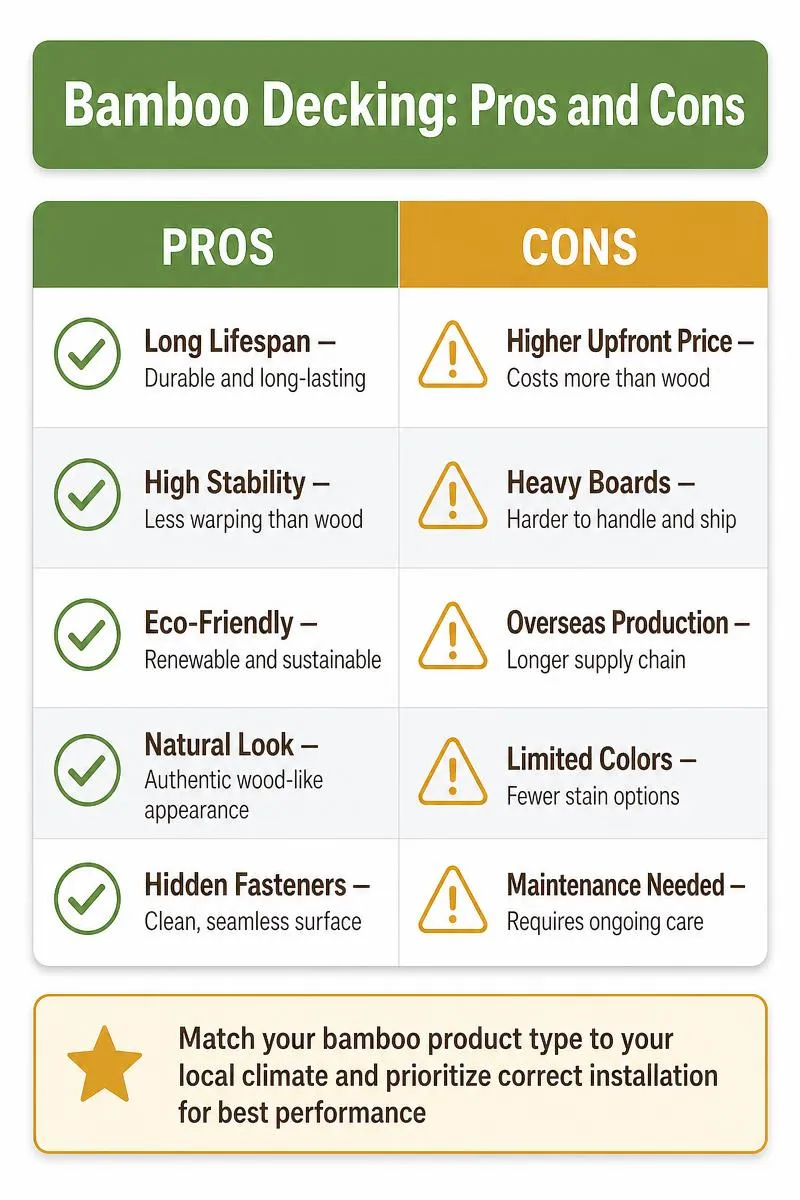
Bamboo Decking Pros And Cons at a Glance
| Pros | Cons |
|---|---|
| Long lifespan — Durable and long-lasting | Higher upfront price — Costs more than wood |
| High stability — Less warping than wood | Heavy boards — Harder to handle and ship |
| Eco-friendly — Renewable and sustainable | Overseas production — Longer supply chain |
| Natural look — Authentic wood-like appearance | Limited colors — Fewer stain options |
| Hidden fasteners — Clean, seamless surface | Maintenance needed — Requires ongoing care |
Bamboo Decking vs Composite and Hardwoods
Bamboo decking occupies a middle ground between composite boards and traditional hardwoods.
Composite decking is made from a blend of wood fibers and plastic polymers, extruded into boards that resist rot and insects without needing stain or seal. Composite comes in a wide range of colors and textures, and the main tradeoff is that the surface doesn’t look or feel like real wood up close.
Hardwood decking offers strong natural durability and a rich, authentic wood surface. Tropical hardwoods come from slow-growing trees harvested from mature forests, which raises sustainability concerns for some buyers. Hardwood also requires periodic oiling to maintain color and can be difficult to source responsibly.
Bamboo decking splits the difference. Like hardwood, bamboo delivers a genuine wood grain and warm tone underfoot. Like composite, bamboo is marketed as a more environmentally responsible choice – bamboo grows to harvest maturity in a fraction of the time a hardwood tree needs.
But bamboo doesn’t match composite’s low maintenance, and bamboo doesn’t have hardwood’s decades-long track record in the field. The boards are also heavier than both alternatives, which adds complexity to shipping and installation.
The right choice depends on what you prioritize. If low maintenance matters most, composite wins. If natural beauty and proven longevity top your list, hardwood still leads. If you want a renewable material with a natural look and you’re willing to do the upkeep, bamboo is worth a close look.
Keep Reading
Side-by-side comparison of bamboo flooring and engineered hardwood’s durability, cost, and stability – useful when…
10 Pros and Cons of Bamboo Decking
The five advantages below explain why suppliers promote bamboo decking; the five drawbacks explain why it isn’t the default choice for every project.
1. Long Lifespan
Bamboo decking’s durability is one of the main reasons suppliers promote the product. Compressed bamboo fibers create a dense board structure that resists wear and weathering better than many softwood options. Buyers planning to stay in their home long-term – or building a deck they want to last without replacing – are the ones who benefit most from this advantage.
A long-lasting deck also means fewer replacement cycles, which is where the environmental math starts to work in bamboo’s favor over time.
2. High Stability
Dimensional stability refers to how much a board expands, contracts, or warps when exposed to moisture and temperature changes. Bamboo decking is reported to have strong dimensional stability compared to standard lumber, which means less buckling, cupping, or splitting when the weather shifts.
This matters most in regions with wide temperature swings or distinct wet and dry seasons. Boards that hold their shape reduce the risk of fasteners popping, gaps opening unevenly, or surfaces becoming tripping hazards over time.
3. Environmentally Friendly Material
Bamboo is a grass, not a tree, and bamboo grows to harvestable size in a few years rather than the decades most hardwood species need. After harvest, the root system regenerates the stalks, so the same plant keeps producing without replanting. That regrowth cycle is what makes bamboo appealing to buyers who want a renewable building material.
The environmental advantage is strongest when you compare bamboo to tropical hardwoods harvested from old-growth forests. Bamboo plantations can be managed without clear-cutting, and the fast growth rate means more material from less land over time.
4. Natural Look and Feel
Bamboo decking has a genuine wood grain and warm tone that synthetic materials struggle to replicate. For homeowners who want a deck that looks like real wood, bamboo delivers an authentic surface underfoot.
Composite decking manufacturers have improved their wood-look textures over the years, but most still have a slightly plastic feel and appearance up close. Bamboo doesn’t have that problem. The compressed fiber surface takes stain and finish similarly to hardwood, which means the deck looks and ages like a natural product.
5. No Visible Fastening
Many bamboo decking systems are designed for hidden fastener installation, where clips or grooves hold the boards down without screws showing on the surface. The result is a clean, uninterrupted deck surface with no screw heads dotting the boards.
Hidden fastener systems appeal to homeowners who prioritize a polished, finished look. These systems can be more time-consuming to install and may limit your fastener options compared to face-screwed boards.
6. Higher Upfront Price
Bamboo decking typically costs more than standard pressure-treated lumber and often more than entry-level composite boards. The compression process, shipping from overseas manufacturers, and smaller market scale all contribute to the premium.
Budget-conscious buyers should factor in not just the material cost but also the total project cost. Heavier boards may require more labor, and if you’re hiring a contractor, the weight and handling characteristics can add to installation time. You’re paying more on day one.
7. Relatively Heavy Boards
Compressed bamboo is dense, which makes bamboo boards heavier than most conventional lumber and many composite options. That weight affects everything from shipping costs – heavier freight costs more – to how easily you can maneuver the boards into place during installation.
For DIY builders, the weight is a real consideration. Moving and positioning heavy boards solo is difficult, and cutting them requires proper tools. A two-person installation team handles the weight more manageably, but that’s an added labor cost if you were planning to do it alone.
8. Overseas Production
Most bamboo decking is manufactured in Asia, where the majority of commercial bamboo plantations and processing facilities are located. The boards travel a significant distance before reaching your local supplier or job site.
Buyers who prioritize local supply chains or domestically sourced materials may find the overseas sourcing a drawback. The transportation distance also adds to the embodied carbon footprint of the product, which partially offsets the renewability advantage for some buyers.
9. Limited Color Options
Bamboo decking is widely available in two colors – one lighter natural tone and one darker finish. That’s the extent of the common product line for most suppliers.
This limits your design flexibility, especially if you’re trying to match a specific exterior color scheme or coordinate with other materials on your property. Composite decking, by comparison, comes in dozens of colors and tones. If you need a specific shade or want options to choose from, bamboo’s two-color palette may feel restrictive.
10. Maintenance Requirements
Bamboo decking is not an install-it-and-forget-it material. To preserve appearance and structural integrity, the boards need periodic cleaning, resealing, and refinishing. Without regular care, the surface can fade, show wear patterns, or absorb moisture in ways that compromise the board over time.
The maintenance routine is comparable to what hardwood decking requires – cleaning, oiling or sealing, and inspection of fasteners and joints. If you wanted a deck that needs nothing but an occasional sweep, composite is the better match.
Bamboo Decking Installation and Maintenance Tips
Handle the boards correctly from delivery onward, then build a maintenance routine around your climate and product type.
Handling Heavy Boards
Plan for two-person handling during delivery and installation. The weight of compressed bamboo makes solo work difficult and increases the risk of dropping or damaging boards. Use proper lifting techniques and consider a dolly or cart for moving materials across the site.
Choosing Fasteners
If your bamboo decking system supports hidden fasteners, use the manufacturer’s recommended clips and follow the spacing guidelines exactly. Hidden fastener systems depend on consistent groove alignment, and bamboo’s density means the clips need to seat properly to hold. For face-screwed installations, use corrosion-resistant screws rated for dense hardwood, and pre-drill to prevent splitting.
Establishing a Maintenance Routine
Start by identifying whether you have standard or fused bamboo decking, as the care requirements can differ. Standard bamboo decking needs regular cleaning with a mild detergent and periodic resealing to protect against moisture. Fused bamboo, which undergoes a higher-pressure compression process, may have different sealing needs – follow the manufacturer’s guidelines.
Clean the deck with the seasons, and more often under overhanging trees or heavy traffic. Reseal when water starts absorbing into the surface rather than beading up. Make fastener and joint checks part of a yearly once-over, and address any boards that show signs of movement or wear before small issues become structural ones.
In wet or humid climates, moisture management is the priority – ensure proper drainage and airflow under the deck. In dry or hot climates, UV protection becomes the main concern, so stay on top of sealing to prevent surface fading and checking.
You Might Also Like
How bamboo compares to oak on hardness, wear, and long-term performance – helpful for readers comparing outdoor-use…
FAQs About Bamboo Decking
How long does bamboo decking last?
Bamboo decking is marketed as a long-lasting option, with suppliers promoting lifespans comparable to hardwood decking when properly maintained. Actual longevity depends on climate, installation quality, and how consistently you follow the maintenance routine. A poorly installed or neglected bamboo deck won’t last as long as a well-cared-for one.
What are the disadvantages of bamboo decking?
The main drawbacks are higher cost than conventional lumber, heavier boards that complicate handling and installation, limited color options, overseas sourcing, and ongoing maintenance requirements. If any of those factors are a dealbreaker for your project, composite or local hardwood may be a better fit.
Why don’t we replace wood with bamboo?
Bamboo isn’t a drop-in replacement for all wood decking. The boards are heavier and more expensive upfront, and they come in fewer colors and profiles than conventional lumber. Its overseas supply chain also makes bamboo less accessible in some markets. Bamboo works well as a decking material for specific projects, but it doesn’t replace the full range of applications where traditional lumber is still the practical choice.
What is the best decking material for the money?
There’s no single best material – the right choice depends on what you value. Pressure-treated lumber is the cheapest upfront but needs the most maintenance. Composite costs more initially but needs almost none. Hardwood and bamboo offer natural beauty and longevity but require periodic care. The best value is the material that matches your budget, climate, and willingness to maintain the deck over time.
What is like Trex but cheaper?
Entry-level composite decking from brands other than Trex can be less expensive while offering similar low-maintenance performance. Bamboo decking can also be a lower-cost alternative to premium hardwood, though bamboo isn’t cheaper than budget composite.
How does bamboo decking compare to composite and hardwoods?
Bamboo offers a natural wood look like hardwood but with faster renewable sourcing. Bamboo requires maintenance similar to hardwood, not the near-zero upkeep of composite. Bamboo boards are heavier than both composite and most hardwoods. On cost, bamboo typically sits between pressure-treated lumber and premium hardwood. On color range, bamboo has far fewer options than composite but a similar natural palette to hardwood.
How much does bamboo decking cost?
Bamboo decking generally costs more than pressure-treated lumber and entry-level composite but less than premium tropical hardwoods. The exact price varies by supplier, board profile, and shipping distance. Get quotes from multiple suppliers to compare, and factor in the higher installation labor that comes with heavier boards.
What is fused bamboo decking?
Fused bamboo decking is made through a high-pressure compression process that bonds bamboo fibers into a denser, more uniform board than standard bamboo decking. The fusion process is designed to improve moisture resistance and dimensional stability. Fused bamboo may perform differently in certain climates than standard compressed bamboo, so check the manufacturer’s climate guidance before buying.
Is bamboo decking suitable for every climate?
Not necessarily. Some sources suggest that standard and fused bamboo products have different climate compatibilities, and not every product performs well in every region. Wet, humid climates may challenge bamboo decking that isn’t properly sealed and drained. Check the manufacturer’s climate recommendations and talk to local suppliers about which product type works where you live.
What is bamboo composite decking?
Bamboo composite decking is a blend of bamboo fibers and plastic or resin, similar to traditional composite decking but using bamboo instead of wood fiber as the organic component. The product offers the low-maintenance performance of composite with a bamboo-based filler. The bamboo content doesn’t give the boards the same look or feel as solid compressed bamboo decking – bamboo composite is a composite product first.
Final Thoughts
Bamboo decking makes sense if you value sustainability and a natural wood aesthetic and you’re willing to handle the upkeep. If you need a wide color range or a zero-maintenance surface, composite is likely a better fit. Your next step is to order samples from a few suppliers and compare the weight and finish against your home’s exterior before committing.
External References
- Advances in Connection Techniques for Raw Bamboo … – Preprints
- Carbon Footprint Study of Bamboo Scrimber Products … – MDPI
- A Review of Weathering Studies in Plastics and … – PMC – NIH (NCBI)
- Hidden Fastener Systems for Exterior Bamboo Decking – Localinfo
- laminate thermal expansion: Topics by … – Science
- The Real Pros and Cons of Bamboo Decking – Dassoxtr