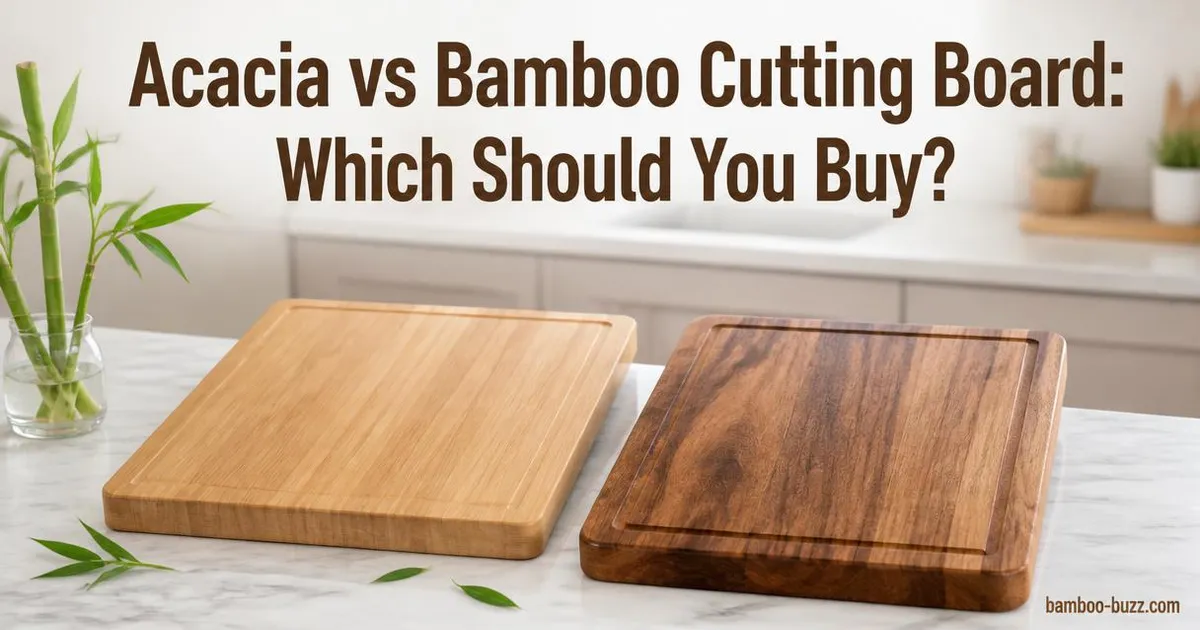
Acacia vs Bamboo Cutting Board: Which Should You Buy?
Most people stuck on the acacia vs bamboo cutting board choice assume the decision comes down to two kinds of wood. Bamboo isn’t wood at all – it’s a grass, and bamboo cutting boards are engineered products made by processing stalks into board form. Acacia, by contrast, is a solid tropical hardwood cut from a tree.
That grass-versus-hardwood distinction shapes everything that matters in this comparison: durability, price, upkeep, and how each material handles daily wear. Acacia brings density, weight, and rich grain; bamboo brings a light, inexpensive board built from one of the fastest-growing raw materials available. Neither one wins every category, so the honest answer depends on how you cook.
Key Takeaways
- Budget edge: Bamboo generally costs less, while acacia sits at the warmer, more premium end of the range.
- Durability caveat: Some sources suggest acacia is highly durable, though hardness varies by acacia species and by how the board is constructed.
- Material reality: Bamboo boards are engineered from a fast-growing grass rather than cut from solid hardwood.
- Shared upkeep: Both materials need regular oiling and thorough drying to last – neither is maintenance-free.
- Simple split: Acacia is the stronger choice for heavy daily chopping and long-term use; bamboo suits light prep and easy handling.
Also Worth Checking Out
Bamboo cutting board vs plastic
A direct comparison of bamboo boards against plastic to help readers weigh durability, hygiene, and value.
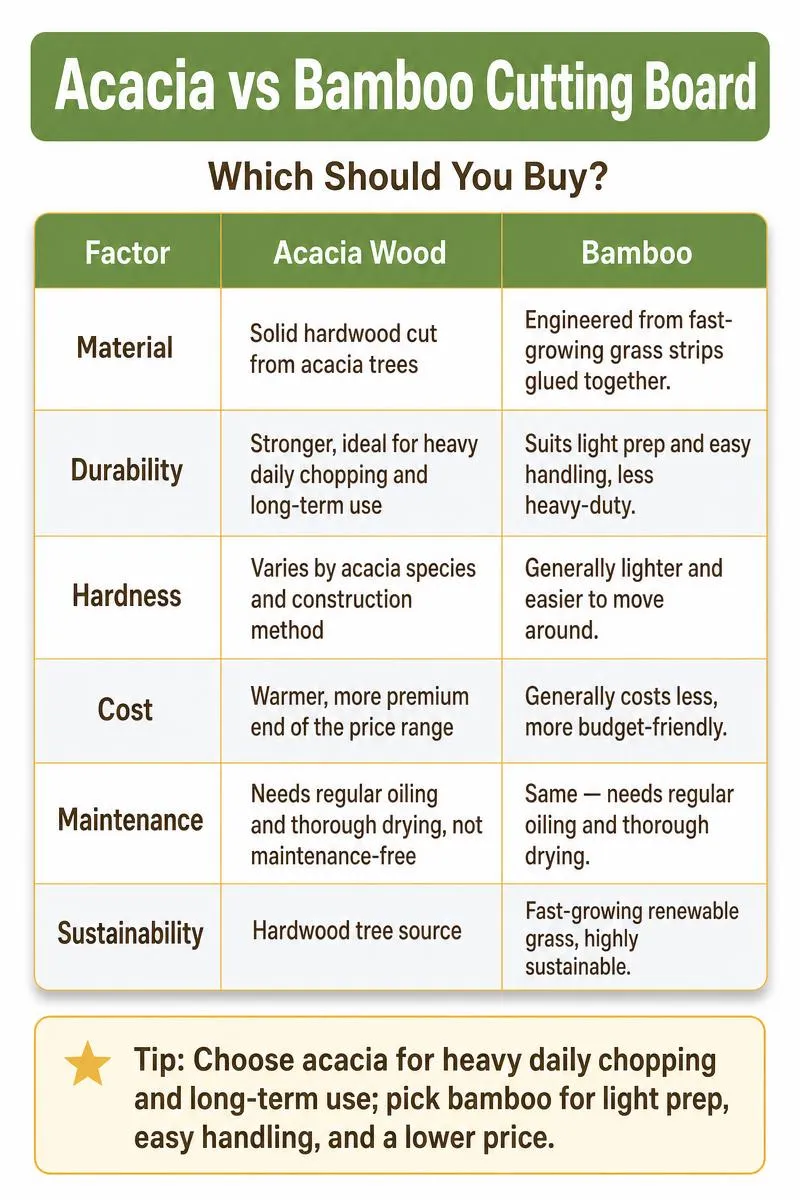
Acacia Vs Bamboo Cutting Board Side-by-Side
| Factor | Acacia Wood | Bamboo |
|---|---|---|
| Material | Solid hardwood cut from acacia trees | Engineered from fast-growing grass strips glued together |
| Durability | Stronger; ideal for heavy daily chopping | Suits light prep; less heavy-duty |
| Hardness | Varies by species and construction | Generally lighter and easier to move |
| Cost | Warmer, more premium price range | Generally costs less; budget-friendly |
| Maintenance | Needs regular oiling and thorough drying | Needs regular oiling and thorough drying |
| Sustainability | Hardwood tree source | Fast-growing renewable grass; highly sustainable |
What Is an Acacia Wood Cutting Board?
An acacia cutting board is a solid board cut from acacia, a tropical hardwood known for rich color and varied grain. The grain differs visibly from board to board, which is part of the appeal – each piece looks distinct rather than factory-uniform.
Acacia’s density gives the board a planted, stable feel on the counter. The weight plus the rich grain make acacia well suited to two jobs at once: a daily chopping surface and a serving piece you’re happy to set out with cheese or bread on it.
Acacia boards usually cost more than bamboo, weigh more to carry and store, and need regular oiling like any hardwood.
What Is a Bamboo Cutting Board?
A bamboo cutting board is an engineered product, not a solid slab of wood. Manufacturers process the fast-growing grass stalks and bond the material into board form – which is why bamboo behaves differently from solid hardwood under a knife.
What bamboo does well is the practical stuff. Bamboo boards cost less, weigh less, and move easily between counter, sink, and cabinet, which makes them a fit for small kitchens, occasional cooking, and light chopping.
The limit is use intensity. Bamboo boards hold up fine for light prep but wear faster under heavy daily chopping, and the bonded construction adds seams and adhesive that solid wood doesn’t have. Bamboo is also widely marketed as sustainable – the raw material really does regrow fast, but the boards themselves are manufactured products rather than naturally occurring planks.
Acacia Wood Cutting Board vs Bamboo Cutting Board: Durability and Hardness
Wood hardness gets rated on the Janka scale, which measures the force needed to embed a steel ball into the material. A higher Janka rating means a surface that resists dents and knife marks better – though for a cutting board, thickness and construction quality matter alongside raw hardness.
Acacia is a dense hardwood, and some sources rate it as highly durable. The caveat: acacia has multiple species, so hardness varies by species and by where the wood was sourced, and two acacia boards aren’t guaranteed to perform identically.
Bamboo is harder to pin down on the Janka scale because a bamboo board is an engineered grass product, not a single named wood. Measured hardness depends on how the stalks were processed and bonded, so bamboo board ratings vary more than ratings for a specific hardwood.
For heavy daily chopping, acacia is the stronger choice. For light prep – slicing fruit, cutting bread, chopping an onion for dinner – bamboo holds up fine.
Related Reading
Acacia wood vs bamboo utensils
Compares acacia and bamboo across kitchen tools, offering transferable insights on hardness and wear that apply to…
Acacia Wood Cutting Board vs Bamboo Cutting Board: Care and Maintenance
Both materials follow the same core routine: wash by hand with mild soap, dry thoroughly right after, and oil regularly with food-safe mineral oil so the surface doesn’t dry out and crack. Neither acacia nor bamboo belongs in the dishwasher.
Water exposure is where acacia and bamboo diverge. Any board can warp after soaking, but bamboo is especially unforgiving – the bonded construction can swell and separate when the board sits in water. Prompt, careful drying matters significantly for bamboo longevity.
Oiling frequency comes down to how the board looks. When the surface turns pale, dry, or rough, rub in mineral oil, let it absorb, and wipe off the excess. Acacia needs the same treatment; the rich color that justifies the price dulls when the wood dries out.
Acacia Wood Cutting Board vs Bamboo Cutting Board: Cost and Value
Bamboo generally costs less than acacia, often by a comfortable margin. If the goal is a working board for minimal spend, or a couple of spares for different jobs, bamboo wins the checkout line.
Acacia sits at the higher end of the price range, and the extra spend only pays back under real use. A well-maintained acacia board outlasts a bamboo board under heavy daily chopping, so the longer working life can offset the higher initial price. For occasional prep, the durability difference rarely gets tested – bamboo’s shorter working life matters less when the board sees the knife infrequently.
The cost winner depends on the timeline: bamboo for lowest upfront price, acacia for long-term value under heavy use.
Acacia Wood Cutting Board vs Bamboo Cutting Board: Sustainability
On raw regrowth speed, bamboo wins outright. Bamboo regrows quickly after harvest, while acacia is a tropical hardwood that takes far longer to reach harvestable size.
Raw material is only part of the picture, though. Bamboo boards are engineered products, and processing the stalks into board form adds manufacturing steps that a solid acacia plank skips. Acacia also has a counterargument in longevity: a board that survives heavy use for a long time generates less replacement waste than one that needs replacing sooner.
The sustainability split: bamboo wins on how fast the raw material renews, and acacia partly offsets that by lasting longer.
Related Reading
Pros and cons of bamboo utensils
A pros-and-cons breakdown of bamboo kitchenware that expands on sustainability and care points raised in the article.
Acacia Wood Cutting Board vs Bamboo Cutting Board: Health and Safety
Neither material is inherently unhealthy for food contact. Both acacia and bamboo boards are sold and used widely as food-safe surfaces when properly cared for – the bigger sanitation variable isn’t the species but the condition of the board in your kitchen.
Deep knife scores are the real problem. Cuts in the surface trap food particles and moisture where a sponge can’t reach, and bacteria grow in those grooves regardless of the material. Cleaning habits and surface condition matter more than the name stamped on the board.
One construction difference is worth knowing. Solid acacia is hardwood lumber through and through, while engineered bamboo is bonded material with seams and adhesive layers, giving acacia fewer joints where moisture and debris can settle. Both are safe with proper care – and a heavily scored board should be replaced regardless of what it’s made from.
Which Should You Choose?
- Tight budget, light prep: Bamboo covers slicing, sandwich assembly, and occasional cooking for less money, and the light weight makes the board easy to grab and store.
- Heavy daily chopping: Acacia’s dense hardwood takes constant knife work far better, which turns the higher price into a long-term investment.
- Most renewable raw material: Bamboo – nothing else in this comparison regrows as fast.
- A stable countertop board: Acacia’s weight keeps the board planted while you chop, and the grain looks good enough to leave out permanently.
- Serving duty: Acacia again – the rich color and varied grain work on a table in a way engineered bamboo doesn’t.
FAQs About Acacia Wood and Bamboo Cutting Boards
Most of these questions come down to the same two variables – how hard the board gets used and how much upkeep it receives.
What are the disadvantages of an acacia wood cutting board?
Higher price, heavier weight, and mandatory regular oiling are the main drawbacks. Acacia hardness also varies by species and source, so a cheaply made acacia board may not perform like a well-constructed one.
What are the disadvantages of a bamboo cutting board?
Bamboo boards are built for light prep, not heavy daily chopping – the surface wears faster under hard use. The bonded construction also makes bamboo less forgiving with water, since soaking or dishwashing can warp the board and shorten its working life.
Which is the healthier cutting board material, bamboo or acacia?
Neither – both are food-safe with proper care. Sanitation depends far more on surface condition and cleaning habits than on species, so the healthier board is whichever one isn’t covered in deep knife grooves.
Why is acacia wood considered special for cutting boards?
Acacia is a dense tropical hardwood with rich color and varied grain, which makes each board distinctive and gives the surface a planted feel under a knife.
What are the pros and cons of an acacia wood cutting board?
The pros: density that handles daily chopping, weight that keeps the board steady, and grain attractive enough for serving. The cons: higher cost, heavier carry, and a regular oiling requirement.
Is acacia or bamboo better for heavy daily use?
Acacia. The dense hardwood takes repeated knife work better, while bamboo boards are matched to light prep and occasional use.
Which cutting board is more budget-friendly, acacia or bamboo?
Bamboo, usually by a comfortable margin. Acacia’s higher price can pay off over a long stretch of heavy use, but if upfront cost decides the purchase, bamboo is the cheaper buy.
How do acacia and bamboo cutting boards differ in size and weight?
Acacia boards run heavier for their footprint because the hardwood is dense – that weight keeps the board steady during chopping. Bamboo boards feel lighter at a similar size, which makes them easier to move, hang, and store in tight kitchens.
Final Verdict
For most home kitchens doing regular meal prep, acacia is the better long-term choice. The dense hardwood handles daily chopping, stays planted on the counter, and looks good enough to serve from, which covers what a main board actually needs to do.
Choose bamboo instead if the priorities are lowest cost or a light board for occasional use – both are things bamboo genuinely does better than acacia.
Whatever the pick, check the board’s thickness and construction quality before buying. A well-built board of either kind outlasts a thin, poorly made one.
External References
- Supplement F to Compilation of Air Pollutant Emission … – EPA
- Cutting Boards – Food Safety and Inspection Service – USDA – USDA FSIS
- Price premiums for certified wood products in Japan – PMC – NIH – NIH (NCBI)
- Study on the Effect of Flattening Modification on Bamboo … – MDPI
- Hot & Cold Pressed Strand Woven Bamboo – Thesolidwoodflooringcompany
- Selecting and Serving Produce Safely – FDA