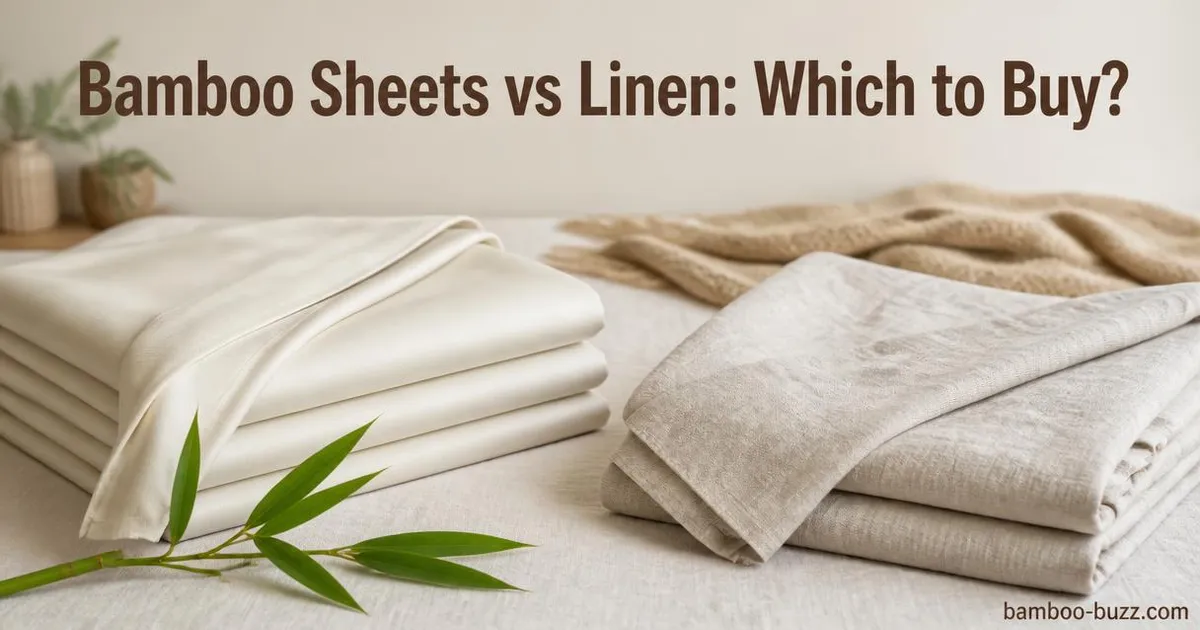
Bamboo Sheets vs Linen: Which to Buy?
Two of the most common cooling-sheet fabrics come from completely different processes – one is made from bamboo pulp dissolved and extruded into viscose fibers, the other is spun from flax stalks. Yet both end up on the beds of people who sleep hot and want something lighter than cotton.
The choice between bamboo sheets vs linen usually comes down to how you want your sheets to feel, how much effort you are willing to put into washing them, and what you think about the chemical processing behind bamboo viscose. Here is how they compare on feel, cooling, care, and sourcing.
Key Takeaways
- Linen suits hot sleepers who want a textured, airy feel; bamboo viscose fits those who prefer silky drape against the skin.
- Linen tolerates hot water and high-heat drying; bamboo viscose needs cold washes and low heat to preserve fiber integrity.
- Bamboo sheet sets often cost less upfront than high-quality linen.
- Some sources suggest linen carries a smaller chemical-processing footprint, since bamboo viscose typically uses a rayon-style dissolving process.
- Neither material needs fabric softener – linen naturally softens with washing, while softeners can coat and weaken bamboo viscose fibers.
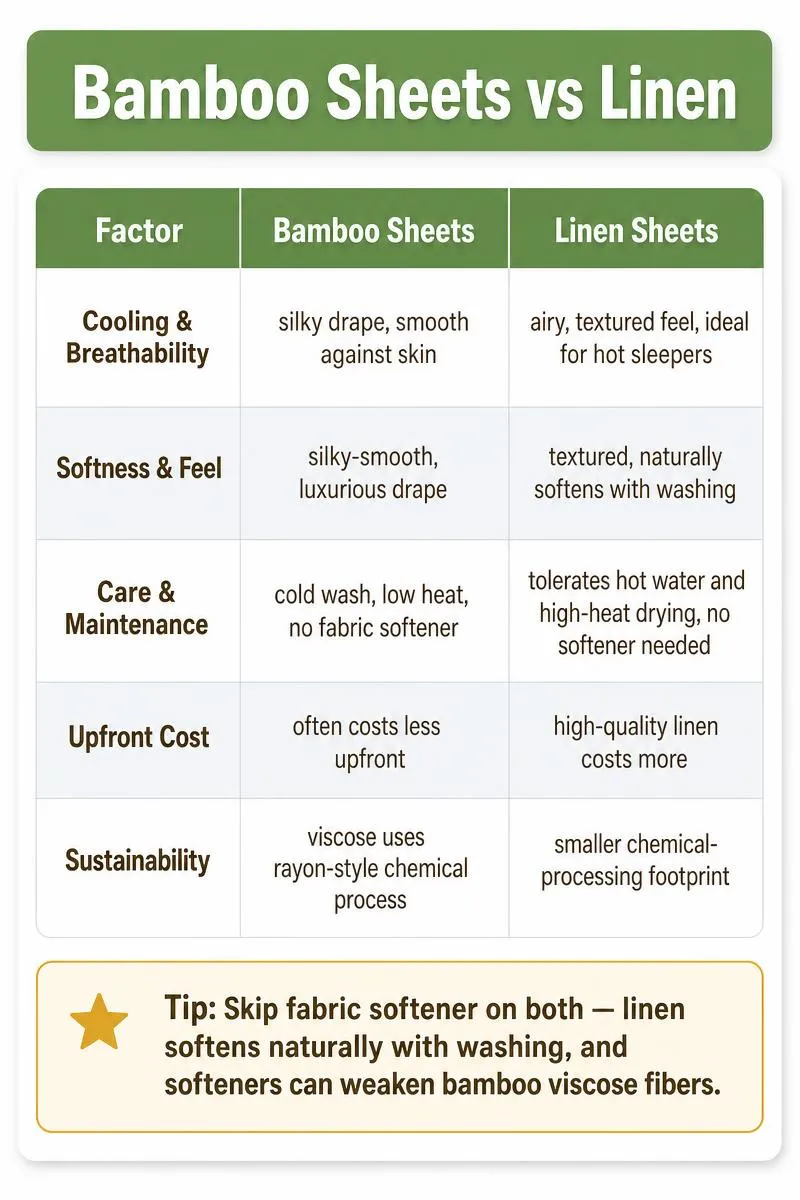
Bamboo Sheets Vs Linen at a Glance
| Factor | Bamboo Sheets | Linen Sheets |
|---|---|---|
| Cooling & Breathability | Silky drape, smooth against skin | Airy, textured feel; ideal for hot sleepers |
| Softness & Feel | Silky-smooth, luxurious drape | Textured; softens with washing |
| Care & Maintenance | Cold wash, low heat, no fabric softener | Tolerates hot water and high-heat drying |
| Upfront Cost | Often costs less upfront | High-quality linen costs more |
| Sustainability | Viscose uses rayon-style chemical process | Smaller chemical-processing footprint |
What Is Bamboo Sheets?
Most sheets sold as bamboo are bamboo viscose, also called bamboo rayon. Manufacturers dissolve bamboo pulp in chemical solvents, then extrude the resulting liquid through spinnerets to form continuous fibers. Those fibers get spun into yarn and woven into fabric.
The result is a smooth, cool-to-the-touch surface with a drape that sits close against the body. Bamboo viscose wicks moisture away from skin, which is why it feels cooler than cotton in dry conditions.
Sleepers who want a silk-like hand-feel without paying silk prices tend to gravitate toward bamboo viscose. The trade-off is that the fibers are vulnerable to high heat, can pill if washed roughly, and the chemical process used to make them varies by manufacturer – some use closed-loop systems that recover solvents, others do not.
Also Worth Checking Out
A clear breakdown of how viscose and modal differ when used in bamboo bedding.
What Is Linen Sheets?
Linen sheets are woven from flax fibers. The production process involves retting (rotting the outer stalk to release fibers), scutching (scraping away debris), and spinning those fibers into yarn.
Fresh out of the package, linen has a crisp, slubbed texture – slightly bumpy and firm. That texture relaxes with every wash cycle, softening gradually without losing the characteristic grain that makes linen feel like linen.
Linen suits sleepers who want breathable, long-lasting bedding that improves with age. The downsides are initial roughness on day one, visible wrinkling after washing, and a higher cost for quality European-grown flax sets.
Bamboo Sheets vs Linen Sheets: Cooling and Breathability
Both materials sleep cooler than most cotton sheets.
Linen’s loose, open weave creates space between the fabric and your skin, promoting airflow. That makes linen especially effective in humid climates where trapped moisture is the real problem.
Bamboo viscose wicks moisture away from the skin rather than relying on airflow alone. In dry heat, that moisture-wicking action makes bamboo viscose sheets feel noticeably cool against the body.
Linen wins for muggy, humid nights. Bamboo viscose wins for dry, hot sleeping conditions where moisture wicking matters more than airflow.
Bamboo Sheets vs Linen Sheets: Softness and Feel
Bamboo viscose feels immediately smooth and silky – it drapes closely to the body and has a consistent surface with no texture to break in.
Linen starts crisp and slightly rough, with a textured grain that some people love and others find scratchy. Repeated washing gradually relaxes the flax fibers, but linen never becomes truly slick – it softens while keeping its characteristic bite.
Bamboo wins for instant silky feel from day one. Linen wins for sleepers who prefer a textured, lived-in feel that develops over time.
Keep Reading
A side-by-side comparison of texture and softness between bamboo viscose and silk for feel-focused shoppers.
Bamboo Sheets vs Linen Sheets: Care and Maintenance
The washing instructions for these two materials are nearly opposites.
Linen handles hot water, chlorine-free bleach, and high dryer heat without issue. The agitation of washing and drying actually helps linen soften – there is no need to baby it.
Bamboo viscose requires cold or warm water, gentle detergent, and low-heat tumble drying or line drying. High heat can damage or shrink the fibers, and rough washing causes pilling.
Linen wins for wash-and-forget durability. Bamboo viscose needs more careful handling to stay in good shape.
Bamboo Sheets vs Linen Sheets: Sustainability and Sourcing
Linen comes from flax, a low-water crop that grows in poor soil with minimal irrigation. Fiber separation is mostly mechanical – retting, scutching, and spinning – without the heavy chemical inputs that viscose production requires.
Bamboo itself is a fast-renewing raw material that grows rapidly with little irrigation. But turning bamboo stalks into fabric typically involves dissolving the pulp in chemical solvents – the same process used to make rayon.
Linen wins for buyers who prioritize minimal chemical processing. Bamboo wins for those who value a fast-renewing raw material and are less concerned about the manufacturing step.
Which Should You Choose?
- Humid-climate sleepers: Linen – the open weave and airflow make a real difference when the air is thick.
- Day-one softness: Bamboo viscose – no break-in period, just silky drape.
- Wash-and-forget care: Linen – hot water, hot dryer, no problem.
- Tight budgets: Bamboo viscose – sheet sets often cost less upfront than quality linen.
- Bedding that ages: Linen – it genuinely improves with repeated washing.
Bamboo vs cotton mattress protector
A practical comparison of bamboo and cotton bedding accessories that helps readers consider the whole-bed comfort setup.
FAQs About Bamboo Sheets and Linen Sheets
What is the downside to bamboo sheets?
Bamboo viscose is vulnerable to high heat – hot water and hot dryer settings can damage or shrink the fibers. The fabric can also pill if washed roughly, and the chemical solvents used in the viscose process are a concern for buyers who prioritize minimal processing.
Is bamboo fabric better than linen?
Neither is objectively better. Bamboo viscose is softer and smoother from the start; linen is more durable, easier to wash, and, by some accounts, a smaller chemical-processing footprint. The right choice depends on what you value more.
Can you put bamboo sheets in the dryer?
Yes – use the low-heat tumble setting, or line dry for the gentlest option. High dryer heat can damage bamboo viscose fibers, so low heat is the safer approach.
What laundry detergent is best for bamboo sheets?
A gentle, pH-neutral detergent without bleach or added fabric softeners. Harsh detergents can weaken the viscose fibers over time.
Should I put fabric softener on bamboo sheets?
No. Fabric softener coats bamboo viscose fibers and can reduce their moisture-wicking ability while making them feel gummy. Linen does not need softener either – it softens naturally with repeated washing.
Can you use vinegar to wash bamboo sheets?
Yes, in small amounts. A splash of white vinegar in the rinse cycle can help remove detergent residue without damaging bamboo viscose fibers. Avoid using vinegar as a full replacement for detergent.
Are bamboo or linen sheets better for hot sleepers?
Both work well. Linen is better in humid climates where airflow matters most; bamboo viscose is better in dry heat where moisture wicking cools the skin more effectively.
Are bamboo sheets or linen sheets more sustainable?
Linen has the edge on processing – flax requires less water and the fiber separation is mostly mechanical. Bamboo is a faster-growing, lower-input crop, but the viscose process typically involves chemical solvents. If minimal processing is your priority, linen wins; if fast-renewing raw material is your focus, bamboo has the advantage.
Final Thoughts
Neither material is objectively better – the right call depends on what your hands and your laundry routine tell you.
Choose linen if you value crisp texture, easy care, and bedding that lasts for years while softening with each wash. Choose bamboo viscose if you want budget-friendly, silky smoothness from the first night.
If you share a bed, consider that linen’s textured feel is polarizing – some people love the grain, others find it rough – while bamboo viscose’s smoothness is broadly agreeable across preferences.
One practical next step: check whether the bamboo set you are considering is genuine bamboo viscose or a microfiber blend labeled as bamboo. The label should list the fiber content specifically, not just the word bamboo.
External References