Bamboo vs Teak: Which Is Better?
Teak shrugs off water like it was built for the outdoors. Bamboo costs less, weighs less, and grows back far faster than teak. The bamboo vs teak question comes up most when you are shopping for cutting boards, shower benches, and kitchen utensils, and the answer depends almost entirely on how much water the item will see.
Both materials look warm and natural on a shelf. Once you bring them home, they behave differently around water, weight, and wear.
This comparison covers durability, maintenance, cost, and specific use cases so you can choose based on how you will actually use the item.
Key Takeaways
- Teak handles moisture and humidity better than bamboo, making it the safer pick for bathrooms and outdoor use
- Bamboo is lighter and costs less upfront, but it is more prone to cracking over time
- Teak requires less frequent maintenance than bamboo, especially in wet environments
- Your decision should depend on whether you prioritize low upkeep or a lower price tag
- For dry kitchen tasks and light use, bamboo works well; for wet or heavy-use environments, teak is the stronger choice
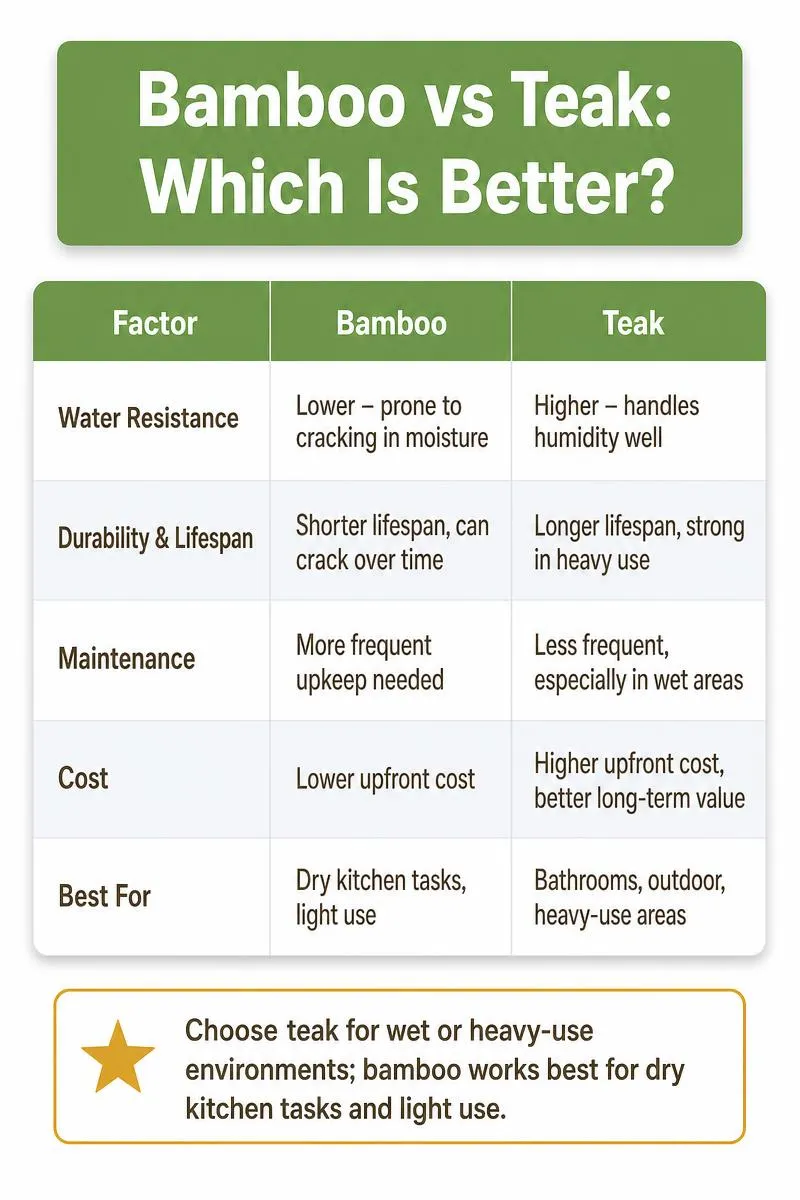
Bamboo Vs Teak Side-by-Side
| Factor | Bamboo | Teak |
|---|---|---|
| Water Resistance | Lower — prone to moisture cracking | Higher — handles humidity well |
| Durability & Lifespan | Shorter — may crack over time | Longer — strong in heavy use |
| Maintenance | More frequent upkeep needed | Less frequent maintenance |
| Cost | Lower upfront cost | Higher upfront; better long-term value |
| Best For | Dry kitchen tasks; light use | Bathrooms; outdoor; heavy-use areas |
What Is Bamboo?
Bamboo is technically a grass, not a wood. The stalks are harvested, flattened, and compressed into boards or strips, often held together with adhesives.
You will find bamboo in cutting boards, utensils, flooring, and lightweight furniture. It regrows fast enough to harvest without replanting entire stands, costs less than most hardwoods, and weighs noticeably less in hand.
The tradeoff is moisture tolerance. Bamboo has a high starch content that can attract moisture damage, and the compressed strips can split if soaked. The adhesives holding the strips together are also a weak point during repeated wash and dry cycles.
Explore More
A side-by-side comparison of bamboo and rattan for furniture and decor.
What Is Teak?
Teak is a dense tropical hardwood known for its natural oils and tight grain. Those oils help the wood resist warping in humid environments, which is why teak shows up in outdoor furniture, boat decks, shower benches, and premium cutting boards.
The density of teak also resists deep knife scarring better than bamboo’s compressed strips. The main drawback is cost.
Teak is significantly more expensive than bamboo, and it takes far longer to renew as a resource. Teak is also heavy, which matters if you plan to move the item frequently.
Bamboo vs Teak: Water Resistance and Stability
Teak wins for wet environments; bamboo holds its own in dry, stable climates.
Teak’s natural oils repel water and resist warping in humid bathrooms or kitchens. The tight grain keeps the wood dimensionally stable even when the air is saturated.
Bamboo absorbs moisture more readily through its compressed strips and exposed cut ends. That absorption can lead to swelling, warping, or mold if the surface isn’t dried quickly after contact with water.
In shower benches or outdoor furniture, teak maintains its shape over years of humidity. Bamboo in the same setting risks degradation along the adhesive seams where moisture works its way in.
Bamboo vs Teak: Durability and Lifespan
Teak wins overall; bamboo only in low-impact, dry conditions.
Teak’s density helps it resist deep cuts and surface damage from knives or daily wear. A teak cutting board can take years of chopping without developing deep grooves.
Bamboo cutting boards can develop cracks along the glued seams after repeated washing or drying cycles. The adhesive joints expand and contract differently from the bamboo fibers, which stresses those connection points over time.
Teak items often last decades with basic care. Bamboo may need replacement sooner in heavy-use settings, especially if the board sees regular water exposure.
Keep Reading
Pros and cons of bamboo decking
An in-depth look at how bamboo performs as decking material in wet and outdoor conditions.
Bamboo vs Teak: Maintenance Requirements
Teak wins for lower-frequency care; bamboo wins for simpler initial maintenance.
Teak needs occasional oiling but tolerates being left untreated far longer than bamboo. The natural oils in teak keep doing their job even if you forget a maintenance cycle.
Bamboo requires prompt drying after washing and benefits from regular mineral oil application to prevent splits. If you leave a bamboo board wet on the counter, you are inviting warping and seam separation.
Both materials should be hand-washed. Teak forgives accidental soaking better than bamboo, though neither belongs in a dishwasher.
Bamboo vs Teak: Cost and Value Over Time
Bamboo wins for upfront budget; teak wins for long-term value.
Bamboo boards and furniture cost significantly less at purchase. If you need a cutting board for occasional dry use, that lower price makes sense.
Teak’s higher initial price can be offset by longer replacement intervals in heavy-use settings. A teak shower bench that lasts decades can cost less per year than a bamboo one you have to replace sooner in a humid bathroom.
Calculate total cost based on expected years of use and replacement frequency. A cheaper item replaced twice may cost more over time than a pricier one that holds up.
Which Should You Choose?
Choose teak if you need a shower bench, outdoor furniture, or a board that can handle frequent water exposure. Teak is the material used for boat decks and shower benches because it holds its shape through constant humidity.
Choose teak if you want the lowest possible maintenance and do not mind paying more upfront. Teak stays sound through skipped oiling; bamboo splits when you skip drying.
Choose bamboo if you need a lightweight cutting board for occasional use and want to spend less. Bamboo is easy to move around and costs a fraction of what teak does.
Choose bamboo if you prefer a rapidly renewable material and will store the item in a dry environment. Bamboo regrows far faster than teak.
Choose teak if knife marks and surface scarring bother you. The density of teak resists damage from blade contact better than compressed bamboo.
Explore More
Pros and cons of bamboo countertops
A practical guide to bamboo countertops’ durability, maintenance, and cost considerations.
FAQs About Bamboo and Teak
Does teak resist water better than bamboo?
Yes. That oil content is why teak gets used on boat decks, while bamboo needs prompt drying after any contact with water.
Why do some bamboo cutting boards crack over time?
The splits start at the glued seams, where wash and dry cycles stress the joints. Drying the board promptly and oiling it regularly slows the process down.
Which is heavier, teak or bamboo?
Teak is heavier. Bamboo’s grass-based compressed structure is lighter, which makes it easier to move but less dense.
Do teak cutting boards change color over time?
Yes, teak can darken or shift tone as the natural oils age and the wood is exposed to light and air. This is normal and does not affect performance.
Are bamboo cutting boards completely wood-free?
Yes. Bamboo is a grass, not a tree, so no tree wood is involved. The boards still use adhesives to bind the compressed strips together.
Which material is better for shower benches and bath furniture?
Teak. The natural oils and tight grain resist constant humidity and water contact, while bamboo risks swelling and seam separation in wet environments.
Is teak or bamboo better for cooking?
For dry prep tasks like slicing bread or chopping herbs, bamboo works fine and costs less. For heavy daily chopping or a board that will see more water, teak’s density and water resistance give it the edge.
What are the main downsides of teak wood?
Expect to pay far more than bamboo, and expect a piece heavy enough that rearranging it takes real effort. Teak trees also regrow far slower than bamboo stalks.
Final Thoughts
Teak is the better investment for wet, heavy-use, or long-term applications. Bamboo is a sensible, affordable choice for dry kitchens and light-duty tasks.
One edge case: if you need the lightest possible board for mobility reasons, bamboo wins despite its drawbacks.
Decide whether your priority is upfront savings or lifetime durability, then inspect board construction before buying. Look at how the strips or pieces are joined, since the seams are where problems usually start.
External References
- Bonding strength performance of bamboo-based composite … – NIH (NCBI)
- The Environmental Impact of Industrial Bamboo Products – ResearchGate
- Supplement F to Compilation of Air Pollutant Emission … – EPA
- Effects of Adhesive Types and Structural Configurations on … – MDPI
- Questions and Answers Regarding Laminate Flooring – EPA