Bamboo Charcoal vs Activated Charcoal: Which to Use?
Both bamboo charcoal and activated charcoal come from carbonized plant material, but one goes through an extra processing step that changes how much it can absorb. That single step – activation – is the whole reason activated charcoal outperforms bamboo charcoal on odor removal, filtration, and medical use. Bamboo charcoal still has real value for passive home deodorizing and moisture control, just not at the same level.
If you’re standing in a store aisle staring at charcoal bags and wondering whether the bamboo version does the same thing as the activated one, the short answer is: mostly, but not as well.
Key Takeaways
- Wins on odor absorption thanks to higher porosity created during the activation step
- Works for passive deodorizing and moisture control in small spaces like closets and drawers
- Processing is the difference – activated charcoal gets heated again with steam or chemicals to expand its pore structure
- Only food-grade activated charcoal is meant for ingestion, and it can bind to medications and reduce their effectiveness
- Mold-related moisture – some sources suggest bamboo charcoal helps, though activated charcoal is generally preferred for stronger odor and mold control
You Might Also Like
How bamboo bath mats handle moisture, mold, and odor in bathrooms.
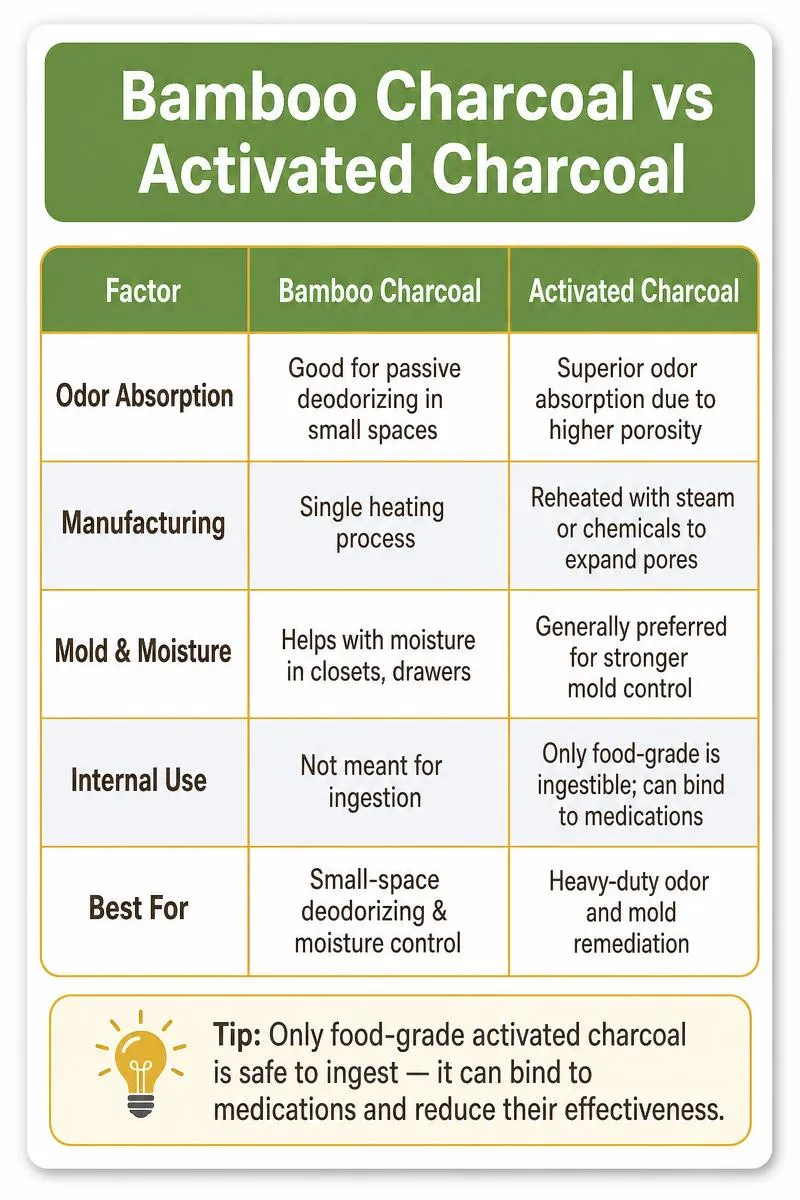
Bamboo Charcoal Vs Activated Charcoal at a Glance
| Factor | Bamboo Charcoal | Activated Charcoal |
|---|---|---|
| Odor Absorption | Good for passive deodorizing in small spaces | Superior odor absorption (higher porosity) |
| Manufacturing | Single heating process | Reheated with steam/chemicals |
| Mold & Moisture | Helps control moisture in closets/drawers | Preferred for stronger mold control |
| Internal Use | Not meant for ingestion | Food-grade only; can bind medications |
| Best For | Small-space deodorizing & moisture control | Heavy-duty odor & mold remediation |
What Is Bamboo Charcoal?
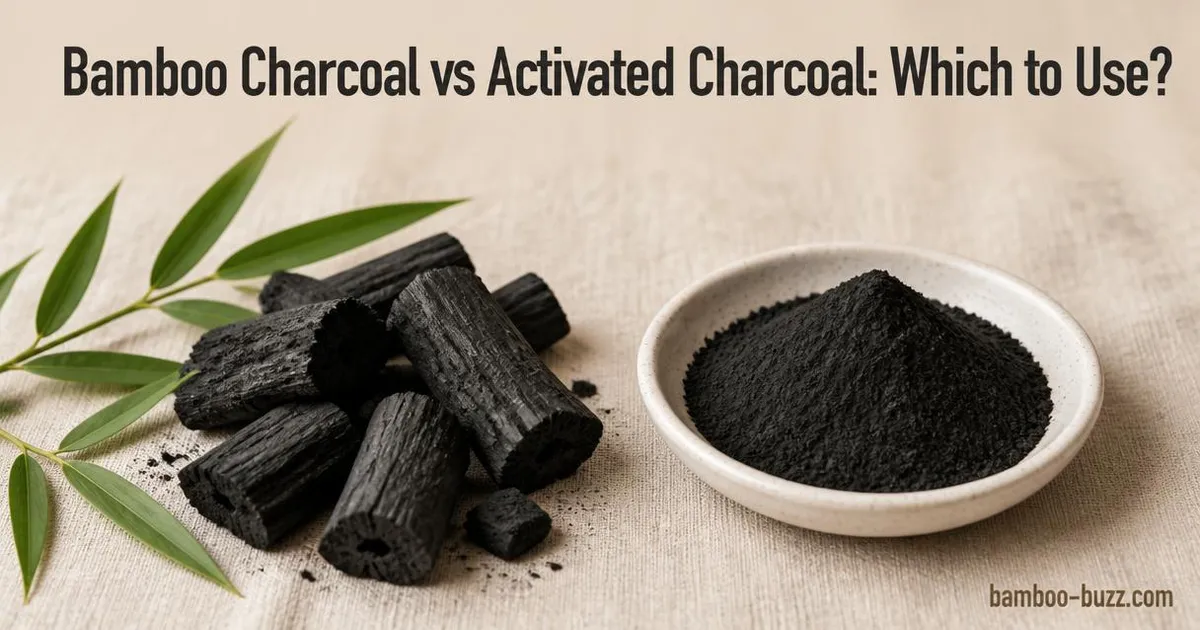
Bamboo charcoal is bamboo stalks burned at high heat until they carbonize, leaving behind a porous black material. It’s sold as breathable fabric bags filled with charcoal chunks, or as a fine powder for household use.
The main appeal is simplicity. No chemical activation, no extra manufacturing steps – just carbonized bamboo in a bag you toss in a closet, bathroom, or car. Bamboo charcoal absorbs odors and moisture passively, meaning it works slowly without any power source or fan.
Its strength is that it’s a natural, low-processing option for light household odors and dampness. Its weakness is lower porosity compared to activated charcoal, which limits how much it can adsorb. Bamboo charcoal is also not intended for ingestion.
What Is Activated Charcoal?
Activated charcoal starts as regular charcoal – which could come from bamboo, wood, or coconut shells – and then goes through an activation step. That step involves heating the charcoal again and treating it with steam or chemicals to crack open the carbon structure, creating an extremely porous network with a massive surface area.
That porosity is what makes activated charcoal effective at adsorption. Adsorption means molecules stick to the surface of the charcoal rather than being absorbed into it. The more pores, the more surface area, the more molecules it can grab.
Activated charcoal is used for strong odor removal, water and air filtration, and medical applications like treating certain types of poisoning. Food-grade activated charcoal is available for ingestion, but it comes with a real caveat: it can bind to medications and supplements, reducing their effectiveness.
Bamboo Charcoal vs Activated Charcoal: Odor Absorption
Activated charcoal wins for maximum odor removal. If you’re dealing with a strong smell – smoke, pet odors, persistent kitchen smells – activated charcoal handles it better.
Bamboo charcoal absorbs odors naturally but with lower efficiency. For light household odors in a closet, drawer, or small bathroom, bamboo charcoal bags may be enough. The tradeoff is that you’ll need more of it or you’ll need to replace it more often to match what activated charcoal does in the same space.
An overview of odor control and moisture-wicking properties in bamboo socks.
Bamboo Charcoal vs Activated Charcoal: Manufacturing and Activation Process
Both start with carbonization – burning plant material at high heat with limited oxygen. That’s where bamboo charcoal stops. The bamboo is carbonized, cooled, and packaged.
Activated charcoal takes an additional step. After carbonization, the charcoal is reheated and exposed to steam or chemical activating agents. This process physically cracks the carbon structure, expanding the pore network and increasing surface area dramatically.
If you prefer less processing, bamboo charcoal skips the activation step entirely. If you want engineered porosity for maximum adsorption, activated charcoal is the one that went through it.
Bamboo Charcoal vs Activated Charcoal: Mold and Moisture Control
Bamboo charcoal is widely marketed for moisture absorption in small spaces. The porous carbon structure does trap water vapor, which is why people place bamboo charcoal bags in damp closets, bathrooms, and basements. For general dampness – that slightly musty air in a closet or laundry room – bamboo charcoal is a reasonable passive option.
Activated charcoal is often recommended when mold-related odor is the main concern. The higher porosity means better adsorption of volatile compounds mold produces, which are what give moldy spaces that distinctive smell. Some sources suggest bamboo charcoal helps with mold-related moisture, but activated charcoal is generally the stronger choice if mold odor is the actual problem you’re trying to solve.
Bamboo Charcoal vs Activated Charcoal: Internal Use and Safety
Only food-grade activated charcoal is meant for ingestion. Bamboo charcoal sold for home use is not processed to food-grade standards and should not be consumed.
Activated charcoal used for digestive or health purposes is typically food-grade powder or capsules. The same adsorption that makes it effective at grabbing toxins also means it binds to medications and supplements. If you take prescription medications, activated charcoal can reduce how much of that medication your body absorbs.
Timing matters – spacing activated charcoal apart from medications reduces this interaction, but you should check with a doctor or pharmacist about your specific medications. For any internal use, choose activated charcoal specifically labeled as food-grade, and be aware of the medication interaction risk.
Which Should You Choose?
- Maximum odor removal: Activated charcoal. Higher porosity means more adsorption capacity per gram.
- Natural, less processed home deodorizing: Bamboo charcoal. No activation step, simpler product.
- Damp spaces: Bamboo charcoal. Passive moisture absorption works for closets, drawers, and small rooms.
- Ingestion or health use: Food-grade activated charcoal only. Never ingest bamboo charcoal.
- Mold-related odor concerns: Activated charcoal. Superior adsorption handles mold odor compounds better than bamboo charcoal.
Explore More
A comparison of breathability and moisture management between bamboo and linen sheets.
FAQs About Bamboo Charcoal and Activated Charcoal
What does bamboo charcoal do, and does it actually work?
Bamboo charcoal absorbs moisture and odors passively through its porous carbon structure. It works for light household use – closets, drawers, small rooms – but has lower adsorption capacity than activated charcoal, so it’s less effective for strong odors.
Is bamboo charcoal better than regular charcoal?
Bamboo charcoal and regular wood charcoal are similar in function, but bamboo’s structure produces a naturally porous charcoal without activation. Neither matches activated charcoal for adsorption. Bamboo charcoal’s advantage is that it comes from a fast-growing, renewable plant.
What toxins does charcoal remove?
Activated charcoal adsorbs certain poisons, gases, and chemicals – which is why hospitals use it for some types of poisoning. Bamboo charcoal has lower adsorption capacity and is not used medically. Neither type binds to all toxins; effectiveness depends on the specific molecule.
What does activated charcoal do for digestion, and why do some people feel better after taking it?
Food-grade activated charcoal adsorbs gas-producing compounds and certain toxins in the digestive tract. Some people report less bloating after taking it, which may relate to gas reduction. Evidence is mixed, and it’s not a treatment for chronic digestive conditions.
What should you not mix with activated charcoal?
Activated charcoal can bind to prescription medications, over-the-counter drugs, and supplements, reducing their effectiveness. If you take any medications, take activated charcoal well away from your medication doses and confirm the timing with a pharmacist.
Is it safe to take activated charcoal every day, and when is the best time to take it?
Daily use isn’t well-studied for long-term safety, and the medication interaction risk makes regular dosing tricky. If you do take it, spacing it away from medications and meals is the general guidance. Talk to a doctor before using activated charcoal as a daily supplement.
How is bamboo charcoal powder different from activated charcoal powder?
Bamboo charcoal powder is ground carbonized bamboo without activation – lower porosity, meant for household use. Activated charcoal powder went through the activation step, giving it far more surface area. Only activated charcoal powder labeled food-grade is meant for ingestion.
Final Verdict
Activated charcoal is the stronger choice when you need high adsorption – strong odors, mold, filtration, or any health-related use. Bamboo charcoal is the practical pick for passive home deodorizing and light moisture control in small spaces, with the bonus of being less processed.
One rule that doesn’t bend: never ingest bamboo charcoal. If internal use is on your radar, look for activated charcoal with food-grade certification on the label, and factor in the medication interaction risk.
Your next step is simple – match your use case to the product label – look for activation status or food-grade certification. Home air and moisture? Bamboo charcoal bags work. Strong odors or mold? Activated charcoal. Digestion? Food-grade activated charcoal only, and check with your doctor first.
External References
- production of activated carbon from charcoal using … – ACADEMIA (.edu)
- Synthesis of bamboo-based activated carbons with super-high … – NCSU (.edu)
- (PDF) Evaluation of Volatile Organic Compound (VOC … – ResearchGate
- Evaluation of Activated Carbon Fibers (ACF) for Removal … – CDC
- The effect of activated charcoal on drug exposure following … – NIH (NCBI)