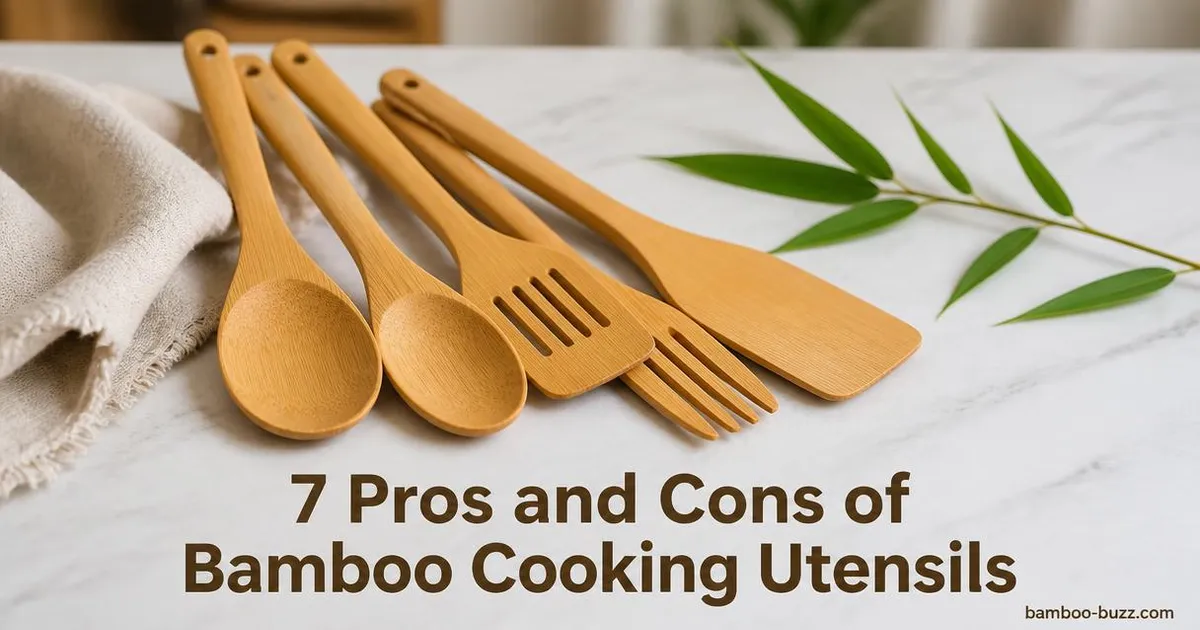
7 Pros and Cons of Bamboo Cooking Utensils
Bamboo cooking utensils cost less than stainless steel and won’t scratch your nonstick pans. They also crack if you leave them in the sink overnight and degrade faster than steel.
Bamboo sounds like the obvious pick for a renewable, plastic-free kitchen, but tradeoffs around hand washing, dry storage, and lifespan only become clear after you’ve warped a spatula in the dishwasher or found a crack in a soup ladle.
Here are seven specific tradeoffs covering renewability, cookware safety, cleaning limits, and lifespan. Bamboo utensils are ideal for some kitchens – and a poor fit if you depend on a dishwasher for most of your cleanup.
Key Takeaways
- Bamboo utensils are a renewable, plastic-free choice that won’t scratch nonstick cookware, but require hand washing and dry storage.
- Some sources suggest bamboo resists bacteria better than porous wood, though no lab data in the research confirms it.
- Dishwasher heat and prolonged soaking cause splitting and warping over time.
- Solid single-piece bamboo avoids adhesive concerns found in laminated multi-piece utensils.
- Best for home cooks who want affordable, gentle utensils and are willing to maintain them by hand.
Bamboo Cooking Utensils Pros And Cons Side-by-Side
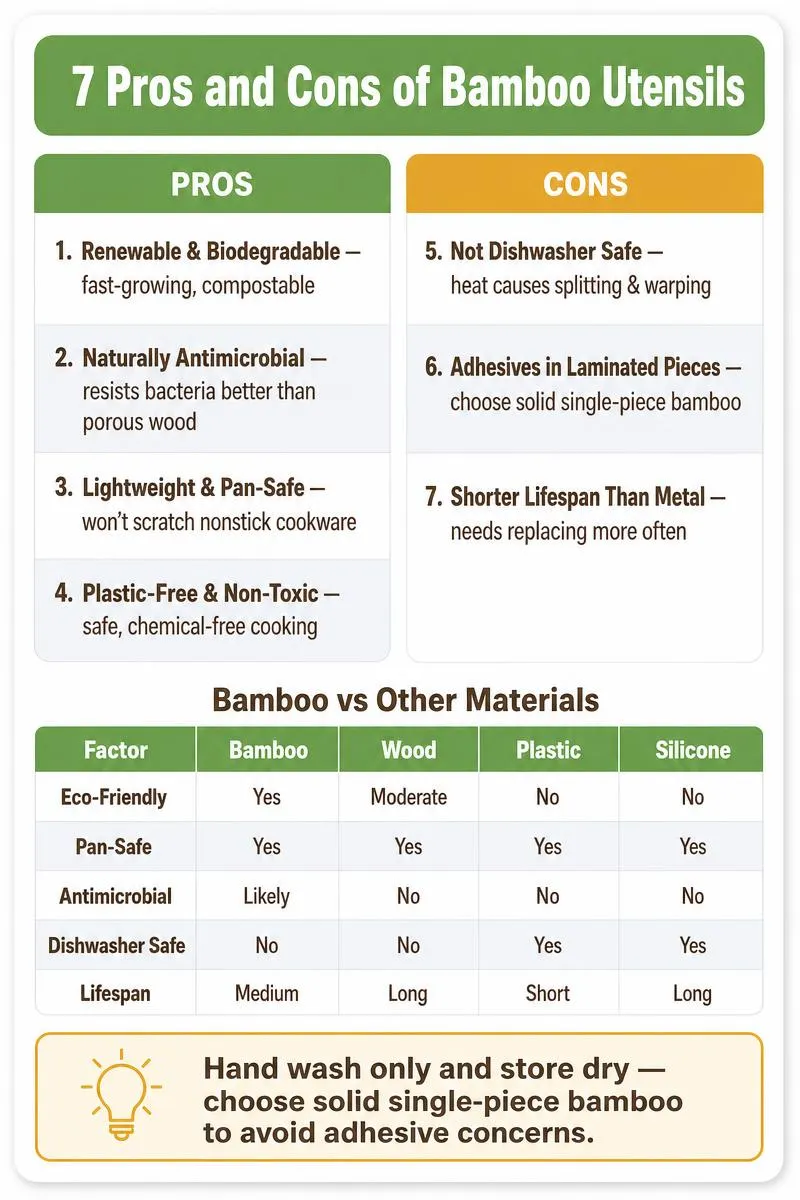
| Factor | Bamboo | Wood | Plastic | Silicone |
|---|---|---|---|---|
| Eco-Friendly | Yes | Moderate | No | No |
| Pan-Safe | Yes | Yes | Yes | Yes |
| Antimicrobial | Likely | No | No | No |
| Dishwasher Safe | No | No | Yes | Yes |
| Lifespan | Medium | Long | Short | Long |
Bamboo Cooking Utensils vs Wood, Plastic, and Silicone
Compared to teak and acacia – both common wooden utensil materials – bamboo is comparably hard, so it resists denting and staining about as well. Harder also means slightly less forgiving on delicate coatings, though still far gentler than metal. Teak and acacia carry natural oils that help the woods handle moisture better than bamboo, so bamboo needs more attention to drying.
Plastic and silicone handle dishwashers without warping or splitting, which is where bamboo falls short. Silicone tolerates high heat without degrading, but plastic can warp or melt against a hot pan edge. Both plastic and silicone raise chemical concerns for some cooks – BPA in older plastics, food-grade silicone’s behavior at very high temperatures – that bamboo sidesteps by being a single plant material with no synthetic additives.
Stainless steel wins on lifespan and heat tolerance. A steel spoon can sit in a simmering pot all afternoon and come out fine.
Steel also costs more and will scratch the coated pans bamboo is gentle enough for. Bamboo fills the gap between metal and plastic: gentler than steel, more heat-tolerant than plastic, but shorter-lived than both.
Explore More
Top bamboo back-scratcher picks
A product roundup of top bamboo back scratchers for readers looking for high-quality bamboo kitchen-adjacent utensils…
7 Pros and Cons of Bamboo Cooking Utensils
Some tradeoffs show up the first time you use bamboo. Others take months to become obvious.
1. Renewable and Biodegradable
Bamboo is a grass, not a tree, and bamboo regrows from the same root system after harvest – no replanting needed. The regrowth cycle is measured in years, not decades, which is why bamboo gets called renewable more often than hardwoods.
A bamboo spatula will also break down in a compost pile over time, unlike a plastic spatula that sits in a landfill indefinitely.
2. Naturally Antimicrobial
Some sources suggest bamboo resists bacteria better than traditional porous woods like maple or beech. The reputation comes from bamboo kun, a compound bamboo produces that has mild antibacterial properties.
No lab data appears in the research to confirm whether the antibacterial quality holds up in a finished utensil. Treat the claim as plausible but unverified – and don’t let the antibacterial reputation replace basic washing.
3. Lightweight and Pan-Safe
Bamboo utensils weigh less than comparable wooden tools, which matters when you’re stirring a large pot through a long simmer.
Bamboo edges are smooth enough that bamboo won’t scratch nonstick coatings, enamel, or seasoned cast iron the way metal edges can. If you cook on coated pans regularly, bamboo is one of the gentlest options available.
4. Plastic-Free and Non-Toxic
Bamboo utensils contain no BPA, no phthalates, and no synthetic chemicals – bamboo is a single plant material shaped into a tool. Cooks who want to avoid plastic contact with hot food don’t need to worry about chemical leaching with bamboo.
The tradeoff: bamboo also doesn’t have the heat tolerance of silicone or steel. A bamboo handle left resting against a hot pan rim can scorch.
5. Not Dishwasher Safe
Dishwasher heat and prolonged water exposure are the two things bamboo handles worst. The heat dries out bamboo fibers, and sustained moisture causes bamboo to swell, then crack as bamboo dries unevenly.
Running bamboo through a dishwasher – or leaving a bamboo spoon in a soaking pot – leads to warping, splitting, and a shorter lifespan.
6. Adhesives in Laminated Construction
Some bamboo utensils are made from a single solid piece of bamboo stalk. Others are laminated – multiple pieces of bamboo glued together to form the shape.
Laminated construction relies on adhesives, but glues introduce a variable that solid bamboo doesn’t have. If you want to avoid any adhesive concern, look for solid single-piece bamboo utensils.
7. Shorter Lifespan Than Metal
Bamboo utensils will eventually splinter with daily use, especially at the thin edges of spatulas and the handles of spoons. Steel doesn’t have the same problem – a stainless steel spoon can last decades.
Bamboo costs less upfront, but the shorter lifespan means more frequent replacement.
How to Care for Bamboo Cooking Utensils
- Hand wash promptly with mild soap and warm water – not hot. Don’t soak bamboo, and don’t put bamboo in the dishwasher.
- Dry and oil bamboo utensils flat or upright in a rack, and make sure bamboo is fully dry before storing. When the surface starts looking dry or feels rough, rub bamboo with food-safe mineral oil to keep the fibers from cracking.
- Replace when splintering appears, when deep cracks form, or when odors stick around after washing. Any of those signs means the material has degraded past the point where oil or cleaning will help.
You Might Also Like
Pros and cons of bamboo toothbrushes
A pros-and-cons breakdown of bamboo toothbrushes covering hygiene, durability, and care that complements utensil care…
FAQs About Bamboo Cooking Utensils
Is it safe to use bamboo cooking utensils?
Yes. Bamboo is a single plant material with no BPA, phthalates, or synthetic additives, and bamboo won’t scratch coated cookware surfaces.
The main safety concern is replacing bamboo when cracks or splinters form, since damaged surfaces can hold bacteria.
What is better, wood or bamboo utensils?
Neither is objectively better. Bamboo is lighter than most wooden utensils and comparably hard, resists staining a bit better, and comes from a faster-growing plant.
Teak and acacia handle moisture better because of natural oils, so wooden utensils need less careful drying. Choose bamboo for affordability; choose wood for better moisture resistance.
Do bamboo utensils need to be oiled?
Yes, occasionally. Rub bamboo with food-safe mineral oil when the surface looks dry or feels rough.
Regular cooks will need to oil more often than occasional ones.
Can bamboo cooking utensils go in the dishwasher?
No. Dishwasher heat and prolonged water exposure cause bamboo to warp, split, and crack.
Hand wash bamboo with mild soap and dry bamboo promptly.
What is the healthiest material for cooking utensils?
No single material is healthiest across the board. Bamboo avoids plastic and synthetic chemicals, silicone is stable at high heat but is synthetic, and stainless steel is inert but scratches coated pans.
The healthiest choice depends on which cookware surfaces you use and which chemicals you want to avoid.
Are bamboo cooking utensils better than plastic or silicone?
For avoiding synthetic chemicals, bamboo beats both. For convenience – dishwasher-safe, heat-tolerant – silicone beats bamboo.
Plastic raises the most chemical concerns of the three. Bamboo sits in the middle: plant-based and pan-safe, but hand-wash only.
Also Worth Checking Out
A comparison of bamboo and cane that explains material differences in strength, moisture resistance, and sustainability…
Final Thoughts
Bamboo cooking utensils suit cooks who prioritize renewable materials and gentle cookware contact over dishwasher convenience and long-term durability. If you’re willing to hand wash and dry your utensils, bamboo delivers a renewable, affordable, non-toxic option that plays well with nonstick pans.
Start with a solid single-piece set – skip the laminated versions – and keep food-safe mineral oil on hand. Hand washing and occasional oiling take minimal effort if you already wash dishes by hand. But if your kitchen runs on a dishwasher and you want tools that survive neglect, steel or silicone will serve you better.
External References
- Investigating the Antibacterial Characteristics of Japanese … – NIH (NCBI)
- Import Alert 66-41 – accessdata.fda.gov – FDA
- A Sweet Solution to Plastic Pollution – Northeastern Global News – NORTHEASTERN (.edu)
- why does my bamboo chopping board crack or warp – Co
- bamboo fiber antibacterial effect (a review) – ResearchGate