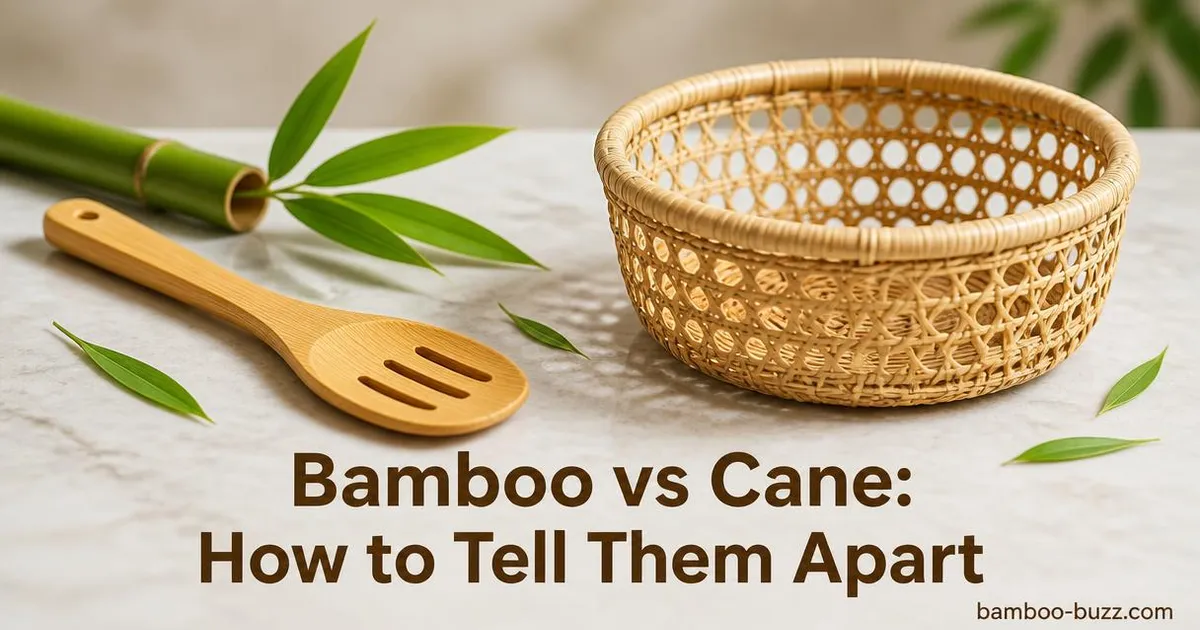
Bamboo vs Cane: How to Tell Them Apart
Walk into a furniture store and you’ll see pieces labeled bamboo, cane, and rattan – sometimes used interchangeably, sometimes to describe the same item. Most of the confusion comes from how sellers name materials, not from the materials themselves being hard to tell apart.
The distinction matters because bamboo and cane are processed differently, built differently, and fail differently. Bamboo gets cut, dried, and laminated into boards and flooring. Cane gets stripped, soaked, and woven into chair seats and basketry. Buying the wrong one for your project means fighting the material instead of using it well.
Here is how to tell bamboo and cane apart by structure, processing, and best use – without needing a botany degree to shop.
Key Takeaways
- Bamboo is a hollow, jointed grass with visible nodes; cane usually refers to rattan cane or river cane, which is solid and more uniform.
- Bamboo works best for structural frames, flooring, and rigid products; cane works best for weaving, flexible accents, and decorative inserts.
- Check the cross-section: hollow with jointed walls means bamboo; solid throughout means cane.
- Bamboo is processed into boards, laminates, veneer, and flooring; cane is woven or bent while green into webbing and wicker.
- Some sources suggest confirming whether a seller means rattan cane or river cane before buying, since the two have different properties despite sharing the name.
A clear comparison of bamboo and engineered hardwood that explains structural differences and manufacturing methods…
Bamboo Vs Cane Compared
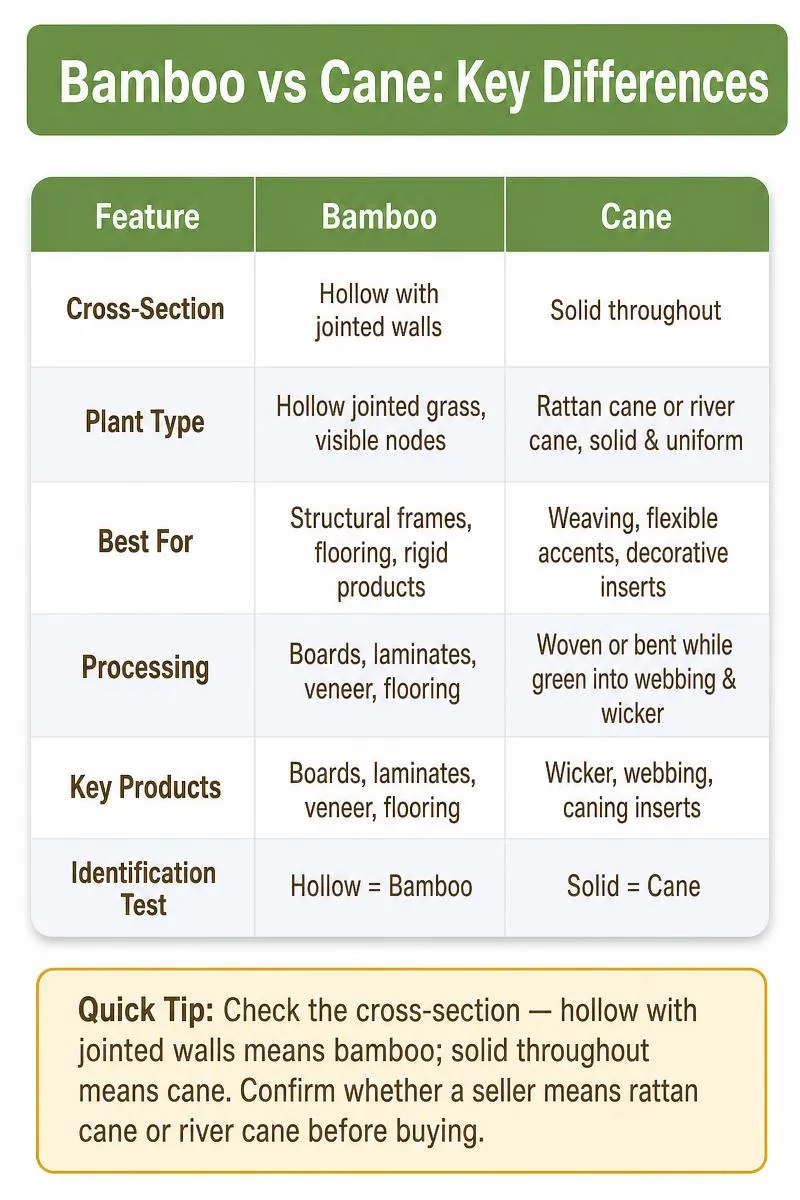
| Feature | Bamboo | Cane |
|---|---|---|
| Cross-Section | Hollow with jointed walls | Solid throughout |
| Plant Type | Hollow jointed grass; visible nodes | Rattan or river cane; solid & uniform |
| Best For | Structural frames, flooring, rigid products | Weaving, flexible accents, decorative inserts |
| Processing | Boards, laminates, veneer, flooring | Woven or bent while green into webbing & wicker |
| Key Products | Boards, laminates, veneer, flooring | Wicker, webbing, caning inserts |
| Identification Test | Hollow = Bamboo | Solid = Cane |
What Is Bamboo?
Bamboo is a fast-growing grass with hollow, segmented stalks. The hollow interior and visible nodes along each stalk are the two features that separate bamboo from almost every lookalike.
Best uses: Bamboo is well suited for furniture frames, flooring, kitchenware, and textiles. Its strength-to-weight ratio makes it practical for structural applications where you need rigidity without heavy mass.
Why it works: Strong for its weight, renewable because it regrows from the same root system after harvest, and versatile enough to be processed into boards, veneer, and composite products.
Where it falls short: Quality varies heavily depending on how the bamboo is processed and manufactured. Lower-grade processing can leave bamboo prone to splitting or warping. Marketing also frequently confuses bamboo with rattan or cane, which makes it harder to know what you are actually buying.
What Is Cane?
In furniture, cane usually means the peeled outer skin of the rattan palm. In North America, cane can also refer to river cane, a native bamboo-like grass that grows in smaller, solid stalks.
Best uses: Cane is ideal for woven chair seats, chair backs, basketry, and decorative accents. Its flexibility and workability make it the go-to material for anything that needs to be bent or woven by hand.
Why it works: Flexible, traditional woven texture, and workable when soaked. Cane conforms to curves and holds its shape once dried, which is why it is the standard material for hand-woven seats.
Where it falls short: Cane is not suited for large structural frames. The same flexibility that makes it good for weaving makes it poor for load-bearing posts or wide spans. The terminology overlap between rattan cane and river cane also creates confusion at the point of sale.
Bamboo vs Cane: Structure and Size
The structural difference between bamboo and cane is the most reliable way to tell them apart.
1. Hollow vs Solid
Bamboo stalks are hollow with visible nodes separating each segment. Cane – whether rattan cane or river cane – is typically solid and more uniform in cross-section. If you can see a hollow center with jointed walls, you are looking at bamboo. If the cross-section is solid throughout, you are likely looking at cane.
2. Size Differences
Bamboo reaches larger diameters and greater heights than cane. Mature bamboo stalks can be thick enough to serve as structural posts, while cane is generally thinner and more pliable. This size difference is part of why bamboo ends up in frames and flooring while cane ends up in webbing and wicker.
3. River Cane Complicates Things
River cane is solid and smaller than most bamboo, which can blur the visual identification. River cane grows like bamboo – segmented, jointed, and grass-like – but its solid structure and smaller size make it easy to mistake for rattan cane.
Bottom line: Bamboo wins for structural posts and rigid applications; cane wins for weaving and flexible work.
Also Worth Checking Out
Pros and cons of bamboo flooring
A practical breakdown of bamboo’s durability, grain, and construction-helpful when reading about structure and size.
Bamboo vs Cane: Furniture and Home Applications
Bamboo shows up where a piece needs to hold weight or span a distance; cane shows up where it needs to bend.
1. Where Bamboo Shows Up
Bamboo frames beds, tables, and shelving. Bamboo is also milled into flooring and laminated into boards for countertops and paneling. Its rigidity and strength-to-weight ratio make it the better choice for anything that needs to hold weight or span a distance without flexing.
2. Where Cane Shows Up
Cane weaves into chair seats and backs, basketry, and decorative panels. The woven texture of cane suits traditional and vintage-style furniture, particularly pieces that aim for a lighter, more open visual feel than solid wood or bamboo provides.
3. Matching Material to Use
Match bamboo to frames, floors, and structural elements where rigidity matters. Match cane to woven inserts, decorative panels, and any application where flexibility and hand-woven texture are the point. Using cane where bamboo belongs – or vice versa – means working against the material’s natural properties.
Bamboo vs Cane: Processing and Products
Bamboo and cane go through entirely different processing paths, which is why they end up in such different products.
1. How Bamboo Is Processed
Bamboo is cut, dried, and then either split into strips or laminated into boards and veneer. The laminating process involves binding strips of bamboo under pressure with adhesive to create engineered products like bamboo plywood and composite boards. These boards can then be cut, sanded, and finished like hardwood.
2. How Cane Is Processed
Cane is stripped from rattan vines, soaked in water to make it pliable, and then woven or bent while green. Once it dries, cane holds whatever shape it was woven into. This is why cane ends up as webbing, wicker panels, and woven seat surfaces rather than as boards or structural lumber.
3. What Each Becomes
Bamboo becomes plywood, composite boards, flooring, and laminated furniture components. Cane becomes webbing, wicker, woven chair seats, and basketry.
Bottom line: Choose bamboo for engineered, structural products; choose cane for hand-woven, flexible goods.
Which Should You Choose?
The choice between bamboo and cane comes down to what you are building or buying, not which material is objectively better.
For structural frames and flooring: Bamboo. Its hollow-but-strong stalks and laminated boards handle weight and span distances that cane cannot.
For woven seats and basketry: Cane. Its flexibility and workability when soaked make it the standard for woven furniture.
For modern, large-scale furniture: Bamboo. The clean lines of bamboo boards and the rigidity of bamboo frames suit contemporary design better than the woven texture of cane.
For traditional woven texture: Cane. If the look you want includes visible weave, open panels, or hand-wrapped joints, cane is the right material.
If a seller uses cane: Confirm whether they mean rattan cane or river cane. Rattan cane is a palm product ideal for weaving. River cane is a bamboo-like grass with different working properties. The two are not interchangeable despite sharing a name.
Also Worth Checking Out
Pros and cons of bamboo countertops
An overview of bamboo countertops’ benefits, drawbacks, and care-useful for the ‘which should you choose’ decision…
FAQs About Bamboo and Cane
Is bamboo considered a cane?
Sometimes, depending on context. River cane is a bamboo-like grass native to North America, and some sources use cane and bamboo loosely in the same breath. But in furniture, cane typically refers to the peeled skin of the rattan palm – a different plant entirely from bamboo.
How do you tell the difference between river cane and bamboo?
River cane is smaller and solid, while most bamboo is hollow with visible nodes. River cane also grows in tighter, denser clusters and reaches lower heights than typical bamboo. If the stalk is thin, solid, and grows in a dense clump, river cane is the more likely answer.
How do bamboo and cane differ in size and structure?
Bamboo stalks are hollow with jointed nodes and can reach large diameters and tall heights. Cane is typically solid, thinner, and more uniform in cross-section. Bamboo is built for structural rigidity; cane is built for flexibility and weaving.
What are the drawbacks of bamboo and why do experts warn against it?
Quality varies by processing – lower-grade bamboo can split, warp, or delaminate if not properly dried and manufactured. Buying from a reputable producer that discloses processing methods reduces the risk of getting poorly manufactured bamboo.
Bamboo vs cane vs rattan: what is the difference?
Bamboo is a hollow, jointed grass used for structural frames and engineered boards. Cane is typically the peeled outer skin of the rattan palm, used for weaving. Rattan is the whole vine the cane comes from – solid and flexible, used for both structural wicker frames and as a source of woven cane. Cane is a part of rattan; bamboo is a separate plant entirely.
Is cane or bamboo better for furniture?
It depends on the role. Bamboo is better for structural frames, legs, and flooring where rigidity and load-bearing matter. Cane is better for woven seats, backs, and decorative panels where flexibility and visible weave are the goal. Many woven chairs pair a bamboo or hardwood frame with a cane seat.
Final Verdict
There is no universal winner between bamboo and cane. Bamboo handles structural, modern, and large-scale applications. Cane handles woven, flexible, and traditional accent work. River cane sits in between – acting like bamboo but on a smaller scale.
Define your project first, then match it to the material whose structure and processing fit that use. If you need a frame, go bamboo. If you need a weave, go cane. If a seller says cane and you are not sure which kind, ask before you buy.
External References
- Formaldehyde – EPA
- Utilization of polypropylene film as an adhesive to prepare … – NCSU (.edu)
- Unlocking the hidden power of bamboo rhizomes: A … – ScienceDirect
- Engineered Laminated Bamboo for Structural Applications – MDPI
- Bonding strength performance of bamboo-based composite … – NIH (NCBI)
- (PDF) Anatomical, Physical, Chemical, and Biological Durability … – ACADEMIA (.edu)