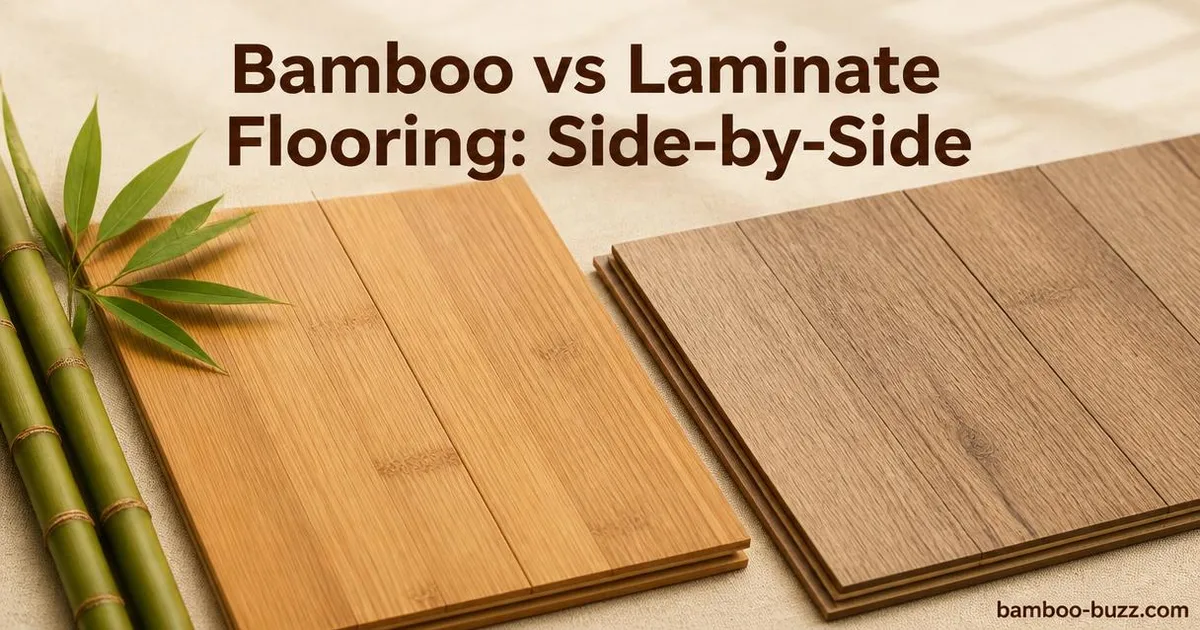
Bamboo vs Laminate Flooring: Side-by-Side
Bamboo flooring and laminate both sit in the affordable-floors aisle, and they look similar enough in a showroom that you might not think the choice matters. It does. One is made from compressed grass fibers and can be sanded down and refinished years later; the other is a composite board with a photographic image layer that gets replaced, not renewed, when it wears out.
The decision comes down to four things: how much you want to spend up front, whether you care about refinishing versus replacing, how much moisture the room sees, and whether rapidly renewable material matters to you.
Key Takeaways
- Laminate almost always costs less up front for materials, and its click-lock installation makes it a realistic DIY project with minimal tools.
- Strand woven bamboo is harder than most laminate wear layers, but standard horizontal or vertical bamboo is softer and can dent more easily.
- Neither material is waterproof – bamboo warps with standing water, and laminate’s fiberboard core swells if the surface seal breaks.
- Bamboo is a rapidly renewable grass that can be refinished; laminate uses recycled wood fiber but cannot be sanded or refinished at all.
- Bamboo offers multiple installation methods (glue, nail, float), while laminate is almost always floated.
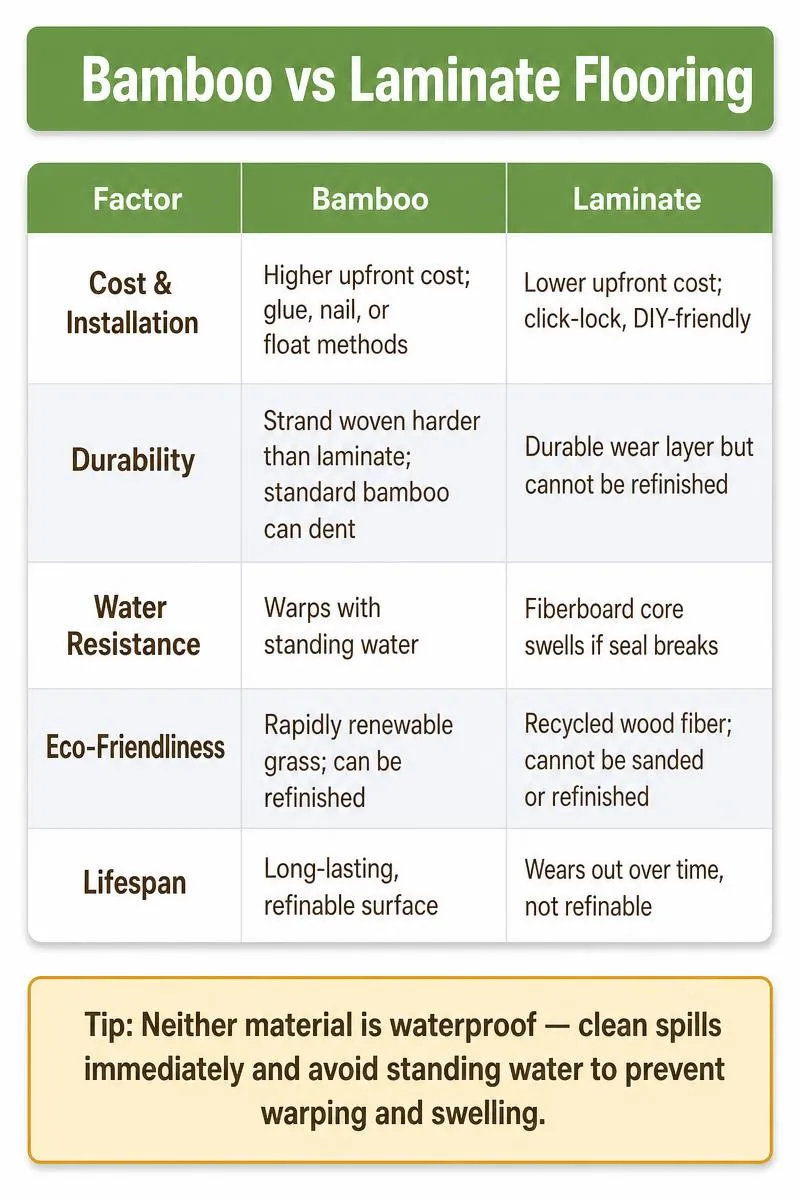
Bamboo Flooring Vs Laminate Side-by-Side
| Factor | Bamboo | Laminate |
|---|---|---|
| Cost & Installation | Higher upfront cost; glue, nail, or float | Lower upfront cost; click-lock, DIY-friendly |
| Durability | Strand-woven harder; standard can dent | Durable wear layer; not refinishable |
| Water Resistance | Warps with standing water | Core swells if surface seal breaks |
| Eco-Friendliness | Rapidly renewable grass; refinishable | Uses recycled wood fiber; not refinishable |
| Lifespan | Long-lasting; can be refinished | Wears out over time; not refinishable |
What Is Bamboo Flooring?
Bamboo flooring is made by harvesting bamboo stalks, shredding them into fibers, and compressing those fibers under heat and pressure into dense planks. The result is a hard surface material that comes from grass, not trees.
Best use cases for bamboo flooring include residential living areas, bedrooms, and eco-focused renovations where a natural grain look matters. It works well in dry, climate-stable rooms.
The main strength of bamboo as a flooring material is that it grows back from the same root system after harvest, making it a rapidly renewable resource. Bamboo flooring also has a distinctive grain pattern that differs from traditional hardwood, and solid bamboo planks can be sanded and refinished when the surface wears down.
The main weakness is that performance varies a lot depending on how the bamboo was constructed. Horizontal and vertical bamboo are softer and dent more easily than strand woven bamboo, which compresses fibers with adhesive under extreme pressure for a denser result. Bamboo also has a narrower style range than synthetic flooring – you’re getting variations on a bamboo grain, not oak or walnut looks.
Pros and cons of bamboo flooring
A clear pros-and-cons breakdown covering durability, cost, maintenance, and common drawbacks of bamboo flooring.
What Is Laminate Flooring?
Laminate flooring is a composite product built in layers: a fiberboard core made from compressed wood fibers, a photographic layer that mimics wood or stone, and a clear wear layer on top that protects the image underneath.
Best use cases for laminate include budget renovations, rental properties, and any space where you need a consistent appearance across a large area for minimal cost.
The biggest strength of laminate is cost – the material itself is cheaper than most bamboo, and the click-lock installation system means you can float it over an underlayment without glue or nails. Laminate also comes in a wide range of styles since the photographic layer can reproduce virtually any wood or stone pattern.
The main weakness is permanence. Once that wear layer wears through or the photographic layer gets damaged, laminate cannot be sanded or refinished – you replace the planks. The fiberboard core is also vulnerable to swelling if water penetrates the surface seal, so one swollen edge pushes neighboring planks out of line.
Bamboo Flooring vs Laminate Flooring: Cost and Installation
On material cost alone, laminate is almost always the cheaper option. Bamboo flooring sits at a moderate price point – higher than basic laminate but often lower than solid hardwood. The gap widens if you choose strand woven bamboo, which costs more than standard horizontal or vertical bamboo due to the additional compression process.
Installation complexity differs significantly between the two. Laminate uses a floating click-lock system that clicks together over an underlayment, requiring no adhesive and minimal tools – a saw, a tapping block, and spacers. Bamboo flooring offers more installation options: some products can be floated, but others need to be glued down or nailed to a subfloor, which means more prep work, more materials, and often a professional installer.
Long-term value tilts toward bamboo if you factor in lifespan. A bamboo floor can be sanded and refinished when it shows wear, extending its usable life without replacing the material. Laminate has no such option – once the surface wears or damages, replacement is the only fix.
The winner: Laminate for lowest upfront cost and easiest installation. Bamboo for long-term value through refinishing.
Bamboo Flooring vs Laminate Flooring: Durability and Lifespan
Bamboo’s hardness depends heavily on its construction type, so the durability comparison changes depending on which bamboo you buy.
Standard horizontal and vertical bamboo flooring is softer than most laminate wear layers and can dent under heavy furniture or dropped objects. Laminate’s clear wear layer resists scratches and fading from sunlight better than bamboo’s natural surface, which can fade with prolonged UV exposure.
Strand woven bamboo changes the calculation entirely. The manufacturing process compresses bamboo fibers with adhesive under extreme heat and pressure, producing a material harder than most domestic hardwoods and tougher than laminate’s fiberboard core. Strand woven bamboo resists denting and impacts that would damage standard bamboo or compress laminate’s core.
Laminate’s wear layer holds up well against everyday scratches from foot traffic and pet nails. But laminate’s fiberboard core is its weak point – if the wear layer gets a deep gouge, the exposed core absorbs moisture and can swell or degrade.
The winner: Laminate for scratch resistance on the surface. Strand woven bamboo for overall hardness, impact resistance, and longer lifespan through refinishing.
Keep Reading
Side-by-side comparison of bamboo and engineered hardwood focusing on durability, lifespan, and performance that…
Bamboo Flooring vs Laminate Flooring: Water Resistance and Maintenance
Neither bamboo nor laminate is waterproof, and both will fail if exposed to standing water.
Bamboo flooring is sensitive to humidity fluctuations and standing water. Bamboo fibers absorb moisture, which causes planks to swell, warp, or cup. In consistently humid environments, bamboo can expand enough to buckle at the seams. Spills need to be wiped up quickly, and bamboo is not recommended for bathrooms, laundry rooms, or basements where moisture is unpredictable.
Laminate’s vulnerability comes from its fiberboard core. The clear wear layer on top is water-resistant, but if water gets through seams or damaged edges, the fiberboard core swells and does not return to its original shape. Some newer laminate products have water-resistant cores, but standard laminate still fails when water penetrates the surface.
For cleaning bamboo floors, use a damp mop with a pH-neutral cleaner – not a soaking wet mop, and never steam cleaning, which forces moisture into the seams. Laminate can be cleaned with a dry or slightly damp mop and laminate-specific cleaner, but excessive water causes the same core-swelling problem.
The winner: Neither is waterproof. Bamboo requires more careful moisture management overall, but both need quick cleanup of spills.
Bamboo Flooring vs Laminate Flooring: Eco-Friendliness
Bamboo’s environmental advantage starts at the crop level. Bamboo is a grass that reaches harvest maturity in a fraction of the time trees need, and it regrows from the same root system after cutting. No replanting is required. That makes bamboo a rapidly renewable material.
Laminate’s environmental claim comes from its fiberboard core, which is made from compressed wood fibers – often including recycled wood waste and sawdust that would otherwise go to landfills. The recycled content reduces the demand for virgin timber, but the product still requires adhesives and resins to bind those fibers together.
Indoor air quality is a consideration for both. Some bamboo flooring uses adhesives that can off-gas volatile organic compounds, though low-emission options are available. Laminate also uses resins and adhesives in its fiberboard core and wear layer, and budget laminate products have been associated with higher formaldehyde emissions. Looking for products with third-party emissions certifications helps with both materials.
The winner: Bamboo for raw material renewability. Laminate for recycled content in its core. Both require attention to adhesives and off-gassing.
Which Should You Choose?
Budget-focused buyers who need the lowest upfront material cost should look at laminate. The material costs less, and the click-lock installation means you can skip professional labor if you’re handy with basic tools.
Eco-conscious buyers who prioritize rapidly renewable materials should choose bamboo. Look for bamboo products with third-party emissions certifications to minimize off-gassing from adhesives.
DIY-focused households who want easy installation with minimal tools will have an easier time with laminate. The floating click-lock system requires no glue, no nails, and no special subfloor prep beyond an underlayment.
Refinishing-minded buyers who want to refinish rather than replace their floors years down the line should choose bamboo. Solid bamboo planks can be sanded and refinished, extending their life without pulling up and discarding old material.
Related Reading
Direct comparison with oak covering water resistance, maintenance, and long-term wear useful for readers deciding which…
FAQs About Bamboo Flooring and Laminate Flooring
Is bamboo or laminate flooring better?
Neither is objectively better – the right choice depends on your budget, room conditions, and priorities. Laminate costs less and installs more easily; bamboo offers refinishing and a more renewable raw material. Strand woven bamboo is harder than laminate, but standard bamboo is softer.
What is the downside of bamboo flooring?
Bamboo is sensitive to humidity and standing water, which can cause warping or buckling. Standard horizontal and vertical bamboo dent more easily than strand woven bamboo. The style range is also narrower than laminate, since you’re limited to bamboo grain variations.
What is the healthiest flooring to put in your house?
Both bamboo and laminate can off-gas volatile organic compounds from their adhesives, though low-emission options exist for both. Look for products with third-party emissions certifications. Solid hardwood and tile generally have fewer adhesive concerns, but they come with different cost and maintenance tradeoffs.
Should bamboo flooring be glued or nailed?
Installation method depends on the product. Some bamboo flooring is designed to float, while others need to be glued down or nailed to a subfloor. Check the manufacturer’s specifications – using the wrong method can void the warranty and cause performance problems.
What is the average lifespan of a bamboo floor?
A maintained bamboo floor typically outlasts laminate because refinishing resets the wear surface, while laminate’s lifespan ends when its wear layer wears through. Strand woven bamboo, being harder, tends to resist wear longer than standard horizontal or vertical bamboo. The actual lifespan depends on traffic levels, maintenance, and whether the floor gets refinished when needed.
What cleaning products and tools are safe to use on bamboo floors?
Use a damp mop with a pH-neutral cleaner designed for hardwood or bamboo. Avoid steam cleaners, which force moisture into seams and can cause warping. Skip abrasive pads, vinegar-based solutions, and wax products that can dull or damage the finish.
What are the most regretted flooring choices?
Common regrets include choosing non-waterproof flooring for moisture-prone rooms like bathrooms or basements, and buying budget laminate that shows wear quickly with no refinishing option. Installing bamboo in a humid space without acclimating the planks first is another frequent complaint.
Why don’t we replace wood with bamboo?
Bamboo works well for flooring, but it has limitations that make it unsuitable as a universal replacement for wood. Bamboo’s style range is narrower, its moisture sensitivity is higher than many hardwoods, and its dimensional stability varies by construction type. Wood also has a broader range of applications beyond flooring where bamboo’s properties may not perform as well.
What is strand woven bamboo flooring?
Strand woven bamboo is made by shredding bamboo stalks into fibers, soaking them in adhesive, and compressing the mixture under extreme heat and pressure. The result is a dense, hard plank that outperforms standard bamboo in dent and impact resistance and is harder than most domestic hardwoods.
Final Verdict
Bamboo wins if you value a renewable raw material, the ability to refinish your floors, and a natural grain look. Laminate wins if your priority is keeping upfront costs low, doing the installation yourself, and having a wide range of style options.
One thing both materials share: neither belongs in a consistently damp room. If you’re flooring a basement, bathroom, or laundry room, consider tile or luxury vinyl plank instead.
Next step: order samples of both bamboo and laminate in your preferred style. Hold them against your walls and furniture in actual room lighting – showroom conditions and your home are rarely the same.
External References
- UL GREENGUARD Certification | UL Solutions – Ul
- FloorScore Certification | Low VOC flooring Flooring – Scsglobalservices
- (PDF) Typological Analysis of Engineered Bamboo Product … – ACADEMIA (.edu)
- Scott A. Leavengood – CoF People Directory – OREGONSTATE (.edu)
- Aluminum-laminated panels: Physical and mechanical … – NCSU (.edu)