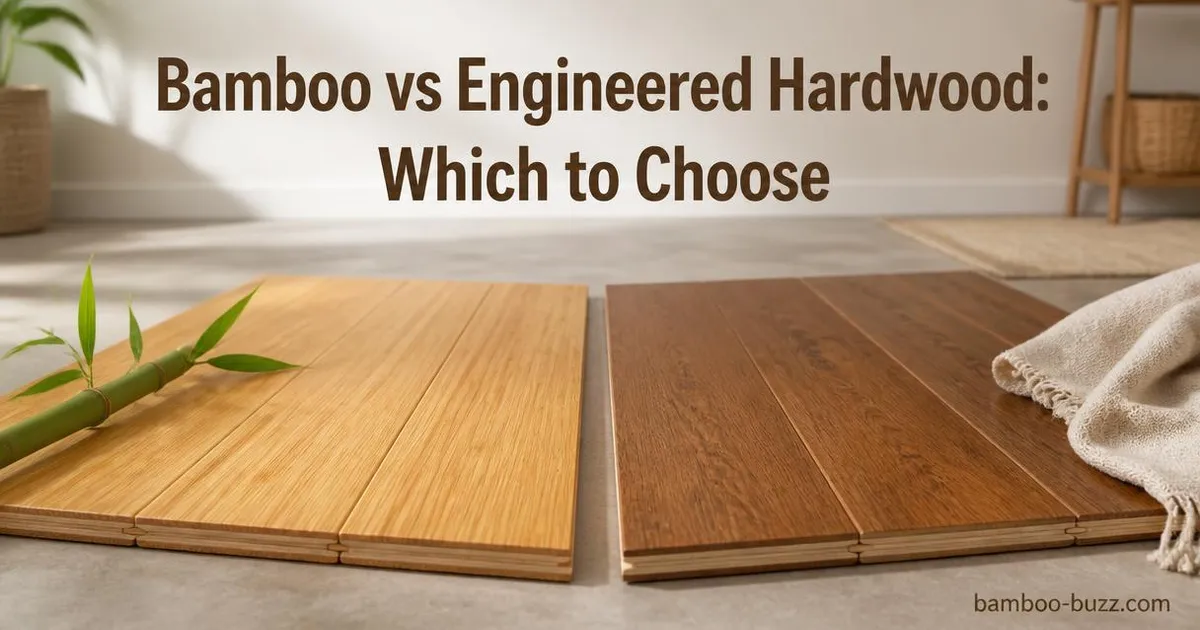
Bamboo vs Engineered Hardwood: Which to Choose
Engineered hardwood costs more, but most bamboo floors can’t be refinished. That single difference explains why one dominates resale listings and the other appeals to budget-focused renovators who plan to stay put. Both avoid the price tag of solid hardwood, yet the tradeoffs between initial cost, longevity, and refinishing potential push most buyers toward one or the other.
The decision hinges less on bamboo versus wood as materials and more on how each is constructed. Engineered formats of both use layered cores for stability, but the top layer determines how long the floor lasts and whether you can sand it down when scratches accumulate. Strand-woven bamboo brings serious surface hardness, while a thick veneer on engineered hardwood buys you multiple refinishing cycles.
Key Takeaways
- Engineered hardwood usually costs more installed, though both sit below solid hardwood.
- Moisture resistance depends on the engineered core and installation environment, not the species alone.
- Engineered hardwood can often be refinished if the veneer is thick enough; most bamboo cannot.
- Scratch resistance depends on finish quality and wear layer thickness more than the base material.
- Some sources suggest bamboo regrows faster, yet both materials require adhesives and manufacturing energy that offset some environmental gains.
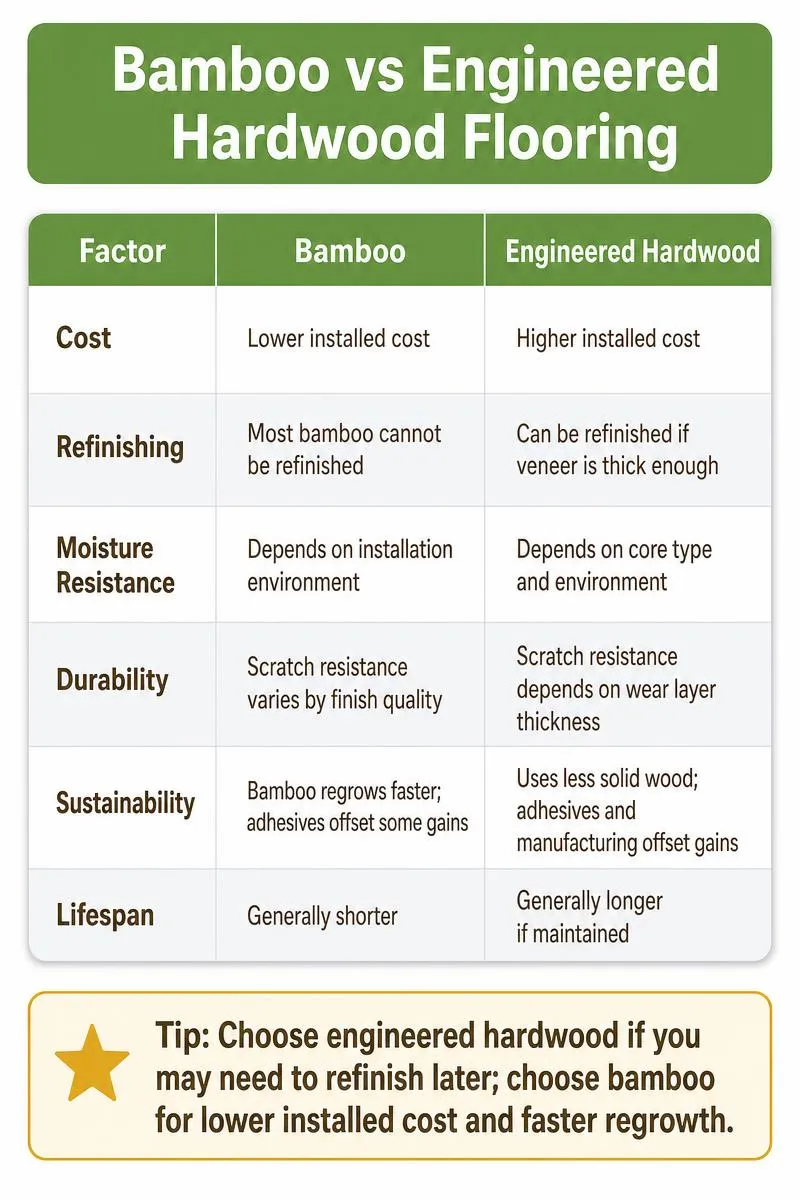
Bamboo Vs Engineered Hardwood Quick Comparison
| Factor | Bamboo | Engineered Hardwood |
|---|---|---|
| Cost | Lower installed cost | Higher installed cost |
| Refinishing | Most cannot be refinished | Refinishable if veneer is thick |
| Moisture Resistance | Depends on installation environment | Depends on core type and environment |
| Durability | Scratch resistance varies by finish | Scratch resistance depends on wear layer |
| Sustainability | Faster regrowth; adhesives offset gains | Uses less solid wood; adhesives offset gains |
| Lifespan | Generally shorter | Generally longer if maintained |
What Is Bamboo Flooring?
Bamboo flooring comes in solid planks and engineered formats, with engineered bamboo offering better dimensional stability through a layered core. Strand-woven construction compresses shredded bamboo fibers under heat and pressure into dense blocks, while horizontal bamboo lays whole strips flat to show the characteristic node pattern. Engineered bamboo pairs a thin bamboo top layer with a plywood or fiberboard base, making it the closer comparison to engineered hardwood.
Bamboo floors work best in residential interiors with moderate foot traffic, eco-conscious projects prioritizing rapidly renewable materials, and spaces where surface hardness matters. Strand-woven bamboo is often rated harder than red oak on the Janka scale, making it durable enough for living rooms and hallways.
Rapid regrowth stands out as bamboo’s primary strength – the grass reaches harvestable size far sooner than the decades hardwood trees need to mature. Competitive pricing typically undercuts engineered hardwood by a noticeable margin, and strand-woven varieties deliver density that rivals or exceeds many traditional hardwoods.
Moisture sensitivity ranks as the biggest weakness. Bamboo swells and warps more readily than most hardwoods in humid or wet conditions, even in engineered formats. Limited refinishability means the top layer wears through without the option to sand and reseal, and wide quality variation across manufacturers makes sourcing reliable products harder.
Keep Reading
Bamboo flooring vs engineered hardwood
A deep dive into construction differences, installation options, and performance between bamboo and engineered hardwood.
What Is Engineered Hardwood?
Engineered hardwood bonds a real wood veneer to a plywood or high-density fiberboard core, creating a stable plank that resists the expansion and contraction solid wood experiences. The veneer thickness determines how many times you can refinish the floor – thicker layers allow multiple sandings over the floor’s lifespan. The core construction handles humidity shifts better than solid planks, making engineered hardwood suitable for dry basements and climates where solid wood would buckle.
Living rooms, bedrooms, and homes prioritizing resale value get the most from engineered hardwood. The traditional wood grain and species variety – oak, maple, walnut, hickory – appeal to a broader buyer base than bamboo’s distinct aesthetic.
Dimensional stability keeps planks flat across seasonal humidity changes, reducing gaps and warping. Traditional wood grain offers the look of solid hardwood at a lower price point, and refinishable veneers extend the floor’s usable life when the finish wears down or scratches accumulate.
Thin veneers allow very few sandings before you hit the core, unlike solid hardwood that handles multiple refinishing cycles. Deep scratches that penetrate the veneer expose the core and can’t be fully repaired, and higher cost compared to bamboo or laminate narrows the budget for buyers watching every dollar.
Bamboo Flooring vs Engineered Hardwood: Cost and Value
Bamboo flooring typically costs less per square foot than engineered hardwood, both for materials and installation. Engineered hardwood prices vary widely based on veneer thickness, wood species, and finish quality, but even mid-range options usually exceed bamboo’s price point. Installation labor runs similar for both since the click-lock or glue-down methods overlap, though bamboo’s lighter weight can speed up handling.
Resale value tilts heavily toward engineered hardwood. Buyers recognize oak, maple, and walnut veneers as traditional flooring, while bamboo reads as a niche choice that doesn’t command the same premium, especially in markets where buyers expect conventional materials.
Winner: Engineered hardwood for resale; bamboo for tighter budgets.
Bamboo Flooring vs Engineered Hardwood: Durability and Lifespan
Strand-woven bamboo delivers notable surface hardness, often rated harder than red oak on the Janka scale. Horizontal bamboo sits closer to softer hardwoods, making construction method more important than the bamboo material itself. Engineered hardwood density depends on the wood species – hickory and maple wear better than softer species like pine or cherry.
Wear layer thickness determines how long either floor holds up in high-traffic areas. A thick veneer on engineered hardwood withstands years of foot traffic and can be sanded to remove surface damage, while bamboo’s wear layer is typically thinner and non-refinishable. Both materials take scratches from dog nails, furniture legs, and grit tracked in from outside, but the finish quality and any protective coatings matter more than the base material.
Dog nails scratch both surfaces. Hard finishes like aluminum oxide reduce visible damage, but no floor is entirely scratch-proof under constant pet traffic. Regular nail trimming and area rugs in main pathways help more than the flooring choice.
Engineered hardwood with a thick refinishable veneer tends to outlast bamboo, since refinishing extends its usable life while bamboo typically needs replacing once the finish wears through. Refinishing potential makes the difference – engineered hardwood gets multiple cycles of sanding and resealing, extending its usable life well beyond bamboo’s single finish.
Winner: Engineered hardwood for longevity if refinishable; strand-woven bamboo for surface hardness.
Also Worth Checking Out
A focused comparison of bamboo and oak floor hardness, scratch resistance, and expected lifespan.
Bamboo Flooring vs Engineered Hardwood: Moisture Resistance and Stability
Engineered construction improves dimensional stability for both materials by using layered cores that resist expansion and contraction. Plywood and fiberboard cores distribute stress across multiple layers, reducing the cupping and warping that solid planks experience when humidity fluctuates. Neither material handles standing water or consistent high moisture well, but engineered formats tolerate typical indoor humidity shifts better than solid planks.
Bamboo’s natural tendency to absorb moisture makes it more vulnerable to swelling than most hardwoods, even in engineered formats. Engineered hardwood’s stability depends on the core material and veneer thickness – a high-quality plywood core outperforms a low-grade fiberboard core regardless of the wood species on top. Installation environment matters more than the choice between bamboo and hardwood; both fail in bathrooms, laundry rooms, or basements with moisture problems.
Winner: Tie; construction matters more than species.
Bamboo Flooring vs Engineered Hardwood: Sustainability
Bamboo regrows far faster than hardwood trees, which need decades to reach harvest size. That regrowth rate makes bamboo a rapidly renewable resource that can be harvested repeatedly from the same root system without replanting. Engineered hardwood uses less wood per plank than solid hardwood by pairing a thin veneer with a plywood core, but the core still relies on trees that grow much slower than bamboo.
Lifecycle impact includes more than raw material regrowth. Both bamboo and engineered hardwood require adhesives to bond layers, and those glues can off-gas formaldehyde unless manufacturers use low-VOC or formaldehyde-free options. Manufacturing energy for strand-woven bamboo – which involves heat, pressure, and resin – compares to the energy needed to slice veneers and press plywood cores for engineered hardwood. Transportation adds emissions for both, especially when bamboo ships from Asia or hardwood comes from distant forests.
End-of-life disposal presents similar challenges. Neither material biodegrades quickly once bonded with synthetic adhesives, and recycling options remain limited. A longer-lasting floor that gets refinished instead of replaced reduces total material consumption over time, which can offset a slower regrowth rate.
Winner: Bamboo for regrowth; engineered hardwood if longevity reduces replacement.
Which Should You Choose?
- Pick engineered hardwood if you’re reselling within a few years and want broad buyer appeal. Traditional wood species and the ability to refinish scratches make it a safer bet for prospective buyers who expect conventional flooring materials.
- Choose bamboo for lower upfront cost and rapidly renewable materials. The price difference frees up budget for other renovations, and the faster regrowth cycle appeals to buyers prioritizing resource efficiency over resale premiums.
- Go with engineered hardwood with a thick wear layer for heavy traffic and refinishing potential. The ability to sand and reseal multiple times extends the floor’s life well beyond bamboo’s single finish, making the higher initial cost worthwhile if you plan to stay long-term.
- Select engineered bamboo for moderately humid climates needing stability. The layered core handles humidity shifts better than solid bamboo, though consistent moisture still causes problems for both materials.
- Pick either with a low-VOC finish if indoor air quality is the priority. Formaldehyde-free adhesives and water-based topcoats reduce off-gassing regardless of whether the top layer is bamboo or hardwood.
You Might Also Like
Explains how bamboo flooring compares with laminate for moisture resistance, cost, and installation choices.
FAQs About Bamboo Flooring and Engineered Hardwood
What is the downside of bamboo flooring?
Most bamboo flooring can’t be refinished, so once the finish wears through or deep scratches appear, replacement is the only option. Moisture sensitivity causes swelling and warping faster than most hardwoods, and quality varies widely across manufacturers – low-grade bamboo dents and scratches more easily than strand-woven varieties.
What is the disadvantage of engineered hardwood?
Thin veneers allow very few sandings before you hit the core, unlike solid hardwood that handles multiple refinishing cycles. Deep scratches that penetrate the veneer can’t be fully repaired, and the higher cost compared to bamboo or laminate narrows options for budget-focused buyers.
Which is better, bamboo or engineered flooring?
Engineered hardwood wins for resale value and refinishing potential, while bamboo costs less upfront and regrows faster. If you plan to refinish the floor or sell within a few years, engineered hardwood adds more value. If initial cost and rapidly renewable materials matter most, bamboo makes more sense.
Can dog nails scratch engineered hardwood floors?
Yes, dog nails scratch engineered hardwood, especially if the finish is soft or the nails are long. Aluminum oxide or other hard finishes reduce visible damage, but maintaining your pet’s nails and placing rugs in high-traffic areas helps more than the flooring type.
Does engineered hardwood add value to a house?
Yes, engineered hardwood adds perceived value in most markets because buyers recognize traditional wood species and expect the material to last. It tends to command a higher premium than bamboo or laminate with buyers, though the exact value depends on local buyer preferences and the quality of the installation.
What is the lifespan of engineered hardwood?
A thick-veneer floor tends to last longer because refinishing cycles extend its life, while thin veneers run out of refinishing depth quickly and need replacing sooner. Veneer thickness is the main factor in total lifespan.
What are the most regretted flooring choices?
Common regrets are floors that scratch easily, show every footprint, or can’t be refinished when damage accumulates. Thin-veneer engineered hardwood and low-grade bamboo both land on the regret list when they wear out faster than expected or deep scratches expose the core. Carpet in high-traffic areas and tile that feels cold underfoot draw similar complaints.
Why don’t we replace wood with bamboo?
Bamboo’s distinct look doesn’t match the traditional wood grain most buyers expect, and its limited refinishability means it doesn’t last as long as solid or thick-veneer hardwood. Moisture sensitivity causes more problems than hardwood in humid climates, and quality variation makes sourcing reliable products harder. Manufacturing still requires adhesives and energy that offset some of the regrowth advantage.
What is the healthiest flooring to put in your house?
Solid hardwood with a water-based finish or natural oil avoids the adhesives and off-gassing that engineered floors and bamboo introduce, though it costs more and requires stable humidity. If engineered formats fit the budget better, look for products certified by CARB Phase 2 or FloorScore for low formaldehyde emissions, and choose low-VOC topcoats. Cork and linoleum are also good options for indoor air quality when installed with low-emission adhesives.
Final Thoughts
Engineered hardwood is the safer long-term investment for refinishing and resale value. Refreshing the finish before listing helps the floor show well at resale, and the ability to sand away damage appeals to buyers looking for lasting flooring.
Bamboo suits budget-focused or eco-conscious buyers in stable climates. The lower upfront cost frees up money for other projects, and the rapid regrowth cycle makes it a defensible choice if resource efficiency outweighs resale premiums.
Avoid both in consistently wet environments – basements with moisture problems, bathrooms, and laundry rooms need tile or luxury vinyl that handles standing water. Order samples and view them in your actual lighting before deciding, since bamboo’s grain and color look very different from hardwood veneers under natural versus artificial light.
External References
- A Potential Substitute for Traditional Wood Carving in Ghana – ACADEMIA (.edu)
- Frequently Asked Questions: Applicable Products – Ca
- life cycle inventory of manufacturing prefinished engineered … – USDA
- Use of lignocellulosic biomaterials for sustainable … – NCSU (.edu)
- FloorScore Certification | Low VOC flooring Flooring – Scsglobalservices
- A review on sustainable bamboo fibre composites in … – ScienceDirect