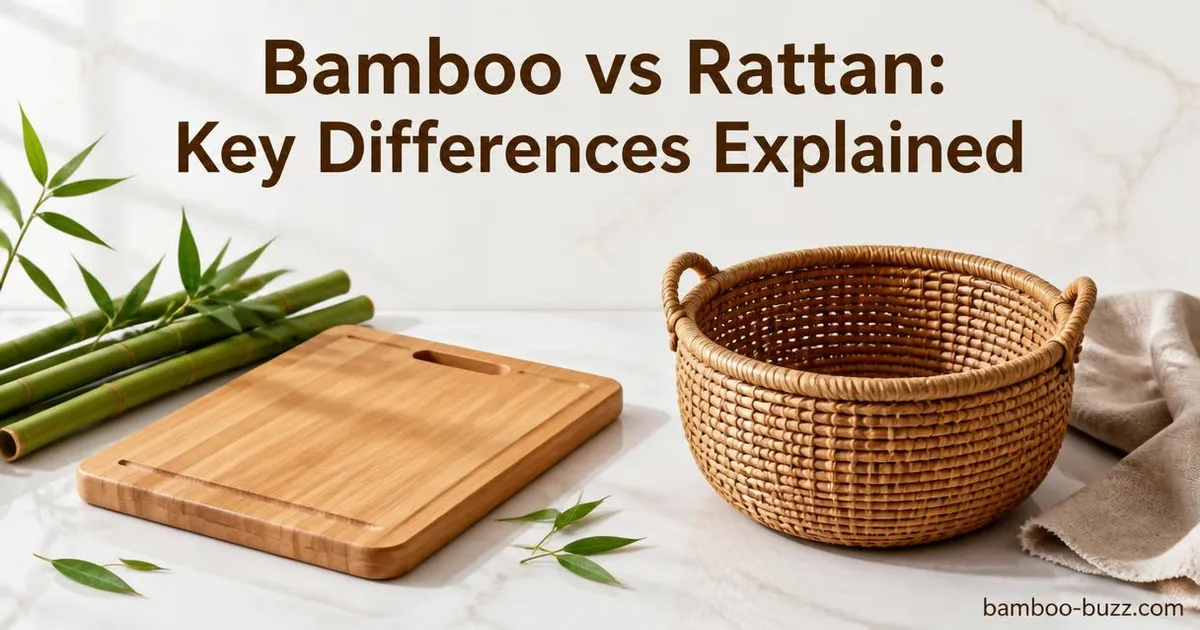
Bamboo vs Rattan: Key Differences Explained
Shoppers see bamboo and rattan grouped together under ‘natural furniture’ and assume they are the same material. They are not. Bamboo is a hollow grass; rattan is a solid vine. The choice between them comes down to whether you need rigid structural support or woven flexibility.
A bamboo dining table and a rattan accent chair look like they belong to the same family, but they are built from fundamentally different plants with different mechanical properties.
Key Takeaways
- Bamboo is a hollow grass; rattan is a solid vine. They are not interchangeable.
- Bamboo suits structural pieces like tables and shelving; rattan excels at woven seating and baskets.
- Both need moisture protection, but bamboo can split if water enters hollow stems, while rattan may crack if it dries out.
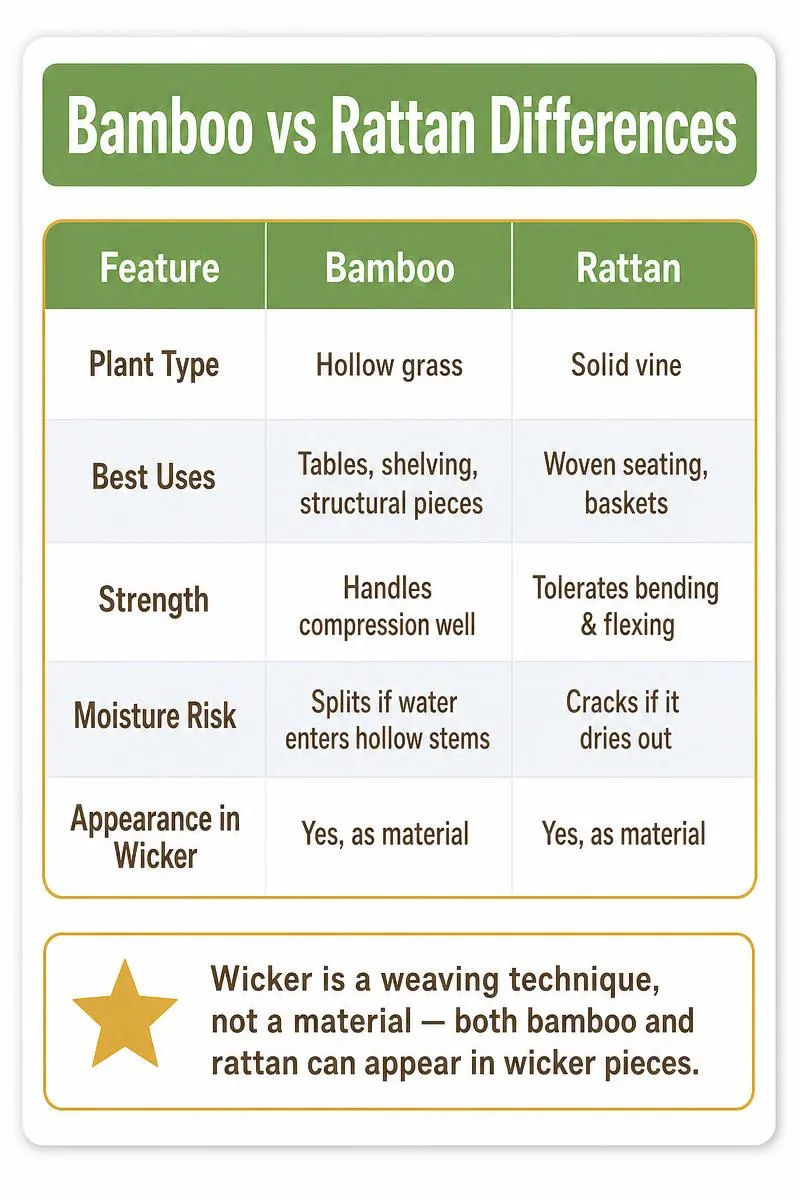
- ‘Wicker’ is a weaving technique, not a material. Both bamboo and rattan can appear in wicker pieces.
- Some sources suggest bamboo handles compression well, while rattan tolerates bending and flexing better.
Bamboo Vs Rattan at a Glance
| Feature | Bamboo | Rattan |
|---|---|---|
| Plant Type | Hollow grass | Solid vine |
| Best Uses | Tables, shelving, structural pieces | Woven seating, baskets |
| Strength | Handles compression well | Tolerates bending & flexing |
| Moisture Risk | Splits if water enters stems | Cracks if it dries out |
| Appearance in Wicker | Yes, as material | Yes, as material |
What Is Bamboo?
Bamboo is a fast-growing woody grass with hollow, segmented poles. Instead of a solid trunk, each pole grows with a hollow interior divided by nodes at regular intervals. The walls of those poles give bamboo its rigidity.
Best for: furniture frames, flooring, cutting boards, textiles, and building poles.
Strengths: rigid, renewable, and versatile across both large and small products. Bamboo poles can be laminated or cut into strips, which gives manufacturers flexibility in how they use the raw material.
Weaknesses: bamboo can crack or split when water pools inside the hollow poles, causing the walls to swell unevenly. Thin-walled poles can also fail under uneven stress where the load concentrates on one side.
Keep Reading
A focused comparison of bamboo-derived fibers and cotton covering strength, breathability, and common uses.
What Is Rattan?
Rattan is a climbing palm vine with a solid inner core and a tough outer skin. That solid core is what allows rattan to bend without collapsing inward.
Best for: woven chairs, basketry, cane webbing, and decorative accents.
Strengths: naturally flexible, easy to bend and weave, and holds shape well under tension. Rattan can be steamed and shaped into curves that would snap a bamboo pole of similar diameter.
Weaknesses: rattan is not suited for heavy structural loads. A rattan cane will flex under weight rather than resist it, which is great for a chair seat but poor for a load-bearing table leg. Rattan can also dry out and become brittle in arid climates, especially when exposed to direct sun or dry indoor heating.
Bamboo vs Rattan: Strength and Durability
Bamboo poles are rigid, and some sources suggest they handle compression well, which is why bamboo works for framing and shelving where the material needs to resist downward force without flexing. The hollow structure keeps bamboo lightweight, but the pole walls still resist crushing along their length.
Rattan bends without snapping, making the vine ideal for woven seats and backs that bear weight flexibly. A rattan chair seat gives slightly under your weight and then returns to shape – something a bamboo pole would not do without risking a split.
Winner: Bamboo for structural load-bearing; rattan for flexibility and impact absorption.
Bamboo vs Rattan: Material and Construction
Bamboo is harvested as hollow poles and is often laminated or cut into strips for building. Those strips can be pressed into boards for flooring or laminated into panels for furniture frames. The hollow poles themselves are also used whole for structural framing and decorative poles.
Rattan is harvested as solid canes and is commonly peeled for weaving or left whole for framing. The outer skin of rattan, called cane, is peeled into thin strips and woven into webbing for chair seats and cabinet panels. The solid core, called reed, is used for heavier weaving and basketry.
A common source of confusion is the word ‘wicker.’ Wicker is a weaving technique, not a material. Both bamboo and rattan can be woven into wicker furniture.
Related Reading
A direct comparison of bamboo and cane that explains differences in material form and furniture construction.
Bamboo vs Rattan: Furniture and Best Uses
Bamboo dominates in tables, bed frames, room dividers, and flooring. These are pieces where rigidity matters – a table that flexes under a plate is a problem, and a bed frame that bends is worse. Bamboo poles and laminated panels hold their shape under load without giving.
Rattan dominates in accent chairs, headboards, storage baskets, and traditional wicker sets. These are pieces where some give is a feature, not a flaw. A rattan accent chair conforms slightly to the body, and a rattan basket absorbs impact when you set it down.
Choose based on whether the piece needs to support weight rigidly or flex comfortably.
Bamboo vs Rattan: Care and Maintenance
Bamboo: wipe with a damp cloth and avoid standing water. The main risk is water pooling inside the hollow poles, which can cause the walls to swell and split. Keep bamboo furniture away from rain and humid basements where moisture lingers.
Rattan: dust regularly and maintain moderate humidity to prevent drying and cracking. Avoid direct sun, which can fade the fibers and make them brittle. Rattan does better in a covered sunroom than on an open patio in a dry climate.
Both materials are low maintenance if kept in stable, covered environments. Problems arise when either material sits in standing water or dry heat.
Which Should You Choose?
- You need sturdy dining tables, shelves, or flooring: Bamboo. The rigidity and compression resistance make bamboo the right call for anything that holds weight at a fixed level.
- You want woven accent chairs, baskets, or cane-webbed panels: Rattan. The flexibility and weaving capacity of rattan make it the natural choice for curved, flexible furniture.
- You are looking for a fast-renewing material for building or large-scale projects: Bamboo. Bamboo regrows from the same root system after harvest and reaches usable size in a fraction of the time hardwood trees need.
- You want lightweight, flexible pieces for a covered sunroom or porch: Rattan. Rattan’s solid-but-thin canes keep woven pieces easy to move, as long as the space is covered.
- You need kitchenware like cutting boards or utensils: Bamboo. The hardness and density of laminated bamboo strips make a good cutting surface that resists knife marks better than soft woods.
You Might Also Like
Pros and cons of bamboo decking
An in-depth look at durability and outdoor-use trade-offs for bamboo, useful when deciding between bamboo and rattan…
FAQs About Bamboo and Rattan
Is rattan the same as bamboo?
No. Bamboo is a hollow grass with segmented poles; rattan is a solid climbing palm vine. They come from different plant families and have different mechanical properties.
What is the difference between wicker, rattan, and cane?
Wicker is a weaving technique, not a material. Rattan is the vine itself. Cane is the outer skin of the rattan vine, peeled into thin strips and used for weaving chair seats and cabinet panels.
What are the disadvantages of bamboo furniture and boards?
Bamboo can split when water enters the hollow poles, and thin pole walls can fail under uneven stress. Laminated bamboo boards can delaminate if the adhesive is exposed to prolonged moisture.
How long does bamboo furniture last?
Bamboo furniture lasts many years when kept dry indoors and away from standing water – moisture control is the main factor.
Is rattan furniture out of style?
No. Rattan furniture has cycled through design trends for decades and remains common in accent chairs, headboards, and woven storage pieces. Its popularity rises and falls, but it has not disappeared.
Why don’t we replace wood with bamboo?
Bamboo works well for many applications, but its hollow pole structure limits certain uses that solid wood handles better. Bamboo also requires processing – lamination, strip-cutting, or treatment – to match the dimensional stability of sawn lumber.
Which is stronger, bamboo or rattan?
Bamboo is generally considered stronger in compression, making it better for load-bearing frames and shelving. Rattan is stronger in flexibility, tolerating bending and flexing without snapping. Each material is strong in the way its structure supports.
Final Verdict
Neither material is universally better. Bamboo wins for structure and scale – tables, shelving, flooring, and building poles. Rattan wins for weaving and flexible furniture – accent chairs, baskets, and cane-webbed panels.
One edge case worth noting: humid, uncovered outdoor spaces will challenge both materials. Bamboo splits when water enters the hollow poles, and rattan can dry out and crack in arid conditions. Covered or treated is the path to longevity.
Decide whether your project needs rigid poles or woven cane, then inspect the joinery and finish quality before buying.
External References
- Systematic review on bamboo forest research – ScienceDirect
- Anatomical, Physical, Chemical, and Biological Durability … – MDPI
- Questions and Answers Regarding Laminate Flooring – EPA
- Bamboo for the Future: From Traditional Use to Industry 5.0 … – NIH (NCBI)
- Use of lignocellulosic biomaterials for sustainable … – NCSU (.edu)